
If you’ve ever paused mid-sentence wondering whether to write “realest” or “realist,” you’re not alone. These two words look almost identical, share the same root, and get mixed up constantly — in social media captions, song lyrics, essays, and everyday conversation. But they are not the same word, and using the wrong one can confuse your reader or make your writing look careless.
This guide breaks down the difference clearly, explains when to use each word, and gives you real examples so you never get it wrong again.
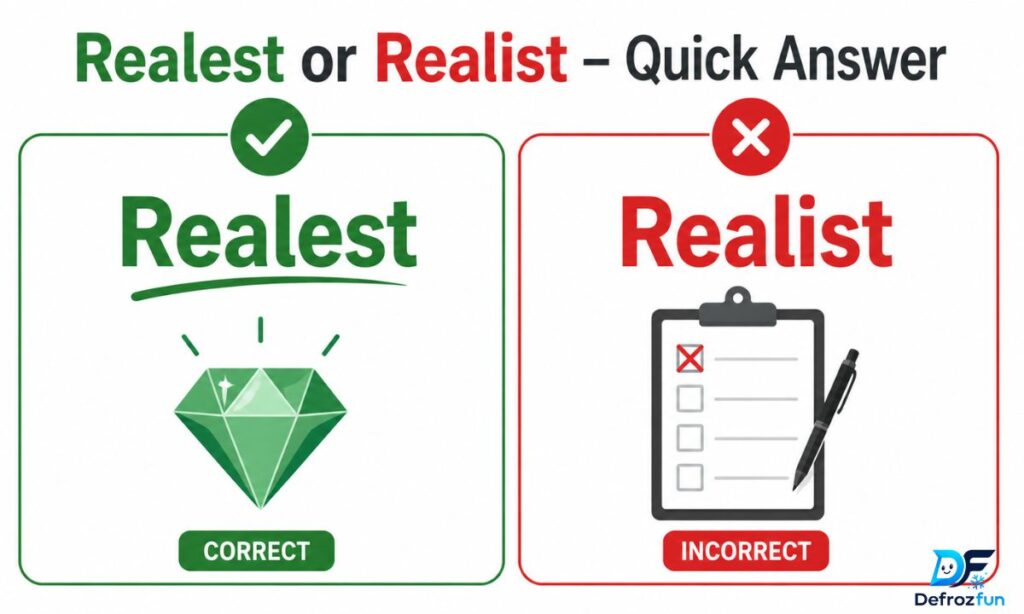
Realest or Realist – Quick Answer
Both words exist, but they mean completely different things.
- Realist is a standard English noun. It describes a person who thinks practically and accepts reality as it is.
- Realest is the superlative form of the adjective real, meaning “most real.” In modern usage, it is informal slang often used to praise someone’s authenticity or loyalty.
Use “realist” in formal or professional writing. Use “realest” in casual, conversational, or expressive contexts.
The Origin of Realist and Realest
Where Does “Realist” Come From?
The word realist dates back to the mid-1500s. According to the Oxford English Dictionary, its earliest recorded use is from 1547. It was borrowed from French réaliste, which itself traces back to Late Latin realis — meaning “actual” or “existing.” Originally, the term was used in philosophy to describe someone who believed in the independent existence of the external world.
Over time, realist expanded into art, literature, and everyday language. By the 1800s, it was widely used to describe artists and writers working in the realism movement — those who depicted life as it truly was, without idealization.
Where Does “Realest” Come From?
The word real goes back to the 14th century, meaning “true” or “existing.” The suffix -est is a standard English tool for forming superlatives — think kindest, strongest, funniest. So realest simply means “most real.”
While the superlative form existed in grammar for centuries, realest gained cultural traction through hip-hop and pop music in the late 1990s and 2000s. Rapper Jevon Jones adopted the stage name “The Realest” in the late ’90s, and the word entered mainstream consciousness when Iggy Azalea opened her 2014 hit Fancy with the now-famous line: “First things first, I’m the realest.”
Since then, realest has become a badge of authenticity — a way of saying someone is the most genuine, loyal, or trustworthy person you know.
British English vs American English Spelling
One common misconception is that realist and realest differ by regional spelling — that one is British and the other American. That is not the case.
Both British English and American English use realist as the standard noun and realest as the informal superlative. The distinction is not about geography — it’s about register and context:
- Formal writing (academic papers, professional emails, journalism): Use realist
- Informal writing (social media, song lyrics, casual conversation): Realest is acceptable
In academic writing across both the UK and the US, realest is rarely appropriate. Instead, writers are advised to use alternatives like most practical, most grounded, or most genuine.
Which Spelling Should You Use?
The right choice depends entirely on what you mean and how formally you are writing.
Use realist when you mean:
- A person who thinks logically and accepts facts as they are
- Someone who avoids wishful thinking or unrealistic expectations
- A practitioner of the realism movement in art or literature
Use realest when you mean:
- The most genuine or authentic version of something
- The most trustworthy or loyal person in a group
- The most honest or “real” experience (informal/slang context)
Quick rule: If you can replace the word with “most genuine” or “most authentic,” use realest. If you mean “a practical, grounded person,” use realist.
Common Mistakes with Realest or Realist
Even careful writers slip up here. These are the most common errors:
Mistake 1: Using “realest” as a noun
- ❌ He is a realest.
- ✅ He is a realist.
“Realest” cannot function as a noun. “Realist” is the noun.
Mistake 2: Using “realist” as a superlative adjective
- ❌ She is the realist person I know.
- ✅ She is the realest person I know. (informal)
- ✅ She is the most genuine person I know. (formal)
Mistake 3: Treating them as interchangeable
- ❌ He makes the best decisions — he’s a realest.
- ✅ He makes the best decisions — he’s a realist.
Mistake 4: Using “realest” in formal or academic writing
- ❌ The realest approach to climate policy involves data-driven solutions.
- ✅ The most practical approach to climate policy involves data-driven solutions.
Realest or Realist in Everyday Examples

Seeing both words in context is the fastest way to lock in the difference.
Examples with “Realist”
- She is a realist — she planned her budget carefully before quitting her job.
- As a realist, he knew the project would take twice as long as anyone hoped.
- Being a realist doesn’t mean being pessimistic; it means seeing things clearly.
- Within a realist perspective on international relations, power is the primary factor.
- He is a realist when it comes to business decisions.
Examples with “Realest”
- She’s always honest with me, even when it hurts. She’s the realest friend I have.
- That conversation we had last night was the realest thing I’ve experienced in years.
- He’s the realest guy in the group — never pretends to be someone he’s not.
- Out of everyone I’ve met, you give the realest advice.
Side-by-Side Comparison
| Sentence | Correct Word | Why |
| “She is a ___ about her career goals.” | realist | Describing a practical mindset |
| “He is the ___ person I know.” | realest | Superlative — most genuine/authentic |
| “Being a ___ helps you plan better.” | realist | Noun — type of thinker |
| “That was the ___ advice I’ve heard.” | realest | Most genuine/honest (informal) |
| “A ___ accepts challenges head-on.” | realist | Referring to a practical person |
Also Read This: Lieing or Lying? Which One Is Correct (And Why It Matters) (2026)
Realist or Realest – Google Trends & Usage Data
Interest in both words has grown significantly in recent years, largely driven by social media and pop culture. Here’s what the data tells us:
- “Realist” consistently outperforms “realest” in formal search volume, reflecting its status as standard vocabulary used in professional, academic, and news contexts.
- “Realest” sees spikes in trending searches tied to music releases, celebrity quotes, and viral social media moments — confirming its strong roots in pop culture and informal speech.
- In academic databases and professional publications, realist appears thousands of times more frequently than realest.
- On platforms like Twitter/X, Instagram, and TikTok, realest is far more common, often used as a term of praise or loyalty.
The takeaway: realist dominates formal and informational content; realest dominates expressive and emotional content.
Comparison Table: Realist vs Realest
| Feature | Realist | Realest |
| Word Type | Noun (sometimes adjective) | Superlative adjective |
| Meaning | A practical, grounded person | Most real, most genuine |
| Register | Formal and informal | Informal / slang |
| Used in academic writing? | Yes | Rarely / not recommended |
| Origin | French réaliste, 1500s | Superlative of real, mainstream use from 1990s–2000s |
| Example | She is a realist about finances. | He’s the realest friend I have. |
| Can be used as a noun? | Yes | No |
| Pop culture presence | Moderate | High (hip-hop, social media) |
| British vs American difference? | Same in both | Same in both |
Conclusion
The confusion between realest and realist is understandable — both come from the same root word and sit just a few letters apart. But once you understand the difference, the choice becomes simple.
Use realistwhen describing a person’s mindset — someone grounded, practical, and clear-eyed about the world. Use realestwhen expressing authenticity — that someone or something is the most genuine, honest, or trustworthy in your experience.
Neither word is wrong on its own. The error only happens when they’re used in the wrong place. Keep your context in mind, match your tone to your audience, and you’ll always pick the right one.

Daniel Brooks is a passionate writer and digital content creator dedicated to sharing insightful, engaging, and informative articles across multiple niches. With a strong interest in technology, lifestyle, trending topics, and online media, Daniel Brooks focuses on delivering well-researched and reader-friendly content that inspires and informs audiences worldwide.