

If you have ever typed “infact” and wondered whether it looks right, you are not alone. This is one of the most common spelling slip-ups in English, made by learners and native speakers alike. The good news? The answer is simple and clear.
Quick Answer
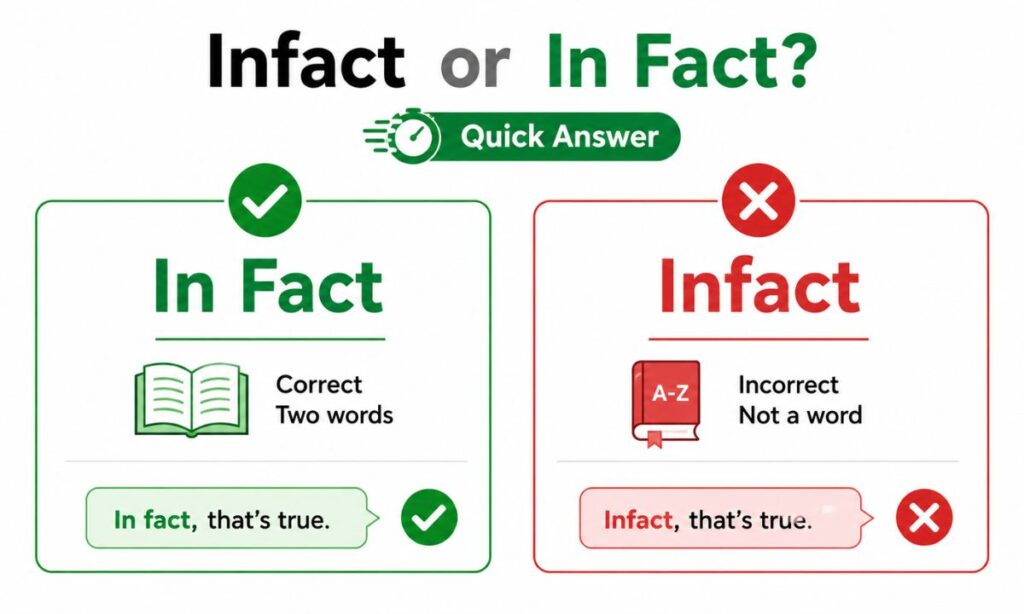
“In fact” is correct. “Infact” is not a word.
Always write it as two separate words. No English dictionary — British or American — recognizes “infact” as a valid term. It is purely a spelling mistake, nothing more.
What Does “In Fact” Mean?
“In fact” is an adverbial phrase used to:
- Emphasize the truth of a statement
- Correct a wrong assumption
- Introduce stronger or more specific information
- Add contrast to what was previously said
It works similarly to words like actually, indeed, and as a matter of fact.
Example:
Many people think sharks are aggressive. In fact, most shark species are harmless to humans.
Grammar Rules Explained Clearly
Rule 1: Always Two Words
“In” is a preposition. “Fact” is a noun. These are two separate words that serve different grammatical roles. Merging them into “infact” removes their individual function and creates a non-word.
Correct: In fact
Incorrect: Infact
Rule 2: Use a Comma After “In Fact” at the Start of a Sentence
When “in fact” opens a sentence, always follow it with a comma.
✅ In fact, she had already submitted the report.
❌ In fact she had already submitted the report.
Rule 3: Use Commas Around “In Fact” in the Middle of a Sentence
When placed mid-sentence, “in fact” is set off by commas on both sides.
✅ He is, in fact, the most qualified person for the job.
❌ He is in fact the most qualified person for the job.
Rule 4: No Comma Needed at the End
When “in fact” comes at the end of a sentence, no additional comma is needed before the period.
✅ She finished the project early, in fact.
Summary Table: Correct Comma Usage
| Position | Example | Comma Rule |
| Beginning | In fact, the test was easy. | Comma after |
| Middle | He was, in fact, nervous. | Commas on both sides |
| End | She passed, in fact. | No extra comma |
Why People Write “Infact” Instead of “In Fact”
This mistake happens for a few very understandable reasons:
- Fast typing — People type quickly and skip the space by accident.
- Pronunciation — When spoken naturally, “in fact” sounds like one flowing word: infact.
- Autocorrect failure — Some devices merge the words or fail to correct the error.
- Influence of compound words — English has words like inside, indeed, and inform, so combining feels natural.
- Informal writing habits — Social media and texting make people less careful about spacing.
None of these are good reasons to keep the mistake. In professional or academic writing, “infact” always reads as an error.
“In Fact” in Real Life Usage
Here are practical examples showing how “in fact” works in different contexts:
Everyday conversation:
I thought the restaurant was expensive. In fact, the prices were very reasonable.
Academic writing:
The study was expected to take six months. In fact, it was completed in three.
Business communication:
Sales were expected to drop this quarter. In fact, they increased by 18%.
Correcting a misconception:
People assume he is shy. He is, in fact, very sociable in small groups.
Adding emphasis:
The project was not just successful — in fact, it exceeded every target we set.
Also Read This: Interment vs Internment: What is the Difference & Meaning? (2026)
British and American English Usage
One question that comes up is whether “in fact” follows different rules in British and American English. The answer is no.
| Feature | British English | American English |
| Correct spelling | in fact | in fact |
| “Infact” accepted? | No | No |
| Comma rules | Same | Same |
| Tone | Slightly more formal | Formal and informal both |
Both dialects use “in fact” identically. There is no regional variation to worry about.
Difference Between “In Fact” and Similar Phrases
Writers often reach for “in fact” when another phrase might serve them better. Here is a clear comparison:
| Phrase | Meaning / Use | Formality |
| In fact | Emphasize or clarify truth | Formal and informal |
| Actually | Correct or surprise | Informal |
| Indeed | Confirm or strengthen | Formal |
| As a matter of fact | Add supporting info | Semi-formal |
| In reality | Contrast with appearance | Formal |
| To be precise | Add specific detail | Formal |
When to choose which:
- Use “in fact” when correcting a belief or adding clarity.
- Use “indeed” in formal essays when confirming something.
- Use “actually” in conversation for a lighter correction.
- Use “as a matter of fact” when you want a slightly more emphatic tone.
Common Mistakes and Corrections
Mistake 1: Writing “infact” as one word
❌ Infact, the deadline was moved.
✅ In fact, the deadline was moved.
Mistake 2: Missing the comma
❌ In fact she was the last to arrive.
✅ In fact, she was the last to arrive.
Mistake 3: Double comma error
❌ He said he was ready but, in fact, he wasn’t.
✅ He said he was ready, but in fact he wasn’t.
When “but” already connects the clauses, you do not need a comma before “but” as well.
Mistake 4: Using “in fact” without actual emphasis
“In fact” should introduce something meaningful — a correction, contrast, or strong supporting point. Do not use it just to fill space.
❌ I went to the store. In fact, I bought milk.
✅ I went to the store. In fact, I bought everything on the list and more.
Advanced Usage of “In Fact”
At a higher level, “in fact” is used as a discourse marker — a word or phrase that signals a relationship between ideas. Here is how skilled writers use it:
To build argument strength:
The data shows a clear pattern. In fact, three separate studies confirm this finding.
To introduce the unexpected:
He appeared confident. In fact, he had rehearsed that speech for two weeks.
To concede and then correct:
The first attempt failed. In fact, they failed three times before getting it right.
In formal reports:
Output increased significantly. In fact, Q3 results marked the highest growth in company history.
Related Confusing Word Pairs
If “infact vs in fact” tripped you up, you might also want to check:
| Incorrect | Correct |
| Infact | In fact |
| Alot | A lot |
| Alright | All right (formal) |
| Everyday (as verb) | Every day |
| Aswell | As well |
| Atleast | At least |
| Inspite | In spite |
| Incase | In case |
These all follow the same pattern: a two-word phrase gets incorrectly merged into one word.
Practice Exercises
Fill in the blank with the correct form (in fact or infact):
- She expected the trip to be tiring. ________, it was the most refreshing experience of her life.
- He claims he is experienced. He is, ________, a complete beginner.
- The app looks simple. ________, it has over 200 features.
- I thought he forgot. ________, he remembered every detail.
- The movie was not just good — ________, it won five awards.
Answers: All five answers are in fact.
Writing Tips to Avoid the “Infact” Mistake
Follow these simple habits to keep your writing clean:
- Slow down when typing transition phrases — give yourself a moment to add the space.
- Proofread specifically for spacing errors — run a quick search for “infact” in your document.
- Use grammar tools like Grammarly or ProWritingAid — they catch this error reliably.
- Read your work aloud — natural pauses often reveal where spaces are missing.
- Build muscle memory — consciously write “in fact” correctly until it becomes automatic.
Conclusion
The rule is simple: “in fact” is always two words. “Infact” does not exist in standard English and using it makes your writing appear careless, especially in professional or academic settings.
Every time you use “in fact,” you are adding emphasis, correcting a misconception, or backing up a claim — all of which make your writing stronger. Just remember the space, remember the comma, and you will never get this one wrong again.

Daniel Brooks is a passionate writer and digital content creator dedicated to sharing insightful, engaging, and informative articles across multiple niches. With a strong interest in technology, lifestyle, trending topics, and online media, Daniel Brooks focuses on delivering well-researched and reader-friendly content that inspires and informs audiences worldwide.