

If you’ve ever typed “make a withdraw” at your bank’s ATM screen and felt something was off — you were right. This is one of the most common grammar slip-ups in everyday English. The words withdraw and withdrawal come from the same root, sound nearly identical, and are used in similar contexts. But they are not interchangeable.
This guide breaks down the difference clearly, with real examples, a comparison table, and simple rules you can use right away.
Withdraw or Withdrawal – Quick Answer
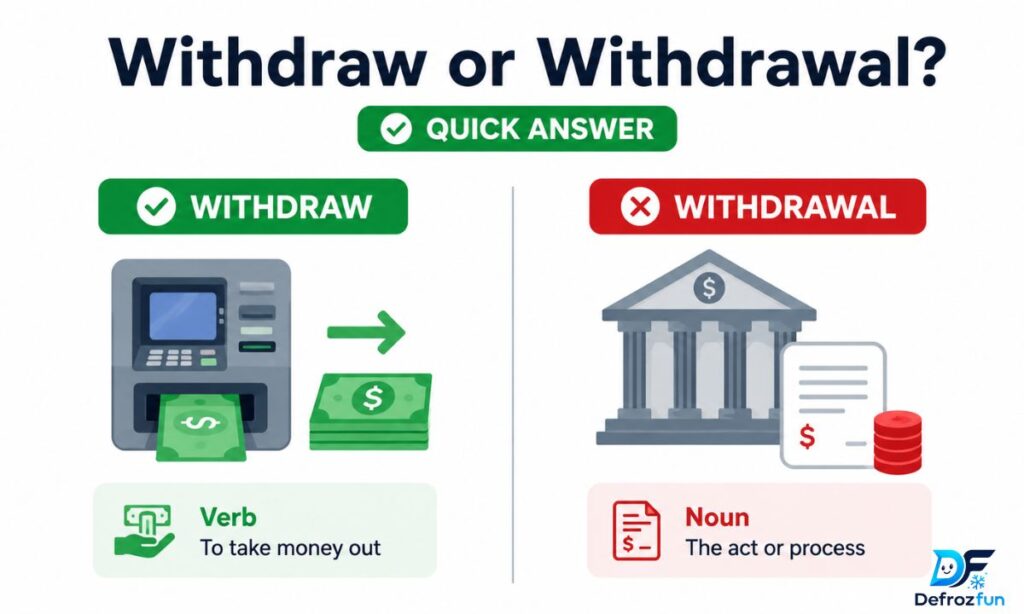
Withdraw is a verb — it describes an action. Withdrawal is a noun — it names the action or its result.
✅ “I need to withdraw money from my account.” (verb — you’re doing something) ✅ “The withdrawal was processed successfully.” (noun — you’re naming something)
One word shows action. The other names it. That’s the entire difference in a nutshell.
The Origin of Withdraw and Withdrawal
Both words trace back to Middle English, built from two parts:
- “With” — meaning away or back
- “Draw” — meaning to pull or to take
So literally, to withdraw means to pull away or take back. The first recorded use of withdraw as a verb dates to the 13th century, originally meaning “to take away or back.” Some linguists also connect it to the Latin retrahere, meaning “to retract.”
Withdrawal came later as the noun form, referring to the act or result of withdrawing. The same root powers both words — the only difference is grammatical function.
Understanding Each Word in Depth
What Does “Withdraw” Mean?
Withdraw is an irregular verb with three key forms:
| Tense | Form | Example |
| Present | withdraw | I withdraw cash every Friday. |
| Past (simple) | withdrew | She withdrew her complaint. |
| Past (participle) | withdrawn | He has withdrawn from the race. |
It works in two ways:
As a transitive verb (action transfers to an object):
- She withdrew $500 from her savings account.
- The lawyer withdrew the question.
As an intransitive verb (no direct object needed):
- He withdrew from the conversation.
- The troops were forced to withdraw.
What Does “Withdrawal” Mean?
Withdrawal is a noun. It refers to the act, process, or result of withdrawing. It can be the subject of a sentence, the object of a verb, or follow a preposition.
Common uses of withdrawal include:
- Banking: The ATM slip showed my withdrawal amount.
- Medical/addiction: He experienced painful withdrawal symptoms after stopping the medication.
- Military: The general ordered an immediate withdrawal of forces.
- Academic: Her withdrawal from the course was processed by the registrar.
- Emotional: After the breakup, she fell into complete withdrawal from social life.
Also Read This: Likeable or Likable: Which Spelling Is Correct to Use? (2026)
British English vs American English Spelling
Here’s something that trips people up: both British and American English spell these words the same way.
- ✅ withdraw — same in both dialects
- ✅ withdrawal — same in both dialects
There is no variant spelling like “withdrawl” or “with-draw.” The only difference between the two dialects is minor pronunciation:
| Region | Pronunciation of “withdrawal” |
| British English | /wɪðˈdrɔːəl/ |
| American English | /wɪðˈdrɔːəl/ or /wɪθˈdrɔːəl/ |
The “th” sound can be voiced (/ð/) or unvoiced (/θ/) depending on accent, but the spelling never changes.
Which Spelling Should You Use?
Always use withdrawal as the noun — never “withdrawl” (missing the second a) and never “withdraw” in a noun position.
Here’s a quick rule: apply the “a/an” test.
If you can place “a” or “an” in front of the word, use the noun form:
✅ “a withdrawal” — correct ❌ “a withdraw” — incorrect
If the word follows a subject and describes an action, use the verb form:
✅ “I will withdraw” — correct ❌ “I will withdrawal” — incorrect
Common Mistakes with Withdraw and Withdrawal
These errors appear constantly — in emails, forms, and even official documents. Here are the most frequent ones:
Mistake 1: Using “withdrawal” as a verb
- ❌ I will withdrawal my application.
- ✅ I will withdraw my application.
Mistake 2: Using “withdraw” as a noun
- ❌ Please process the withdraw of funds.
- ✅ Please process the withdrawal of funds.
Mistake 3: Misspelling “withdrawal” as “withdrawl”
- ❌ The withdrawl limit is $500 per day.
- ✅ The withdrawal limit is $500 per day.
Mistake 4: Wrong past tense
- ❌ He has withdrew his name from the list.
- ✅ He has withdrawn his name from the list.
Memory tip: Think of withdrawal as withdraw + al. The “al” ending is a common noun suffix (like “arrival” from “arrive,” or “refusal” from “refuse”). If you can swap it with another noun-forming suffix, you’re dealing with a noun.
Withdraw and Withdrawal in Everyday Examples
Seeing both words used correctly side by side makes the rule much easier to remember.
Banking & Finance
- She decided to withdraw her savings before the bank closed. (verb)
- The withdrawal was rejected due to insufficient funds. (noun)
Medical & Health
- The doctor advised him to withdraw from the trial gradually. (verb)
- He suffered intense withdrawal symptoms after stopping cold turkey. (noun)
Academic & School
- She chose to withdraw from the semester due to illness. (verb)
- The withdrawal deadline is the last Friday of October. (noun)
Military & Politics
- NATO agreed to withdraw its forces from the region. (verb)
- The withdrawal of troops took three weeks to complete. (noun)
Social & Emotional
- After the argument, he began to withdraw from his friends. (verb)
- Her withdrawal from the group worried everyone around her. (noun)
Withdraw vs Withdrawal – Google Trends & Usage Insight
Search data and corpus studies consistently show that both words are frequently used — but in completely different sentence positions. Analysis of large English text databases (like the Google Ngram Viewer) shows:
- “Withdrawal” appears far more often in formal writing, legal documents, medical reports, and news headlines.
- “Withdraw” dominates in spoken language, conversations, and action-focused sentences.
The most commonly searched phrases include:
- withdrawal symptoms
- cash withdrawal
- withdraw from a course
- early withdrawal penalty
- how to withdraw money
This confirms that while both words are common, they serve very distinct roles depending on context.
Comparison Table: Withdraw vs Withdrawal
| Feature | Withdraw | Withdrawal |
| Part of Speech | Verb | Noun |
| Role in Sentence | Action/doing word | Subject, object, or name of action |
| Comes after “a/an”? | ❌ No | ✅ Yes |
| Past tense | withdrew / withdrawn | — (nouns don’t conjugate) |
| Common context | Banking, military, social | Banking, medical, academic |
| Example | I will withdraw funds. | The withdrawal was approved. |
| Common misspelling | — | withdrawl (wrong) |
| Follows “make a ___”? | ❌ No | ✅ Yes (make a withdrawal) |
Conclusion
The difference between withdraw and withdrawal is simple once you remember the grammar rule: one is a verb, the other is a noun.
- Use withdraw when someone is doing something — taking out, retreating, or removing.
- Use withdrawal when you’re naming that action, process, or result.
Avoid the common misspelling “withdrawl” — always include that second a. And never use “withdrawal” in place of the verb, no matter how natural it might sound in the moment.
Keep this rule in your back pocket: “I withdraw; the withdrawal is complete.” That one sentence captures everything you need to know.

Daniel Brooks is a passionate writer and digital content creator dedicated to sharing insightful, engaging, and informative articles across multiple niches. With a strong interest in technology, lifestyle, trending topics, and online media, Daniel Brooks focuses on delivering well-researched and reader-friendly content that inspires and informs audiences worldwide.