
If you have ever typed this word and paused over the last two letters, you are not alone. Thousands of people search “blankie or blanky” every month because both versions look and sound completely natural. The good news is that the answer is simple, and once you understand the reasoning, you will never second-guess it again.
Blankie or Blanky – Quick Answer
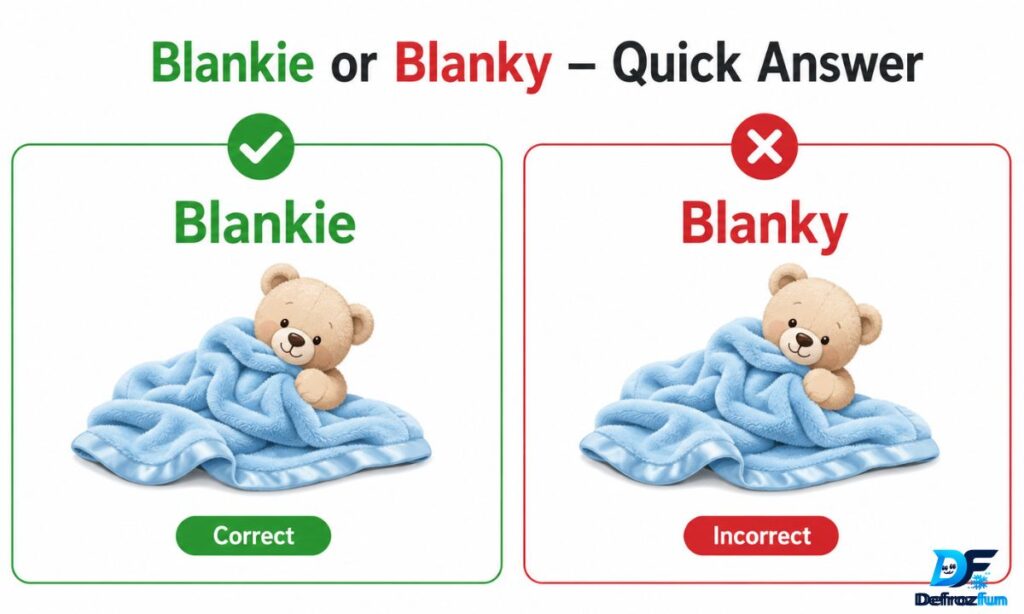
Blankie is the correct and widely accepted spelling. It refers to a small, soft blanket that provides comfort and emotional security, most often to young children.
Blanky is a rare spelling variant. It means exactly the same thing, but it appears far less often in dictionaries, parenting content, and everyday writing. If you want the safest, most universally recognized spelling — use blankie.
The Origin of Blankie or Blanky
To understand why these two spellings exist, you need to look at the root word: blanket.
The word blanket traces back to Old French blanquet, meaning “little white cloth.” One popular theory also links it to Thomas Blanket (Blanquette), a Flemish weaver who lived in Bristol, England, during the 14th century. Over time, English speakers took blanket and created a shorter, warmer, more affectionate version of it for everyday use.
The Oxford English Dictionary records the earliest known use of blankie from 1899, found in the Pedagogical Seminary — a journal focused on child psychology. This places the word firmly in North American English from the very beginning.
Wiktionary confirms the straightforward formation: blanket + -ie = blankie.
The word was created the same way English forms dozens of other informal, affectionate terms. Think of doggie, birdie, sweetie, or cookie. The “-ie” ending turns a plain noun into something warmer and more child-friendly.
British English vs American English Spelling
A common assumption is that blankie is American and blanky is British — similar to color vs colour or favorite vs favourite. But this is actually not the case.
Unlike formal spelling conventions, there is no official dictionary standard where British English uses blanky and American English uses blankie. Both regions use blankie as the dominant spelling in published writing, parenting blogs, product labels, and child development literature.
Here is how usage breaks down by region:
| Region | Preferred Spelling | Notes |
| United States | blankie | Dominant in parenting content and product listings |
| United Kingdom | blankie | Appears most often in published writing |
| Commonwealth Countries | blankie | Standard informal usage |
| Global/Social Media | blankie | Widest recognition and reach |
The bottom line: this is not a US vs UK spelling debate. It is simply a case of one spelling becoming the dominant standard while the other faded into occasional use.
Which Spelling Should You Use?
Use blankie in almost every situation. Here is a quick guide:
Use blankie when:
- Writing parenting articles, blogs, or social media posts
- Naming or marketing baby products
- Writing for a global or American audience
- Submitting content to publications or websites
- Using the term in casual, everyday conversation
Blanky might appear in:
- Older literature or informal personal writing
- Dialogue written to reflect a specific regional or personal voice
- Creative fiction where stylistic variation is intentional
For SEO, content marketing, and professional writing — blankie is always the better choice. It is more searchable, more recognized, and more consistent with dictionary references.
Also Read This: Party’s or Parties: Grammar, Meaning and Usage (2026)
Common Mistakes with Blankie or Blanky
Even knowing the correct spelling, writers make a few recurring errors. Here are the most common ones to avoid:
1. Using “blanky” as the default spelling Many writers type blanky because the “-y” ending feels natural for informal words. However, blankie with “-ie” is the standard form.
- ❌ My toddler can’t sleep without his blanky.
- ✅ My toddler can’t sleep without his blankie.
2. Spelling it “blankee” This three-vowel ending is not recognized in any standard dictionary. Avoid it entirely.
- ❌ She packed her blankee for the trip.
- ✅ She packed her blankie for the trip.
3. Capitalizing unnecessarily Blankie is a common noun, not a proper noun. Do not capitalize it unless it begins a sentence.
- ❌ She always brings her Blankie to daycare.
- ✅ She always brings her blankie to daycare.
4. Using it in formal writing without context Blankie is an informal word. In academic writing, medical literature, or formal reports, use security blanket or simply blanket instead.
Blankie or Blanky in Everyday Examples
Seeing the word used in real sentences makes the correct spelling stick faster. Here are examples across different contexts:
Parenting and childcare:
- She won’t nap without her blankie nearby.
- His grandmother hand-stitched a new blankie for him.
- Daycare staff asked parents to label their child’s blankie.
Casual conversation:
- I still have the blankie I grew up with — I can’t throw it away.
- He dragged his blankie from room to room all morning.
Social media and blogs:
- “Day 3 of vacation and someone forgot their blankie 😅”
- “Toddler tip: keep a backup blankie in the car at all times.”
Child development writing:
- Many psychologists classify a child’s blankie as a transitional object.
- Attachment to a blankie typically fades between ages three and five.
Figurative use (adult context):
- After a brutal week at work, a good movie is basically my blankie.
Blankie or Blanky – Google Trends & Usage Data
Search data consistently shows that blankie dominates blanky across all major English-speaking markets.
| Metric | Blankie | Blanky |
| Google Search Volume (US) | High | Very Low |
| Dictionary Recognition | Yes (major dictionaries) | Rarely listed |
| Parenting Blog Usage | Very Common | Uncommon |
| Social Media Hashtag Use | Dominant | Minimal |
| Product Listing Usage | Standard | Rare |
The data reinforces what linguistics already tells us: blankie is the established standard. Blanky is not wrong in the absolute sense, but it is uncommon enough that using it may look like a spelling error to most readers.
Keyword Variations Comparison Table
Below is a quick reference for related terms and alternate searches people use when looking for this topic:
| Search Term | Correct Form | Notes |
| blankie or blanky | blankie | Correct standard spelling |
| blanky vs blankie | blankie wins | No meaningful difference in meaning |
| blankee spelling | blankee is incorrect | Non-standard, avoid |
| security blanket | security blanket | Formal/clinical term for the same object |
| comfort blanket | comfort blanket | Common alternative, especially in UK |
| baby blankie | baby blankie | Common in parenting and product content |
| child’s blankie | child’s blankie | Standard phrasing in developmental writing |
| blankie meaning | comfort + security | Emotional and functional definition |
| how to spell blankie | b-l-a-n-k-i-e | The “-ie” ending is correct |
Conclusion
The blankie or blanky debate is simpler than it looks. Blankie is the correct, widely accepted spelling — backed by the Oxford English Dictionary, Wiktionary, Cambridge Dictionary, and decades of written usage data. Blanky is not technically wrong, but it is uncommon enough to read as a misspelling to most readers.
Whether you are writing a parenting blog, naming a baby product, or simply texting a friend about a toddler’s favorite comfort item — go with blankie. It is the spelling that readers recognize, search engines prefer, and dictionaries support.
One word. Two endings. One clear winner.

Daniel Brooks is a passionate writer and digital content creator dedicated to sharing insightful, engaging, and informative articles across multiple niches. With a strong interest in technology, lifestyle, trending topics, and online media, Daniel Brooks focuses on delivering well-researched and reader-friendly content that inspires and informs audiences worldwide.