

Do you write “the party’s theme” or “the parties theme”? Most people get this wrong — not because they don’t know grammar, but because one small apostrophe changes everything. Party’s and parties look almost identical, yet they serve completely different purposes in English.
This guide breaks down the difference clearly, with real examples, simple rules, and a quick-reference table so you never confuse them again.
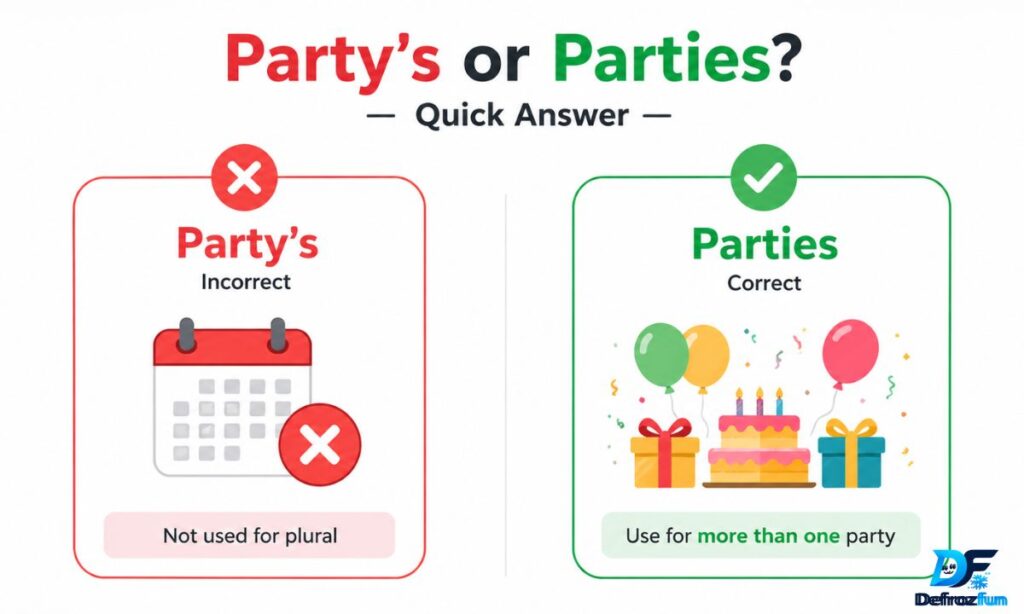
Party’s or Parties – Quick Answer
| Form | Type | Meaning | Example |
| party’s | Singular possessive | Something belongs to one party | The party’s decorations were stunning. |
| parties | Plural noun/verb | More than one party | Several parties were organized this month. |
| parties’ | Plural possessive | Something belongs to multiple parties | The parties’ agreement was signed today. |
Quick rule: Ask yourself — does something belong to one party? Use party’s. Are there multiple parties? Use parties.
The Origin of Party’s or Parties
The word party comes from the Old French word partie, meaning “a division” or “a portion.” When it entered Middle English, its meaning expanded to cover three main uses:
- Social gathering — a birthday party, dinner party
- Political group — the Democratic Party, a political party
- Legal participant — a party to a contract, the involved parties
Understanding these meanings matters because both party’s and parties appear across all three contexts — from casual conversation to legal documents.
British English vs American English Spelling
One thing worth knowing upfront: there is no spelling difference between British and American English for either form.
Unlike colour vs color or centre vs center, the rules for party’s and parties are identical on both sides of the Atlantic. Whether you are writing for a UK audience or a US audience, the grammar rules stay exactly the same.
| Feature | British English | American English |
| Plural of party | parties | parties |
| Singular possessive | party’s | party’s |
| Plural possessive | parties’ | parties’ |
| Spelling difference | None | None |
The confusion is purely grammatical, not regional.
Which Spelling Should You Use?
Use party’s when:
1. Showing ownership (singular possessive)
Add apostrophe + s to show something belongs to one party.
- The party’s music was too loud.
- The party’s guest list included close friends only.
- The party’s location changed at the last minute.
2. As a contraction (informal writing only)
Party’s can contract “the party is” — though this appears only in casual or spoken English.
- The party’s starting at 9 PM.
- The party’s been going on for two hours.
⚠️ Avoid the contraction form in formal, academic, or professional writing.
Use parties when:
Referring to more than one party (plural noun)
The plural of party drops the y and adds -ies — a standard English rule for nouns ending in consonant + y.
- Two birthday parties happened on the same day.
- Several political parties debated the issue.
- The two parties reached a settlement.
Using party as a verb (plural)
- Everyone parties harder during the holidays.
Use parties’ when:
Something belongs to multiple parties (plural possessive)
Add an apostrophe after the s in parties to show shared ownership.
- The parties’ agreement was finalized.
- Both parties’ signatures were required.
Also Read This: Hide vs Hid: What is the Difference and Meaning? (2026)
Common Mistakes with Party’s or Parties
These are the most frequent errors writers make:
Mistake 1: Using party’s as a plural
❌ We attended three party’s last weekend. ✅ We attended three parties last weekend.
Mistake 2: Using parties to show possession
❌ The parties theme was retro. ✅ The party’s theme was retro.
Mistake 3: Forgetting the apostrophe entirely
❌ The partys decorations were beautiful. ✅ The party’s decorations were beautiful.
Mistake 4: Confusing parties’ with party’s
❌ The party’s involved agreed to the deal. (implies one party owns something) ✅ The parties involved agreed to the deal.
Party’s or Parties in Everyday Examples
Here are natural, real-world sentences showing both forms in action:
Using party’s:
- The party’s host greeted everyone at the door.
- Nobody liked the party’s playlist.
- The political party’s policies were widely criticized.
- The party’s venue was booked months in advance.
Using parties:
- Graduation parties filled the neighborhood all weekend.
- The two parties in the lawsuit reached a compromise.
- Summer parties often last late into the night.
- Several parties were competing for the government contract.
Using parties’ (plural possessive):
- Both parties’ legal teams reviewed the contract.
- The three parties’ demands were hard to reconcile.
Party’s or Parties – Google Trends & Usage Data

Search data and usage patterns reveal interesting insight into how people engage with this grammar question:
- Searches for “party’s or parties” peak around exam seasons and grammar-checking periods
- The topic is most searched in the US, UK, Canada, and Australia
- Most online confusion centers on the apostrophe, not the -ies spelling rule
- “Parties” appears far more frequently in legal and business writing than “party’s”
- In casual social media writing, “party’s” is commonly misused as a plural — one of the most frequent apostrophe errors online
The data confirms that this isn’t an obscure grammar debate — it’s a real, everyday writing challenge for millions of English users.
Keyword Variations Comparison
| Phrase | Correct Form | Notes |
| The party’s theme | party’s | Possessive — the theme belongs to one party |
| Three parties tonight | parties | Plural — more than one party |
| The parties’ decision | parties’ | Plural possessive — shared decision |
| Party is starting | party’s (contraction) | Informal only |
| Political parties | parties | Plural noun |
| Party’s platform | party’s | One political party’s platform |
| Both parties agree | parties | Plural subject |
| The party’s been great | party’s | Contraction of “party has” |
Conclusion
The difference between party’s and parties is straightforward once you know the rule:
- party’s = something belongs to one party, or a contraction of “party is/has”
- parties = more than one party
- parties’ = something belongs to multiple parties
A simple test: replace party’s with “the party is” or “belonging to the party.” If the sentence makes sense, your apostrophe is correct. If not, you likely need parties.
Getting this right matters — whether you’re writing a casual text, a professional email, or a legal contract. Small grammar details shape how readers perceive your writing, and an unnecessary apostrophe (or a missing one) can shift the entire meaning of a sentence.

Daniel Brooks is a passionate writer and digital content creator dedicated to sharing insightful, engaging, and informative articles across multiple niches. With a strong interest in technology, lifestyle, trending topics, and online media, Daniel Brooks focuses on delivering well-researched and reader-friendly content that inspires and informs audiences worldwide.