

Have you ever typed “suprise” and wondered if it was correct? You are not alone. This is one of the most common spelling mistakes in the English language. Whether you are writing an email, a social media post, or a formal document, getting this word right matters.
This guide covers the correct spelling, meaning, grammar, pronunciation, and real-world examples of surprise so you never get confused again.
Surprise or Suprise – Quick Answer
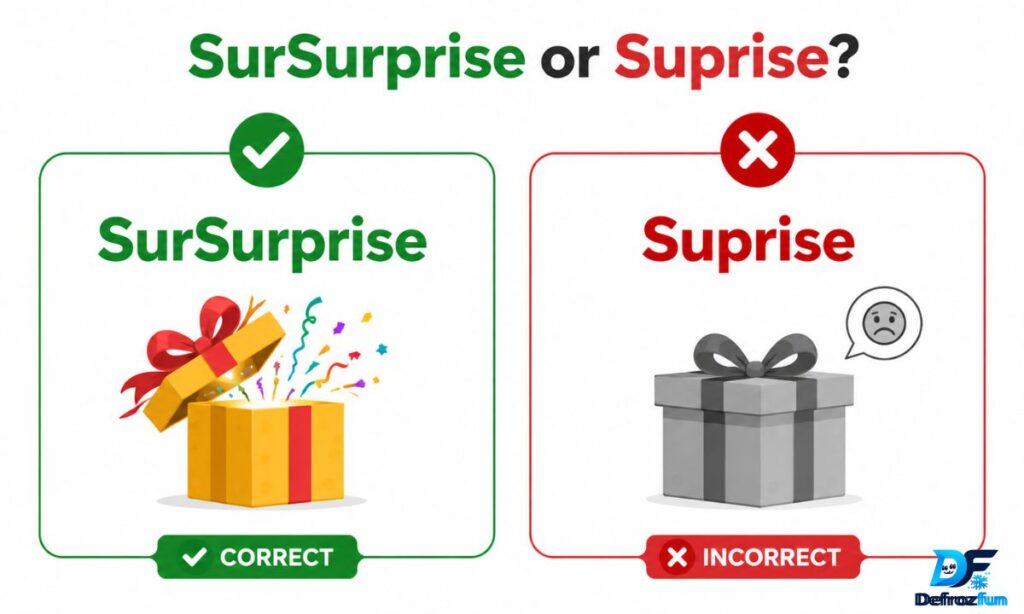
The correct spelling is surprise.
Suprise is incorrect. It is not a real English word and does not appear in any dictionary. The confusion happens because the first “r” in surprise is often not pronounced clearly in everyday speech, which leads people to skip it when writing.
Quick rule: Always write sur-prise, not su-prise.
Is Suprise a Word?
No. Suprise is not a word.
It is simply a misspelling of surprise. No major dictionary — not Oxford, not Merriam-Webster, not Cambridge — recognizes “suprise” as a valid English word. If you type it, your spell checker will flag it as an error.
The only correct form is surprise, with two r’s and two s’s.
Surprise or Suprise Meaning
Surprise means something unexpected that shocks, astonishes, or catches someone off guard. It can be a feeling, an event, or an action.
The word carries the core idea of something happening without warning — it could be pleasant, neutral, or unpleasant.
Surprise Meaning Examples:
- Her sudden arrival was a surprise to everyone in the room.
- What a pleasant surprise to see you here after all these years!
- The announcement came as a complete surprise to the team.
- The magician’s trick was a delightful surprise for the audience.
- I couldn’t hide my surprise when I saw the birthday cake.
The Origin of Surprise
The word surprise has a rich history. It traces back to the Old French word “surprendre”, meaning “to overtake” or “to seize unexpectedly.” From there, it entered Middle English as “surprisen.”
The earliest recorded use of the noun “surprise” in English dates to 1457, found in the writings of chronicler John Hardyng. Originally, the word was used in a military sense — referring to an unexpected attack or seizure of a place.
Over centuries, the meaning softened and expanded to include any unexpected event or feeling. The spelling “surprize” was once used by writers like Jane Austen, but that form is now considered archaic. Today, surprise is the only accepted spelling in both British and American English.
Surprise or Suprise Grammar
From a grammar standpoint, only surprise is correct. There are no exceptions, no regional variations, and no informal allowances for “suprise.”
Surprise can function as:
1. A Noun
Used to describe an unexpected event or feeling.
- The gift was a lovely surprise.
- Her reaction came as no surprise to anyone.
- The decision was greeted with surprise by the committee.
2. A Verb
Used to describe the action of causing astonishment.
- Don’t surprise me like that again.
- Her performance surprised everyone in the audience.
- It surprised me to hear the news.
3. An Adjective Form
Used as a modifier before a noun.
- They threw a surprise party for her birthday.
- The CEO made a surprise visit to the office.
- It was a surprise announcement at the press conference.
Surprise or Suprise Pronunciation
One reason “suprise” is such a common misspelling is pronunciation. In natural, fast speech, the first “r” is often swallowed or barely heard — leading writers to forget it exists.
Correct pronunciation:
“sur-PRIZE”
- Phonetic: /səˈprʌɪz/
- The stress falls on the second syllable: sur-PRIZE
- Say it slowly: sur (like “sir”) + prize (like the reward you win)
Tip: If you remember that surprise rhymes with prize, you will never forget the ending. And knowing it starts with sur- will help you remember both r’s.
Surprise or Suprise Oxford Dictionary
The Oxford English Dictionary (OED) lists surprise as the only correct and accepted spelling. The OED entry for “surprise” as a noun dates back to the Middle English period, with the earliest evidence from 1457.
The Oxford Advanced Learner’s Dictionary defines surprise as:
- (noun) A feeling caused by something happening suddenly or unexpectedly — e.g., “To everyone’s surprise, the plan succeeded.”
- (verb) To make someone feel surprised — e.g., “The outcome did not surprise me at all.”
The OED entry was most recently revised in March 2026, confirming that “surprise” remains the only standard spelling.
British English vs American English Spelling
Unlike many English words — such as “colour/color” or “organise/organize” — surprise is spelled identically in both British and American English.
There is no regional variation here. Both Merriam-Webster (American) and Cambridge Dictionary (British) confirm that surprise is the one and only accepted spelling worldwide.
This means no matter your audience — UK, US, Australia, or Canada — you always write surprise.
Spelling Comparison Table
| Form | Correct? | Notes |
| surprise | ✅ Yes | Standard spelling — British and American English |
| suprise | ❌ No | Common misspelling — missing the first “r” |
| surprize | ❌ No | Archaic variant — used by Jane Austen; now obsolete |
Which Spelling Should You Use?
Always use surprise. There is no situation in which “suprise” or “surprize” is acceptable in modern writing.
Correct usage for all audiences:
- Formal writing: surprise
- Informal writing: surprise
- British English: surprise
- American English: surprise
- Academic writing: surprise
- Social media: surprise
The answer never changes: it is always surprise.
Common Misspellings of Surprise
Surprise is frequently misspelled in more than one way. Here are the most common errors:
- suprise — drops the first “r” (most common mistake)
- surprize — old archaic variant, now considered incorrect
- surpise — drops the second “r”
- suprize — drops the first “r” and uses “z”
- surprisse — adds an extra “s” at the end
Easy Memory Tip
Break the word into two parts: sur + prise
Think of it this way: “I am sure I will win the prize.” That gives you sur-prize → surprise.
“sur-PRIZE”
Say it out loud: sur + prize. Once you hear it clearly, the spelling becomes natural.
Surprise or Suprise Everyday Examples
Seeing how “surprise” works in real contexts makes it easier to use correctly.
Email Example
“I wanted to reach out with a surprise update — the project has been approved ahead of schedule.”
Social Media Example
“What a surprise to wake up to 10,000 followers this morning! Thank you all so much.”
News Example
“In a surprise move, the central bank announced an emergency interest rate cut on Tuesday.”
Formal Writing Example
“The audit results came as a surprise to senior leadership, prompting an internal review.”
Conversation Example
“I can’t believe you flew in from London. What a surprise — I had no idea you were coming!”
Is a Surprise Good or Bad?
A surprise can be either positive or negative, depending on the context. The word itself is neutral — the tone comes from what surrounds it.
Positive Surprise Examples
- Receiving an unexpected gift
- Getting promoted without expecting it
- A friend showing up after years apart
- Winning a contest you forgot you entered
- Hearing good medical news
Negative Surprise Examples
- An unexpected bill or financial setback
- A sudden cancellation of an event
- Finding out bad news without warning
- An unannounced inspection at work
- A product arriving broken with no prior warning
What Does “No Surprise” Mean?
“No surprise” means that something was completely expected — the outcome was predictable and nobody is shocked by it.
It is often used sarcastically or matter-of-factly to express that the result was obvious.
Example:
- “He missed the deadline again — no surprise there.”
- “The film flopped at the box office, which was no surprise given the reviews.”
- “It came as no surprise when the underdog lost the match.”
Also Read This: Antipasto vs Antipasta: Meaning, Difference & Correct Usage (2026)
Synonyms and Fancy Words for Surprise
What’s a Fancy Word for Surprise?
If you want to sound more sophisticated, try these elevated synonyms:
| Synonym | Usage Level |
| Astonishment | Formal / literary |
| Amazement | Everyday formal |
| Bewilderment | Formal / academic |
| Stupefaction | Literary / elevated |
| Consternation | Formal — often negative |
What Is a Bombastic Word for Surprised?
If you want a dramatic, over-the-top word for surprised:
- Flabbergasted — utterly shocked beyond belief
- Thunderstruck — struck with sudden, overwhelming surprise
- Gobsmacked — British English for completely astonished
- Dumbfounded — so surprised you are speechless
- Astounded — deeply shocked, often in a powerful way
What Is an Idiom for Surprise?
English has many vivid idioms that express surprise without using the word itself.
Common Idioms:
- Out of the blue — something unexpected: “The offer came out of the blue.”
- A bolt from the blue — a completely shocking surprise: “His resignation was a bolt from the blue.”
- Catch someone off guard — to surprise someone unprepared: “The question caught me off guard.”
- Take someone by surprise — to do something unexpected: “The news took everyone by surprise.”
- Drop a bombshell — to reveal shocking news: “She dropped a bombshell at the meeting.”
- Knock someone off their feet — to overwhelm with surprise: “The announcement knocked us off our feet.”
What Are 5 Synonym Words?
The five most commonly used synonyms for surprise are:
- Astonish — to surprise someone greatly
- Amaze — to fill with wonder or disbelief
- Astound — to shock with an overwhelming surprise
- Startle — to surprise suddenly, often causing a mild fright
- Stun — to leave someone speechless with shock
What Is a 5 Letter Word for Surprise Starting With A?
AMAZE
Amaze is a five-letter word starting with “A” that means to surprise greatly, filling someone with wonder or disbelief.
- “The magician’s tricks never ceased to amaze the crowd.”
- “I was amazed by how quickly the project came together.”
It is one of the strongest and most common synonyms for surprise in both formal and informal writing.
Is There a Word Called Surprise?
Yes, absolutely. Surprise is a real, widely used English word recognized by every major dictionary including Oxford, Merriam-Webster, and Cambridge.
It functions as a noun, verb, and adjective modifier. It has been in use in the English language since the Middle Ages, and it remains one of the most commonly searched and used words in modern English today.
Surprise – Google Trends & Usage Data
Search data consistently shows that “suprise” is one of the most common spelling errors in the English language. People search for both spellings, which confirms just how widespread the confusion is.
“Surprise” appears in billions of web pages and is heavily used across emails, social media, news articles, and formal documents worldwide. Its usage has remained consistently high across all English-speaking regions.
Keyword Comparison Table
| Keyword | Correct? | Search Intent |
| surprise | ✅ Yes | Correct spelling — high volume |
| suprise | ❌ No | Common misspelling — high search frequency |
| surprize | ❌ No | Archaic — very low modern usage |
| surprise meaning | ✅ Yes | Definition lookup |
| how to spell surprise | ✅ Yes | Spelling confirmation |
| surprise synonym | ✅ Yes | Vocabulary building |
Conclusion
The answer is simple: surprise is always the correct spelling. Suprise is not a word and should be avoided in all writing.
The confusion comes from pronunciation — the first “r” is soft, so many people drop it when writing. The fix is easy: break the word into sur + prise and you will never misspell it again.
Whether you are writing a casual text, a professional email, or an SEO article, always use surprise. It is the same in British English, American English, and every other variety of the language.
One word. One spelling. No exceptions.

Daniel Brooks is a passionate writer and digital content creator dedicated to sharing insightful, engaging, and informative articles across multiple niches. With a strong interest in technology, lifestyle, trending topics, and online media, Daniel Brooks focuses on delivering well-researched and reader-friendly content that inspires and informs audiences worldwide.