

If you have ever typed “peice” and then second-guessed yourself, you are not alone. This is one of the most searched spelling questions in English. The good news? The answer is simple — and once you learn the trick, you will never mix it up again.
Piece vs. Peice — Quick Answer
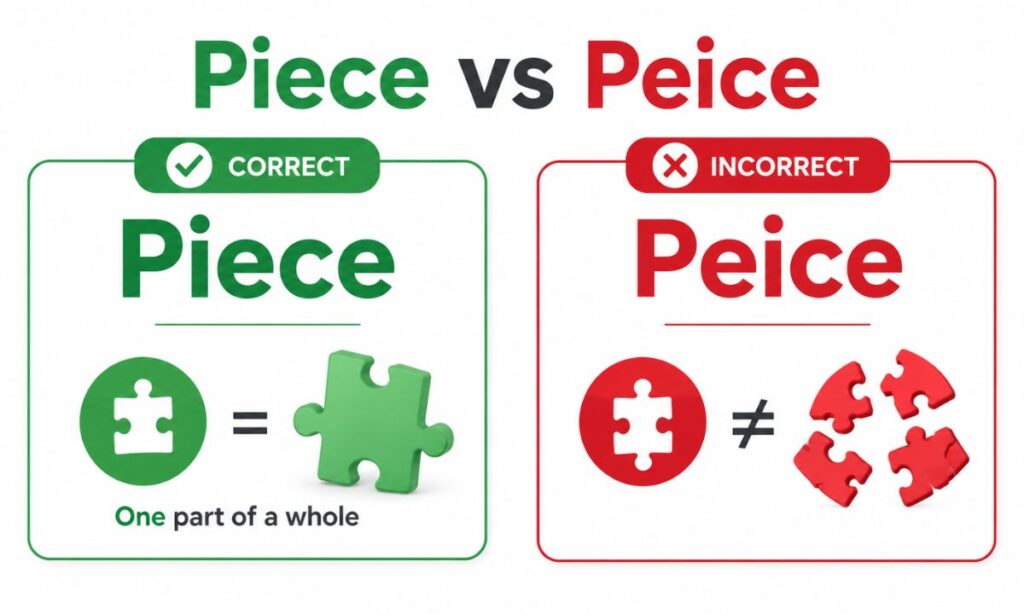
“Piece” is the correct spelling. “Peice” does not exist in the English language.
“Peice” is a misspelling. No dictionary recognizes it, and using it in formal or professional writing can make your work look careless. Always write piece.
| Spelling | Correct? |
| Piece | ✅ Yes |
| Peice | ❌ No — misspelling |
What Does “Piece” Mean?
The word piece is used in two ways in English — as a noun and as a verb.
As a noun, it refers to:
- A part or portion of something larger (a piece of bread)
- A single item within a group (a chess piece)
- A creative or artistic work (a musical piece, a written piece)
- A unit used with uncountable nouns (a piece of furniture, a piece of advice)
As a verb, to “piece” means to assemble or join parts together:
- She pieced the torn letter back together.
- The investigators pieced together the clues.
The word traces back to the 13th century and comes from Old French piece, meaning a part or portion. It has stayed consistent in English spelling ever since.
Why “Peice” Is Wrong
“Peice” is simply a misspelling of “piece.” It has no definition, no entry in any dictionary, and no accepted use in any variety of English — British, American, or otherwise.
If you type “peice” in any spell-checker, it will flag it immediately. The same goes for the plural: “peices” is wrong; “pieces” is correct.
The Spelling Rule Explained in Depth
The most helpful guideline for this word is the classic English spelling rule:
“I before E, except after C.”
Let’s apply it to “piece”:
- The word does not contain a “C” before the vowels
- So the correct order is I before E → pie + ce = piece
This rule also applies to similar words like believe, achieve, thief, and grief — all follow the “IE” pattern.
Where the rule flips (after C) you get words like receive, ceiling, and deceive — notice the “EI” order after the letter C.
Since “piece” has no C before the vowel pair, it always takes IE, never EI.
Why People Make the Piece vs. Peice Mistake
Several factors make this a common error:
- Typing speed — fingers hit E before I by accident
- Phonetics — the word sounds like “pees” and the vowel sound does not clearly signal which letter comes first
- Confusion with “ei” words — words like weird, their, vein, and protein all use “EI,” so some writers apply that pattern to “piece” by mistake
- Similarity to “peace” — both words have five letters, start with P, end with CE, and sound related. The “EA” in peace can subconsciously influence the spelling of “piece”
Knowing these triggers helps you stay alert the next time you type the word.
Piece in Real-World Usage
Here is how “piece” appears across different real-world contexts:
Everyday speech:
- She cut the pizza into eight equal pieces.
- Can I have a piece of that chocolate cake?
Academic or formal writing:
- The researcher published a compelling piece on climate change.
- This sculpture is a remarkable piece of modern art.
Idiomatic expressions:
- Say your piece — to express your opinion
- Give someone a piece of your mind — to speak frankly, often with frustration
- Piece of cake — something very easy
- Fall to pieces — to break apart or become emotionally overwhelmed
- A piece of the pie — a share of something valuable
British vs. American English
There is no difference here. Both British and American English use the same spelling: piece.
| Variety | Spelling |
| American English | piece ✅ |
| British English | piece ✅ |
| Australian English | piece ✅ |
“Peice” is not accepted in any dialect or regional variety of English.
Also Read This: Dose or Dosage: Which Medical Term Should You Use? Meaning, Differences & Examples (2026)
Common Mistakes and Corrections
| Incorrect | Correct |
| peice | piece |
| peices | pieces |
| peiced | pieced |
| peicing | piecing |
All forms of this word follow the same IE spelling. The moment you add a suffix (-s, -d, -ing), the base spelling “piece” stays the same.
Piece in Different Contexts
Food and Daily Life
- He ate the last piece of pie.
- She divided the loaf into thick pieces.
Art and Music
- The pianist performed an original piece.
- That painting is a stunning piece of abstract art.
Games and Puzzles
- One piece of the jigsaw is missing.
- The chess piece fell off the board.
Writing and Journalism
- He submitted a short piece to the magazine.
- This is the best-written piece I have read this year.
Construction and Objects
- The mechanic replaced a broken piece of the engine.
- They assembled the furniture piece by piece.
Related Words and Similar Spellings
Understanding related words helps reinforce the correct pattern:
| Word | Correct Spelling | Common Misspelling |
| piece | piece | peice |
| pieces | pieces | peices |
| pieced | pieced | peiced |
| piecing | piecing | peicing |
| believe | believe | beleive |
| achieve | achieve | acheive |
| thief | thief | theif |
| friend | friend | freind |
All of these follow the “I before E” rule. Grouping them together strengthens your memory of the pattern.
Memory Trick to Remember “Piece”
The most popular and effective memory trick is:
Think of “a piece of pie.”
The word PIE is hidden right at the start of PIECE — P-I-E-C-E.
Whenever you write this word, picture a slice of pie. The spelling “pie” at the beginning reminds you that I comes before E, not the other way around.
Other tricks that work:
- Say the rule aloud: “I before E — that’s piece for me.”
- Visualize: P + IE + CE = PIECE
- Compare it to similar IE words: pie, lie, tie — all put I before E
Practice Exercises
Test yourself with these quick exercises.
Fill in the blank with the correct word (piece / peice):
- She dropped a _____ of glass on the floor.
- He wrote a beautiful _____ of poetry.
- Can I have a _____ of your sandwich?
- The artist displayed every _____ carefully.
- One _____ of the puzzle is still missing.
Correct the error in each sentence:
- I want a peice of that birthday cake. ❌
- The museum featured a peice of ancient pottery. ❌
- They put the machine together peice by peice. ❌
Answers: Fill in the blank: piece (all five). Corrections: replace every “peice” with “piece.”
Advanced Usage of “Piece”
Once you are confident in the basic spelling, you can also handle these advanced forms:
Compound words and phrases:
- masterpiece — a great work of art or skill
- centerpiece — the main item of display or focus
- timepiece — a clock or watch
- piecemeal — done gradually, one step at a time
- piecework — work paid per item produced
Idiomatic and literary usage:
- “To say one’s piece” means to formally state your view, often in a debate or meeting.
- “Pièce de résistance” (borrowed from French) refers to the most impressive item or achievement.
- “Piece of work” can describe a complex or difficult person: “He is quite a piece of work.”
These advanced uses all share the same core spelling — always piece, never peice.
Conclusion
The answer to piece vs. peice is clear: piece is always correct, peice is always wrong.
Remember the trick — think of “a piece of pie” — and you will never misspell this word again. The “pie” sitting at the start of the word tells you exactly how the vowels line up: I before E.
Whether you are writing an academic paper, a text message, or a professional email, correct spelling reflects the care you put into your communication. A single misspelling like “peice” can distract readers from an otherwise strong piece of writing.
Keep practicing, use spell-check as a backup, and trust the rule: I before E — and that gives you piece, every time.

Daniel Brooks is a passionate writer and digital content creator dedicated to sharing insightful, engaging, and informative articles across multiple niches. With a strong interest in technology, lifestyle, trending topics, and online media, Daniel Brooks focuses on delivering well-researched and reader-friendly content that inspires and informs audiences worldwide.