

A single hyphen changes everything. “I met her in person” and “we had an in-person meeting” look almost the same, yet one is an adverb and the other is an adjective. Get this wrong in a resume, an email, or a business report, and it quietly signals sloppy writing.
This guide breaks down the meaning, grammar rule, and real usage of in person and in-person so you never second-guess the hyphen again.
Quick Answer
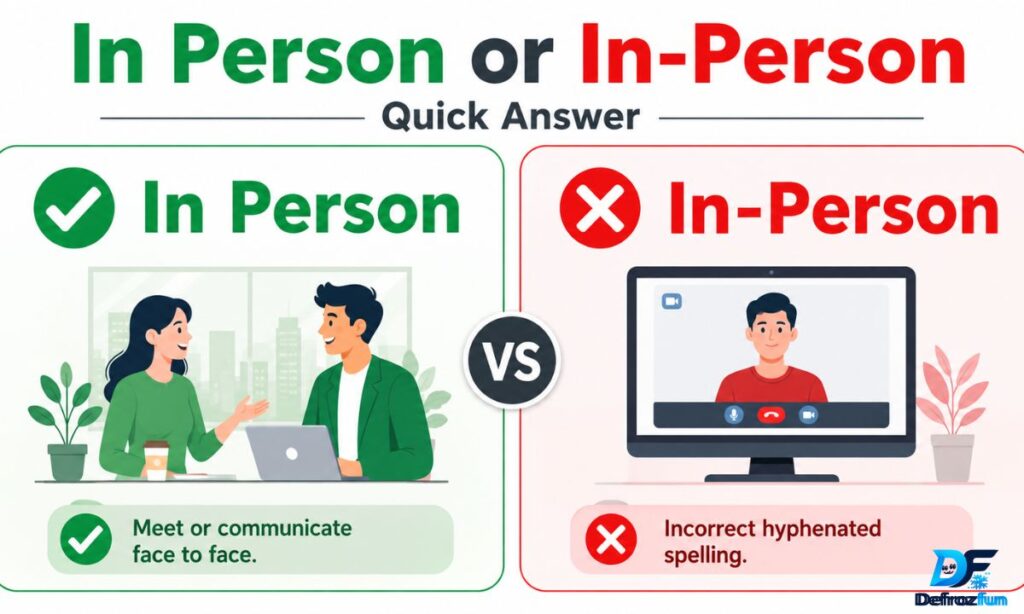
Use in person (no hyphen) when describing how an action happens, usually after a verb. Use in-person (with a hyphen) when describing a noun that comes right after it.
| Form | Part of Speech | Example |
| in person | Adverb / adverbial phrase | We spoke in person. |
| in-person | Adjective (compound modifier) | It was an in-person meeting. |
In Person vs In-Person Meaning Explained
In person means being physically present somewhere, face to face, not on a call, not through email, and not on video. It describes bodily presence.
In-person, once hyphenated, becomes a compound adjective. It describes a noun such as an event, class, interview, or appointment that happens with people physically present rather than remotely.
So the meaning barely shifts. What changes is grammatical job: one modifies a verb, the other modifies a noun.
In Person vs In-Person Difference
The core difference comes down to sentence position and function, not intent.
- If the phrase follows a verb and explains how something happens, drop the hyphen: “She applied in person.”
- If the phrase sits directly before a noun and describes what kind of noun it is, add the hyphen: “She submitted an in-person application.”
A simple test: try substituting “face-to-face.” If it modifies a noun, hyphenate. If it modifies an action, leave it open.
The Origin of the Phrase In Person
The expression “in person,” meaning by bodily presence, has been documented in English since the 1560s, evolving from the sense of representing something “in bodily form.” Related legal and literary phrasing referencing physical presence dates back even further, into the 1300s, in contexts describing someone appearing in their own body rather than through a representative. The hyphenated adjective form, in-person, is a much newer development, arriving alongside modern needs to distinguish physical events from phone, video, and online alternatives.
In-Person or In Person Training
Both are correct, depending on where the phrase sits.
- “Employees must complete the training in person.” (adverb, after a verb)
- “The company offers in-person training every quarter.” (adjective, before a noun)
If you are describing the training session itself, hyphenate it. If you are describing how someone attends, leave the hyphen out.
Grammar Rule Depth
English routinely joins two or more words with a hyphen when they act together as a single adjective before a noun. This is called a compound modifier. “In-person,” like “long-term” or “high-quality,” follows that same rule.
Key grammar points:
- Adverbial phrase (no hyphen): functions like “personally” or “physically,” modifying a verb.
- Compound adjective (hyphenated): functions like a single describing word placed before a noun.
- Predicate position: when the phrase comes after “to be” and does not directly precede a noun, most style guides still drop the hyphen, as in “The interview was in person.”
- Capitalize only at the start of a sentence or in a title; otherwise, keep both forms lowercase.
Why People Get Confused About In Person vs In-Person
The confusion is understandable. Both forms sound identical when spoken, so the ear gives no clue. Add in the fact that many other adverb-adjective pairs in English do not change spelling at all, and writers assume this pair should behave the same way. The rise of hybrid work, online classes, and virtual events has also pushed the phrase into far more daily writing than a decade ago, exposing the hyphen question to more people than ever.
Real World Usage of In Person
News outlets, universities, and government offices use “in person” constantly to distinguish physical attendance from remote or online options. It appears in job postings, court notices, election guidance, healthcare appointment reminders, and everyday conversation about meeting up with friends or family.
In Person Examples in Sentences

- He seemed taller in person than in photos.
- They finally met in person after months of texting.
- Voters were required to register in person before the deadline.
- I would rather explain this in person than over email.
- She hadn’t seen her grandmother in person in over a year.
In Person in Professional Writing
In business communication, precision matters. Using “in person” correctly as an adverb keeps sentences about actions clean: “Please confirm whether you will attend in person or virtually.” It also appears often in HR documentation, onboarding emails, and meeting invitations where clarity between remote and physical attendance is essential.
In-Person or In-Person Interview
When the phrase sits before “interview,” it becomes a compound adjective and needs the hyphen: “in-person interview.” Without a following noun, it drops back to two words: “She was interviewed in person.”
| Sentence | Correct Form |
| We scheduled an ___ interview. | in-person |
| He was interviewed ___. | in person |
In Person in Social Media and Conversation
In casual writing, texting, and social media captions, people are far less strict about the hyphen, and platforms rarely enforce it. Still, “in person” as two words remains correct in most casual sentences like “can’t wait to see you in person,” since it typically follows a verb rather than sitting before a noun.
Common Mistakes with In Person
- Writing “in-person” after a verb: ~~”We met in-person.”~~ Correct: “We met in person.”
- Dropping the hyphen before a noun: ~~”An in person event.”~~ Correct: “An in-person event.”
- Using “inperson” as one solid word; this is never correct in standard English.
- Capitalizing mid-sentence without reason.
Also Read This: Privilege vs. Priviledge: Which Spelling Is Correct? Meaning, Examples & Common Mistakes (2026)
Related Words and Similar Expressions
- Face-to-face: near-identical meaning, same hyphenation logic applies before a noun.
- In the flesh: an idiomatic synonym for “in person,” used mostly in casual speech.
- On-site: often used interchangeably with “in-person” in workplace contexts, referring to physical location rather than remote work.
- Remote / virtual: the direct opposites of both forms.
In Person in Modern English
Since 2020, hybrid work and hybrid learning have made this phrase far more common in everyday writing, from calendar invites to school newsletters. Style guides across journalism, business, and academic writing now treat the hyphen rule as standard practice, and most professional editors flag inconsistent usage during proofreading.
Attend in Person or In-Person
“Attend” is a verb, so the phrase that follows it stays open: “Please attend in person if possible.” The hyphenated form only appears here if a noun follows directly, such as “in-person attendance is mandatory.”
Usage Patterns in Different Countries
American and British English largely agree on this rule, treating “in-person” as a compound adjective and “in person” as an adverbial phrase. Professional and academic writing in both regions increasingly favors hyphenation before nouns for clarity, especially in official communications from universities, healthcare providers, and government agencies. Minor style differences exist mainly in how strictly individual publications enforce the hyphen in fast, informal writing such as texting or social captions.
Exercise 1: Choose the Correct Form
- The clinic offers ______ appointments for patients. (in-person / in person)
- Customers can apply ______ at the office. (in-person / in person)
- It was an ______ ceremony. (in-person / in person)
- She prefers to talk ______ rather than by phone. (in-person / in person)
Exercise 2: Correct the Sentence
- “We had an in person meeting yesterday.” → Correct: “We had an in-person meeting yesterday.”
- “He apologized in-person.” → Correct: “He apologized in person.”
- “The school announced inperson classes.” → Correct: “The school announced in-person classes.”
Conclusion
The choice between in person and in-person is not about meaning, since both point to physical, face-to-face presence. It is about grammar. If the phrase describes how something happens, after a verb, leave it as two words. If it describes a noun that follows it, add the hyphen. Once that single test becomes automatic, this pair stops being confusing and starts making your writing look sharper, whether you are drafting a job posting, a meeting invite, or a quick text to a friend.

Daniel Brooks is a passionate writer and digital content creator dedicated to sharing insightful, engaging, and informative articles across multiple niches. With a strong interest in technology, lifestyle, trending topics, and online media, Daniel Brooks focuses on delivering well-researched and reader-friendly content that inspires and informs audiences worldwide.