

If you have ever paused mid sentence wondering whether a dog is “vicious” or “viscous,” you are not alone. These two words are spelled almost the same, sound similar out loud, and yet describe completely different things. One belongs to the world of behavior and emotion. The other belongs to the world of physics and texture.
This guide breaks down everything you need to know about vicious and viscous: their meanings, origins, correct usage, real world examples, and the small memory tricks that make the confusion disappear for good.
Quick Answer
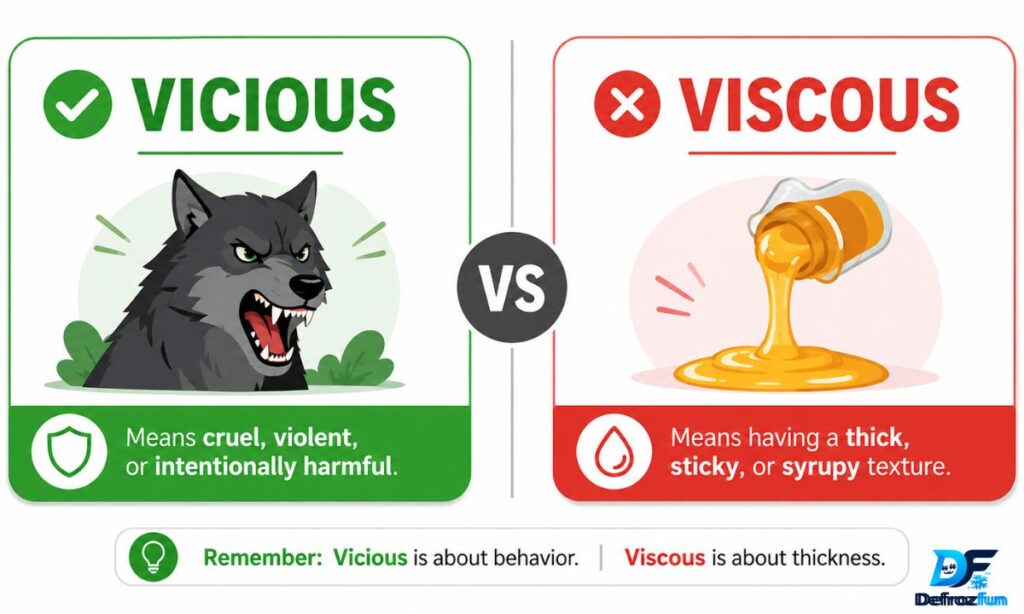
Vicious means cruel, aggressive, violent, or morally wrong. It describes behavior, attitude, or actions that cause harm.
Viscous means thick, sticky, and slow flowing. It describes the physical property of a liquid or substance.
| Word | Meaning | Describes | Example |
| Vicious | Cruel, aggressive, harmful | People, animals, behavior, cycles | A vicious attack shocked the neighborhood |
| Viscous | Thick, sticky, slow moving | Liquids, fluids, substances | Honey is a viscous liquid |
If you can swap the word for “cruel,” use vicious. If you can swap it for “thick,” use viscous. That single test solves nearly every mix up.
Grammar Rules and Word Meaning Explained
Both words are adjectives, and that shared part of speech is one reason people confuse them so easily. Beyond that, their grammar behaves the same way any standard adjective does: they can sit before a noun (a vicious rumor, a viscous paste) or after a linking verb (the rumor was vicious, the paste felt viscous).
A few grammar notes worth remembering:
- Both words follow regular comparative and superlative rules: more vicious, most vicious; more viscous, most viscous.
- Neither word changes form for plural nouns. You say “vicious dogs,” not “viciouses dogs.”
- The related noun forms are viciousness and viscosity. Viscosity is a scientific measurement used in chemistry, engineering, and cooking, while viciousness describes intensity of cruelty or aggression.
- Vicious pairs naturally with words like attack, rumor, cycle, dog, and criticism.
- Viscous pairs naturally with words like liquid, oil, syrup, fluid, and gel.
Because the only spelling difference is the second letter (i versus s after the first syllable), spellcheck tools often miss the error since both are real, correctly spelled words. That makes manual proofreading essential.
Deep Meaning of Vicious
Vicious comes from the Latin word vitiosus, related to vitium, meaning “vice” or “fault.” Over centuries it evolved to describe anything marked by cruelty, immorality, or intense hostility.
In modern English, vicious carries several closely related senses:
- Deliberately cruel or violent, as in a vicious assault.
- Spiteful or malicious, as in vicious gossip.
- Fierce or dangerous, often used for animals, as in a vicious guard dog.
- Severe or intense, as in a vicious headache or a vicious storm.
- Self-perpetuating and harmful, as in a vicious cycle of debt.
Common synonyms include brutal, savage, ferocious, malicious, and ruthless. The opposite of vicious is gentle, kind, or harmless.
Deep Meaning of Viscous
Viscous traces back to the Latin viscosus, meaning “sticky,” which itself comes from viscum, the Latin word for mistletoe. Ancient mistletoe berries produced a sticky substance once used to trap small birds, and that stickiness gave the word its lasting meaning.
Today, viscous is mainly a descriptive and scientific term used for substances that resist flowing freely. A viscous liquid moves slowly and clings together rather than spreading out quickly.
Key points about viscous:
- It measures internal friction within a fluid, a property scientists call viscosity.
- High viscosity means slow flowing, like honey, tar, or motor oil.
- Low viscosity means fast flowing, like water or rubbing alcohol.
- Viscous is common in cooking, chemistry, engineering, and everyday descriptions of liquids like sauces, lotions, and paints.
Vicious vs Viscous Examples
Seeing both words side by side in real sentences makes the difference click faster than any definition alone.
Vicious in a sentence:
- The vicious storm tore through the coastal town overnight.
- She was hurt by his vicious remarks during the meeting.
- The stray dog had a vicious reputation in the area.
- They were trapped in a vicious cycle of poverty for years.
Viscous in a sentence:
- The chef drizzled a viscous caramel sauce over the dessert.
- Cold weather made the engine oil more viscous than usual.
- The lava moved as a slow, viscous stream down the hillside.
- Honey is far more viscous than water at room temperature.
Why People Confuse Vicious vs Viscous
The mix up is extremely common, and there are clear reasons behind it.
- Near identical spelling. Only one letter separates the two words, which makes typos and misreads easy.
- Similar sound. When spoken quickly, especially in casual conversation, the words can blur together.
- Same part of speech. Both are adjectives, so they slot into sentences in the same grammatical position.
- Autocorrect blind spots. Since both words are spelled correctly on their own, spellcheck software will not flag a wrong choice.
- Limited exposure. Viscous is a more specialized, scientific word, so many people simply encounter it less often and default to the more familiar vicious.
Recognizing these causes is often enough to help writers slow down and double check before hitting publish.
Vicious vs Viscous in Real World Usage
Both words show up across very different fields, which is part of what makes them worth learning properly.
| Field | Word Typically Used | Example |
| News and journalism | Vicious | A vicious crime shocked residents |
| Cooking and food writing | Viscous | The batter turned thick and viscous |
| Chemistry and engineering | Viscous | Engineers measured the fluid’s viscosity |
| Everyday conversation | Vicious | He made a vicious comment online |
| Weather reporting | Vicious | A vicious cold snap hit the region |
| Product descriptions | Viscous | This serum has a viscous, gel like texture |
In legal writing, “vicious” can describe intent, such as a vicious attack that implies deliberate harm. In scientific and industrial writing, “viscous” is standard vocabulary for describing how a fluid behaves under pressure or temperature change.
Also Read This: Lended vs. Lent: Meaning, Difference, Grammar Rules, Examples, and Correct Usage (2026 Guide)
Viscous vs Non Viscous

In science, fluids are often grouped by how much resistance they offer to flow.
- Viscous fluids flow slowly and resist changes in shape. Examples include honey, molasses, motor oil, and melted chocolate.
- Non viscous (or low viscosity) fluids flow quickly and offer little resistance. Examples include water, alcohol, and most gases.
Viscosity is not fixed. Temperature changes it directly: heating usually lowers viscosity, making a substance flow more easily, while cooling raises it, making the substance thicker. That is why cold honey pours slower than warm honey, and why engine oil is rated for how it performs across a range of temperatures.
Which Word Should You Use
A simple decision process removes the guesswork:
- Ask what you are describing. A person, animal, or action points to vicious. A liquid or substance points to viscous.
- Try the substitution test. Replace the word with “cruel.” If the sentence still makes sense, use vicious. Replace it with “thick.” If that fits, use viscous.
- Check the surrounding vocabulary. Words like attack, rumor, dog, and cycle signal vicious. Words like liquid, syrup, oil, and gel signal viscous.
Common Mistakes and Corrections
| Incorrect | Correct | Why |
| The syrup was vicious and slow to pour | The syrup was viscous and slow to pour | Describes thickness, not cruelty |
| The dog attacked in a viscous manner | The dog attacked in a vicious manner | Describes aggressive behavior |
| That was a viscous rumor to spread | That was a vicious rumor to spread | Describes harmful intent |
| The oil felt vicious on my hands | The oil felt viscous on my hands | Describes physical texture |
A quick habit that helps: before publishing anything, search your document for both words and read each sentence out loud. If a sentence sounds odd when you say “cruel” or “thick” in place of the word, you likely have the wrong one.
Related Confusing Word Pairs
English has many look alike word pairs that trip up writers the same way vicious and viscous do:
- Affect vs effect
- Complement vs compliment
- Principal vs principle
- Stationary vs stationery
- Elicit vs illicit
- Discreet vs discrete
Learning one pair well often builds the habit of slowing down and checking others.
Practice Exercises
Fill in the blank with vicious or viscous.
- The ___ shark circled the boat before disappearing.
- Melted cheese becomes ___ as it cools.
- Her ___ comments left the whole room silent.
- The ___ tar was nearly impossible to clean off the tools.
- He broke the ___ cycle of bad habits after years of effort.
Answers: 1. vicious, 2. viscous, 3. vicious, 4. viscous, 5. vicious
Conclusion
Vicious and viscous may look like near twins on the page, but their meanings sit worlds apart. Vicious lives in the territory of behavior, cruelty, and intensity, while viscous lives in the territory of physics, texture, and flow. Once you anchor each word to its core idea, cruel for vicious and thick for viscous, the confusion tends to disappear for good.
The next time you are unsure which word fits, run the quick substitution test, check the surrounding context, and trust the pattern you have learned here. Clear word choice is a small detail, but it consistently signals careful, credible writing.

Daniel Brooks is a passionate writer and digital content creator dedicated to sharing insightful, engaging, and informative articles across multiple niches. With a strong interest in technology, lifestyle, trending topics, and online media, Daniel Brooks focuses on delivering well-researched and reader-friendly content that inspires and informs audiences worldwide.