

If you’ve ever paused mid-sentence wondering whether to write “I lended him my car” or “I lent him my car,” you’re not alone. This is one of the most common irregular verb mix-ups in English, and it trips up native speakers and language learners alike. The short answer: “lent” is correct, and “lended” is not a real word in standard English.
This guide breaks down the meaning, grammar rules, origin, and real-world usage of “lend,” “lent,” and the mistaken form “lended,” so you never second-guess this word again.
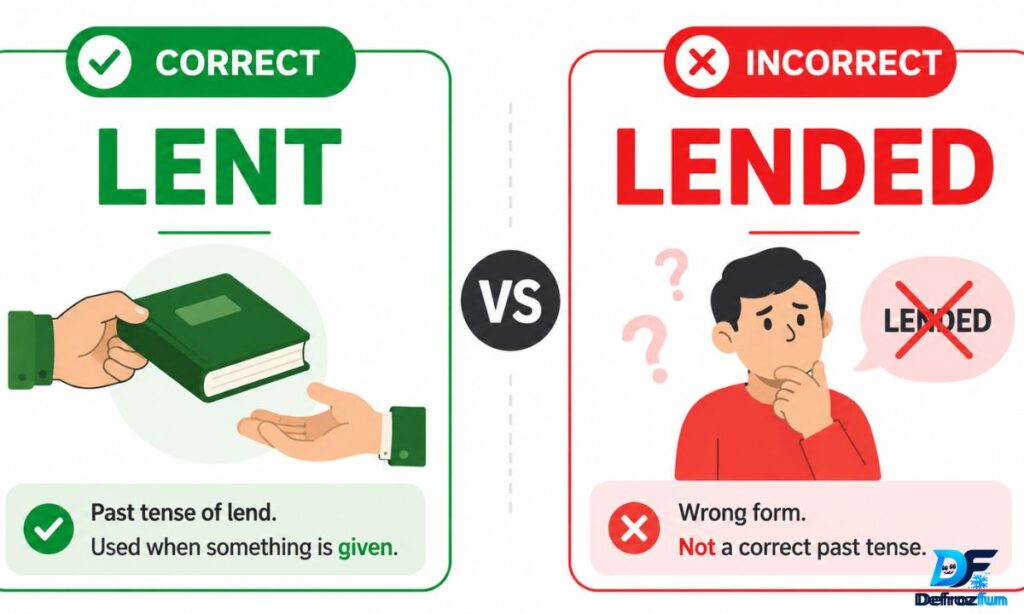
Lended vs Lent Quick Answer
| Word | Correct? | Part of Speech | When to Use |
| Lend | Yes | Base verb (present tense) | “I will lend you my notes.” |
| Lent | Yes | Past tense / past participle | “I lent you my notes yesterday.” |
| Lended | No | Nonstandard form | Never use in formal or casual writing |
There is no situation in modern standard English where “lended” is the right choice. “Lend” is an irregular verb, and irregular verbs don’t take the usual “-ed” ending.
Lended vs Lent Meaning
“Lend” means to give something to someone temporarily, on the understanding that it will be returned. It could be money, an object, or even help.
- Present tense: lend — “I lend my brother tools all the time.”
- Past tense / past participle: lent — “I lent my brother a drill last week.”
“Lended” attempts to do the same job as “lent,” but it simply isn’t a recognized word in any major dictionary or style guide. It looks like it should work because so many English verbs form their past tense by adding “-ed” (walk → walked, jump → jumped). Lend just doesn’t play by that rule.
Lended vs Lent Difference
The core difference comes down to grammatical correctness, not meaning. Both words are attempts to express the past tense of “lend,” but only one is accepted.
- Lent: Standard, dictionary-approved past tense and past participle of “lend.”
- Lended: A nonstandard, incorrect form that shows up occasionally in casual speech, social media, and rough drafts, but never in edited, professional, or academic writing.
If you remember nothing else from this article, remember this: whenever you need the past form of “lend,” the answer is always “lent.”
Also Read This: Posible vs. Possible: Meaning, Difference, Spelling Rules, Examples & Correct Usage (2026 Guide)
Grammar Rule Depth
English verbs fall into two broad categories:
- Regular verbs — form the past tense by adding “-ed” (talk → talked, play → played).
- Irregular verbs — change their spelling in unpredictable ways (go → went, eat → ate, lend → lent).
“Lend” belongs to a small family of irregular verbs that swap a final “-d” for a “-t” in the past tense. This pattern shows up in several closely related words:
| Base Form | Past Tense | Past Participle |
| Lend | Lent | Lent |
| Send | Sent | Sent |
| Spend | Spent | Spent |
| Bend | Bent | Bent |
| Build | Built | Built |
Notice the pattern: none of these become “lended,” “sended,” “spended,” or “bended” in standard English. Once you see “lend” as part of this family, the “-t” ending starts to feel natural instead of exceptional.
The Origin of Lend and Lent
“Lend” comes from the Old English word lǣnan, related to lǣn (a loan or gift). Over centuries, the verb kept its irregular past-tense pattern, unlike many verbs that eventually regularized. This is common in older, high-frequency English verbs — the more a word is used in everyday speech, the more likely it is to hold on to its ancient, irregular form rather than shift to the modern “-ed” pattern.
That’s part of why “lent” has stayed fixed for so long: it’s used constantly in banking, lending, borrowing, and everyday favors, so the correct form gets reinforced through repetition.
Why People Say Lended Instead of Lent
“Lended” isn’t a random error — it follows a very logical (if incorrect) pattern. Common reasons people use it include:
- Overgeneralizing the regular past-tense rule. Most English verbs add “-ed,” so the brain defaults to that pattern.
- Unfamiliarity with irregular verb lists. Learners who haven’t memorized irregular verbs often regularize them by habit.
- Autocorrect or typing speed. Fast typing sometimes produces “lended” simply as a slip.
- Regional or informal speech habits. In casual conversation, some speakers use “lended” without realizing it’s nonstandard.
- Confusion with similar-looking regular verbs, like “blend,” which does become “blended.”
That last point is a genuine source of confusion. “Blend” and “lend” look alike but behave differently — “blend” is regular (“blended”), while “lend” is irregular (“lent”).
Real World Usage of Lent
“Lent” appears constantly across everyday, professional, and financial contexts:
- Banking and finance: “The bank lent the company $50,000 to expand operations.”
- Personal favors: “She lent me her umbrella during the storm.”
- Figurative use: “His experience lent credibility to the presentation.”
- Formal writing: “The government lent its support to the new policy.”
Note the figurative use above — “lent” doesn’t only apply to physical objects or money. It’s also used to describe abstract qualities being added to a situation, such as credibility, weight, or atmosphere.
Lent in Everyday Examples
- “Can you lend me $20? I’ll pay you back Friday.” → “I lent you $20 last Friday.”
- “My neighbor lent me his ladder to clean the gutters.”
- “The library lent out over 10,000 books last month.”
- “Her calm voice lent a sense of order to the chaotic meeting.”
Lended vs Lent Grammar

Here’s a simple grammar checklist to keep the two straight:
- Use lend when speaking in the present or future tense.
- Use lent for both the simple past tense and the past participle (after “has,” “have,” or “had”).
- Never use lended — it does not exist in standard grammar references.
- Watch for auxiliary verbs: “has lent,” “have lent,” and “had lent” are all correct; “has lended” is not.
Common Mistakes with Lended vs Lent
| Incorrect | Correct |
| I lended him my phone. | I lent him my phone. |
| She has lended her support. | She has lended her support. → She has lent her support. |
| The bank lended money to small businesses. | The bank lent money to small businesses. |
| They have lended us their car before. | They have lent us their car before. |
A quick self-check: if you’re tempted to write “lended,” swap in “sent” or “spent” in the same sentence. If those sound wrong with “-ed,” then “lended” is wrong too.
Lend vs Borrow Clarification
Another frequent mix-up sits right next to this one: lend vs. borrow.
- Lend means to give something to someone temporarily. (“I lent her my jacket.”)
- Borrow means to receive something temporarily from someone else. (“She borrowed my jacket.”)
A common but incorrect habit is using “borrow” when “lend” is meant, as in “Can you borrow me $10?” The correct version is “Can you lend me $10?” The direction of the action determines the word: the giver lends, the receiver borrows.
Lended vs Lent in Different Contexts
| Context | Correct Usage |
| Casual conversation | “I lent my charger to a coworker.” |
| Business/finance | “The firm lent capital to the startup.” |
| Academic writing | “Historical evidence lent weight to the theory.” |
| News reporting | “Local officials lent their backing to the initiative.” |
“Lent” fits every one of these registers without changing form — it’s equally correct in a text message and a legal document.
Related Words and Similar Patterns
Beyond send, spend, and bend, a few other word pairs cause similar confusion for the same reason — people expect a regular “-ed” ending where English uses an irregular form instead: laid (not “layed”), built (not “builded”), and meant (not “meaned”). Recognizing the family of “-d to -t” irregular verbs makes it easier to avoid similar mistakes across your writing.
Usage Trends
Search and usage data consistently show that people look up “lended vs lent” because they’re genuinely uncertain, not because “lended” is gaining acceptance. Major dictionaries, style guides, and grammar checkers all mark “lended” as nonstandard or flag it as an error, and that consensus has remained stable for years. In short: “lent” isn’t just more popular — it’s the only form considered correct.
Exercise 1: Choose the Correct Word
- Yesterday, I ______ (lended/lent) my friend my calculator.
- The bank has ______ (lended/lent) millions to local businesses.
- She ______ (lended/lent) her voice to the campaign.
- They ______ (lended/lent) us their cabin last summer.
- He has never ______ (lended/lent) anyone his tools before.
(Answer key: 1. lent, 2. lent, 3. lent, 4. lent, 5. lent)
Exercise 2: Correct the Sentence
- “She lended me her notes before the exam.”
- “We have lended equipment to the school for years.”
- “The company lended funds to support the project.”
- “I lended my jacket to him last night.”
- “They have never lended their car to anyone.”
(Corrected: replace every instance of “lended” with “lent.”)
FAQs
Is “lended” ever correct? No. “Lended” is not recognized in standard English grammar or dictionaries.
What is the past tense of “lend”? The past tense of “lend” is “lent,” used for both simple past and past participle forms.
Why do people confuse “lended” and “lent”? Because most English verbs add “-ed” for the past tense, so writers assume “lend” follows the same rule.
Is “lend” a regular or irregular verb? “Lend” is an irregular verb; its past tense changes spelling instead of adding “-ed.”
What’s the difference between “lend” and “borrow”? “Lend” means to give something temporarily, while “borrow” means to receive something temporarily.
Can “lent” be used in formal writing? Yes, “lent” is fully acceptable in academic, business, and formal writing contexts.
Conclusion
The rule is simple and permanent: “lend” is the present tense, “lent” is the past tense and past participle, and “lended” isn’t standard English at all. The confusion makes sense — English has plenty of regular “-ed” verbs to set the expectation — but “lend” belongs to a small, stable group of irregular verbs that includes “send,” “spend,” and “bend.”
Once you associate “lend” with that family instead of treating it as a standalone word, choosing “lent” becomes automatic. Whether you’re writing a text message, a business report, or an academic paper, “lent” is always the safe, correct choice.

Daniel Brooks is a passionate writer and digital content creator dedicated to sharing insightful, engaging, and informative articles across multiple niches. With a strong interest in technology, lifestyle, trending topics, and online media, Daniel Brooks focuses on delivering well-researched and reader-friendly content that inspires and informs audiences worldwide.