

If you have ever typed “traveler” in an email and then spotted “traveller” on a UK website, you already know the confusion. Both spellings look correct, both sound the same, and both show up constantly across travel blogs, airline apps, and grammar checkers. So which one is actually right?
The short answer: both are right. This guide breaks down the grammar rule behind the spelling split, where it came from, and exactly which version to use depending on your audience, your country, and your writing style.
Quick Answer
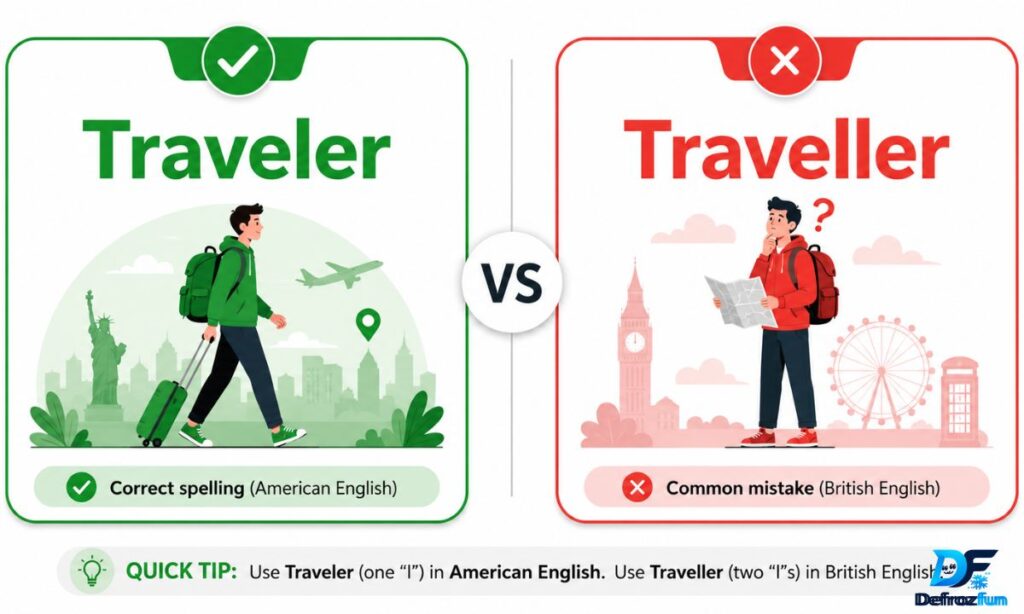
Traveler is the American English spelling. Traveller is the British English spelling. Both mean exactly the same thing — a person who travels — and neither is grammatically wrong. Your choice depends entirely on which English variant your audience expects.
| Spelling | Region | Example |
| Traveler | United States | She is a frequent traveler. |
| Traveller | United Kingdom, Australia, Canada, India, Pakistan | She is a frequent traveller. |
Also Read This: Rational vs. Rationale: Meaning, Grammar Rules, Examples, Common Mistakes & Correct Usage (2026 Guide)
Grammar Rule Depth
The real grammar rule sitting behind traveler vs traveller is about consonant doubling, not the word itself.
In British English, when a verb ends in a single vowel plus a single consonant, the final consonant is usually doubled before adding a suffix like -er, -ed, or -ing — even when the last syllable isn’t stressed. That’s why British English writes:
- travel → traveller, travelling, travelled
- cancel → cancelled, cancelling
- label → labelled, labelling
American English only doubles the consonant when the final syllable is stressed (as in occur → occurred). Since the stress in “travel” falls on the first syllable, American spelling rules leave the consonant single:
- travel → traveler, traveling, traveled
This single rule explains almost every American vs British spelling pair you’ll ever run into.
The Origin of Traveler and Traveller
Both words trace back to the Old French verb travailler, meaning “to work” or “to toil” — a nod to how difficult and labor-intensive journeys used to be before modern transport existed. The noun form entered Middle English by the 14th century as “travailour” or “traveller,” already carrying the double consonant that later became a hallmark of British spelling.
For centuries, English spelling wasn’t standardized at all. Writers used whichever form felt natural, and both single-L and double-L versions appeared in manuscripts side by side. The real split happened much later, once American English began charting its own course.
British English vs American English Spelling
The divide widened sharply in the 19th century, largely due to one man: Noah Webster. In his 1828 An American Dictionary of the English Language, Webster deliberately simplified British spelling conventions to make American English more efficient and distinct. He trimmed unnecessary letters from words like colour, centre, and traveller — giving us color, center, and traveler.
Britain, meanwhile, held onto its traditional forms. As the British Empire expanded, countries influenced by British rule — including Canada, Australia, New Zealand, India, and Pakistan — largely adopted British spelling conventions, keeping the double L in traveller.
| Feature | American English | British English |
| Base spelling | Traveler | Traveller |
| Present participle | Traveling | Travelling |
| Past tense | Traveled | Travelled |
| Standardized by | Noah Webster (1828) | Traditional British usage |
| Common in | US | UK, Australia, Canada, India, Pakistan |
Which Spelling Should You Use
There’s no universal “correct” answer — only the correct answer for your audience. Use this quick checklist:
- Writing for a US audience, US publication, or American company → use traveler
- Writing for a UK, Australian, Canadian, Indian, or Pakistani audience → use traveller
- Writing academic or business content → match the style guide you’ve been given
- Writing for a global or mixed audience → pick one spelling and stay consistent throughout the entire document
The one rule that matters more than region: never mix both spellings in the same piece of writing. Consistency signals professionalism; inconsistency reads as careless.
Traveler vs Traveller Examples
- He is a frequent traveler. (US) / He is a frequent traveller. (UK)
- She packed light like an experienced traveler. (US) / She packed light like an experienced traveller. (UK)
- The traveler checked in at the airport counter. (US) / The traveller checked in at the airport counter. (UK)
Why People Confuse Traveler vs Traveller
The confusion isn’t really about grammar — it’s about exposure. Most people read content from both American and British sources every day: US news sites, UK travel blogs, Australian airline websites, and global brands that switch spelling depending on region. Autocorrect and spellcheck tools also vary by device settings, so a phone set to UK English will flag “traveler” as wrong, while a US-set laptop does the opposite. That constant exposure to both forms is exactly what makes the spelling feel unstable, even though the underlying rule is simple.
Traveler vs Traveller in Real World Usage
Global brands often adapt spelling by market rather than picking one form permanently. Airlines, hotel chains, and travel platforms frequently localize their websites — showing “traveler” to US visitors and “traveller” to UK or Australian visitors. Publishing houses do the same: a book edited for the American market will consistently use traveler, while the same title released in the UK will switch every instance to traveller.
Traveler Spelling in American English
In American English, traveler always takes a single L across every form:
- traveler (noun)
- traveling (present participle)
- traveled (past tense)
- traveler’s checks, traveler’s insurance (possessive forms)
This single-L pattern is standard in US newspapers, government documents, and style guides like AP and Chicago.
Traveler vs Traveller in Sentences
| American English | British English |
| The traveler booked a hotel online. | The traveller booked a hotel online. |
| He is a business traveler. | He is a business traveller. |
| She is a world traveler. | She is a world traveller. |
| The traveler explored new places. | The traveller explored new places. |
Common Mistakes and Corrections
- ❌ He is a traveler and a frequent traveller. → ✅ Pick one spelling and use it consistently.
- ❌ Traveling with double L in American writing (travelling). → ✅ Use traveling for US audiences.
- ❌ Traveler’s cheque spelled with US “check” for a UK audience. → ✅ Match currency and spelling terms to your target region.
- ❌ Switching spelling mid-document because of autocorrect. → ✅ Set your document language once and proofread before publishing.
Traveller or Traveler Synonym
Depending on tone and context, you can swap traveler/traveller for:
- Wanderer
- Voyager
- Wayfarer
- Globetrotter
- Explorer
- Tourist (though this technically implies leisure travel specifically, unlike the broader “traveler”)
Related Words With Similar Differences
The traveler vs traveller pattern repeats across many other American vs British word pairs:
| American English | British English |
| Canceled | Cancelled |
| Labeled | Labelled |
| Modeling | Modelling |
| Jeweler | Jeweller |
| Counselor | Counsellor |
| Fueled | Fuelled |
If you remember the traveler rule, you’ve essentially learned all of these at once.
Google Trends and Usage by Region
Search interest confirms the regional split clearly: “traveler” dominates search volume in the United States, while “traveller” is the dominant search term across the UK, Australia, New Zealand, Canada, India, and Pakistan. Countries with historical ties to British English almost universally lean toward the double-L spelling, while American-influenced markets favor the single-L form.
Practice Exercises
Choose the correct spelling for a US audience:
- She is a frequent ______ (traveler/traveller).
- He was ______ (traveling/travelling) to Paris next week.
- The ______ (traveler/traveller) lost his passport.
Choose the correct spelling for a UK audience:
- The ______ (traveler/traveller) checked her ticket twice.
- They were ______ (traveling/travelling) across Europe.
Conclusion
Traveler and traveller are two correct spellings of the same word, separated only by regional convention rather than grammar. Traveler belongs to American English, traveller to British English, and the difference traces all the way back to Noah Webster’s 19th-century spelling reforms.
The only real rule to remember is consistency: choose the spelling that matches your audience, then use it throughout your entire piece of writing. Once you understand this single pattern, you’ll never second-guess traveler vs traveller — or any of the many word pairs that follow the exact same rule — again.

Daniel Brooks is a passionate writer and digital content creator dedicated to sharing insightful, engaging, and informative articles across multiple niches. With a strong interest in technology, lifestyle, trending topics, and online media, Daniel Brooks focuses on delivering well-researched and reader-friendly content that inspires and informs audiences worldwide.