

If you have ever written a sentence and stopped to wonder whether to write hide or hid, you are not alone. This is one of the most common verb tense mistakes in English. Both words come from the same verb, but they belong to different time frames. Get the tense wrong and your sentence sounds off instantly. This guide explains everything clearly so you never confuse the two again.
Hide or Hid – Quick Answer
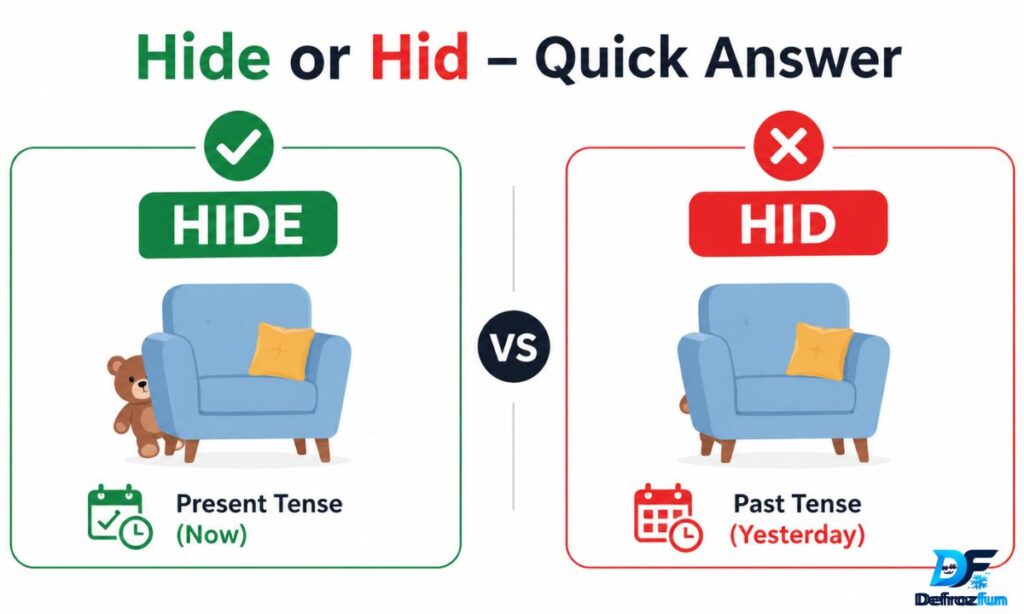
Hide is the base (present tense) form of the verb. Use it when the action is happening now, happens regularly, or will happen in the future.
Hid is the simple past tense of hide. Use it when the action is already finished and happened at a specific point in the past.
Quick rule: If the action is done, use hid. If it is happening now or regularly, use hide.
Is Hid a Verb?
Yes, hid is a verb. It is the simple past tense form of the verb to hide. It works as a standalone verb in a sentence without needing any helping verb. For example:
- She hid the letter under her pillow.
- He hid from his friends during the game.
No auxiliary verb (has, had, was) is needed when you use hid. It stands on its own to describe a completed past action.
What Is the Meaning of Hid and Hide?
Both words carry the same core meaning, just at different points in time.
Hide means to put something or yourself in a place where others cannot see or find it. It can also refer to concealing feelings, information, or identity.
Hid carries the same meaning but refers to something that already happened.
| Word | Tense | Core Meaning |
| Hide | Present / Future | To conceal something now or habitually |
| Hid | Simple Past | To have concealed something at a specific past time |
Can You Say Hid?
Yes, hid is a completely correct and standard English word. It appears in every major dictionary, including Merriam-Webster, Oxford, and Collins. You can and should say hid whenever you are describing a past concealing action.
Correct:
- They hid the evidence before the police arrived.
- I hid behind the couch as a child.
Incorrect:
- ~~They hide the evidence yesterday.~~
Hid Pronunciation
Hide is pronounced: /haɪd/ — rhymes with side, ride, guide.
Hid is pronounced: /hɪd/ — rhymes with lid, bid, did.
Pronunciation at a Glance
| Word | IPA | Sounds Like |
| Hide | /haɪd/ | “h” + “eye” + “d” |
| Hid | /hɪd/ | “h” + “id” |
The vowel sound is the key difference. Hide uses a long “i” sound (/aɪ/), while hid uses a short “i” sound (/ɪ/). This vowel shift is exactly what makes hide an irregular verb — the vowel changes in the past tense rather than a simple “-ed” being added.
Hide or Hid Past Tense
The past tense of hide is hid. The past participle is hidden.
Full Conjugation of “Hide”
| Form | Word | Example |
| Base / Infinitive | hide | I hide the key every morning. |
| Present (3rd person) | hides | She hides her diary in the drawer. |
| Present Participle | hiding | He is hiding behind the tree. |
| Simple Past | hid | They hid the gift before the party. |
| Past Participle | hidden | The treasure was hidden for centuries. |
When to Use Hid vs Hidden
- Use hid alone: She hid the phone. (simple past, no helper verb)
- Use hidden with a helper: She has hidden the phone. (perfect tense, requires has/had/was/were)
A very common mistake is writing “She has hid the phone.” — this is incorrect. If a helping verb is present, you must use hidden, not hid.
Hide or Hid Meaning
Beyond the verb, hide also works as a noun with two distinct meanings:
- Animal skin — The dried skin of an animal, especially used in leather-making. (Example: The tanner worked with cowhide.)
- Hunting blind — A concealed spot used by hunters or birdwatchers to observe wildlife without being seen. (Example: The birdwatcher sat quietly in his hide near the marsh.)
Hid has no noun form. It is used exclusively as a verb.
Hide or Hid Synonym
Synonyms for Hide (verb)
- Conceal
- Cover up
- Disguise
- Mask
- Stash
- Tuck away
- Secrete
Synonyms for Hid (past tense)
Since hid is just the past form, its synonyms follow the same pattern:
- Concealed
- Covered up
- Disguised
- Masked
- Stashed
- Secreted
Hide or Hid Grammar
Here is a breakdown of where each form fits in English grammar:
Hide — Present Tense Uses
- Simple present: I hide the cookies in the top cabinet.
- Third person singular: She hides her feelings well.
- Future tense: We will hide the surprise until her birthday.
- Imperative: Hide behind that wall!
Hid — Past Tense Use
- Simple past only: She hid the documents before the meeting.
Hidden — Past Participle Uses
- Present perfect: He has hidden the money.
- Past perfect: They had hidden the car keys.
- Passive voice: The clue was hidden inside the envelope.
- Adjective: There is a hidden room behind the bookshelf.
Hid Meaning
Hid means that someone or something was placed out of sight or concealed at a specific moment in the past. The action is complete. There is no ongoing effect implied.
Examples:
- The child hid under the blanket.
- She hid her tears from her family.
- The spy hid the documents in a false wall.
- He hid his identity for years.
Hid Pronunciation Audio
Since audio cannot be embedded here, here is how to practice both pronunciations:
- Hide: Open your mouth wide, say “eye,” and close with a “d.” Like the word sighed without the “s.”
- Hid: Short and clipped. Rhymes with bid, kid, did, lid. Keep the vowel short and tight.
Practice tip: Say this out loud — “I hide the key, but yesterday I hid it in the kitchen.” Hearing both in the same sentence trains your ear quickly.
The Origin of Hide or Hid
The word hide comes from the Old English word hȳdan, meaning to conceal or preserve. It traces back to Proto-West Germanic huʀdijan and even further to the Proto-Indo-European root (s)kewdʰ-, meaning to cover or wrap.
The word has been part of English for over 1,000 years. Related words exist in other languages, including Welsh cuddio (to hide) and Ancient Greek keúthō (to conceal).
Hid developed naturally as English evolved. Many Old English and Middle English verbs changed their internal vowel to form the past tense instead of adding “-ed.” These are called irregular verbs or strong verbs. Other examples of the same pattern:
- ride → rode
- bite → bit
- find → found
- sit → sat
So hide → hid follows a long-established pattern in the English language.
British English vs American English Spelling

Unlike many English words that differ between British and American spelling (such as colour/color or organise/organize), hide and hid are spelled the same in both varieties.
| Feature | British English | American English |
| Present tense | hide | hide |
| Simple past | hid | hid |
| Past participle | hidden | hidden |
| Spelling difference | None | None |
The only time British and American English might differ slightly is in word usage in context, but the spellings of hide and hid remain identical worldwide.
Which Spelling Should You Use?
The choice between hide and hid is not about spelling preference — it is purely about tense.
- Use hide when the action is present, habitual, or future.
- Use hid when the action happened at a specific time in the past and is now complete.
Quick Decision Guide
| Situation | Correct Word | Example |
| Action happening right now | hide | I hide my snacks here. |
| Habit or routine | hide | She hides her journal daily. |
| Action completed in the past | hid | He hid the cash last week. |
| With a helping verb | hidden | They have hidden the truth. |
Common Mistakes With Hide or Hid
❌ Mistake 1: Using hide when you mean past tense
~~Yesterday, I hide the letter.~~ ✅ Yesterday, I hid the letter.
❌ Mistake 2: Using hid with a helping verb
~~She has hid the money.~~ ✅ She has hidden the money.
❌ Mistake 3: Using hided as past tense
~~He hided the notebook in his bag.~~ ✅ He hid the notebook in his bag.
(Hided is not a word in standard English when referring to the act of concealing. The only exception: in informal or dialectal speech, “hided” can mean “spanked” as in “I’ll tan your hide” — but this is entirely separate from the concealment meaning.)
❌ Mistake 4: Confusing hid and hidden
~~The prize was hid inside the box.~~ ✅ The prize was hidden inside the box.
Hide or Hid in Everyday Examples
Here are natural, real-world sentences showing both words in action:
Using “hide”:
- Parents often hide Christmas presents in the garage.
- She tries to hide her nervousness before presentations.
- The app lets you hide your location from other users.
- Cats hide when they sense something is wrong.
Using “hid”:
- The children hid behind the sofa when they heard the door.
- He hid his real feelings for years.
- The police found where the suspect hid the stolen items.
- She hid the birthday cake in the basement freezer.
Using “hidden”:
- The treasure has been hidden for decades.
- Her talent had been hidden behind years of self-doubt.
- A secret message was hidden inside the painting.
Google Trends & Usage Data
Search interest around hide vs hid and past tense of hide remains consistently steady year-round. This happens because English learners, students, and writers across all levels regularly encounter irregular verbs and need quick clarification.
Key search patterns observed:
- “What is the past tense of hide?” — high global search volume
- “Hide or hid which is correct?” — popular in ESL communities
- “Hid or hidden difference” — frequently searched alongside both terms
This makes hide vs hid an evergreen grammar topic that stays relevant regardless of season or trend. The confusion is not going away because irregular verbs are simply part of how English works, and not everyone learns them in school.
Comparison Table
| Feature | Hide | Hid |
| Word type | Verb (base form) | Verb (simple past) |
| Tense | Present / Future | Simple Past |
| Pronunciation | /haɪd/ | /hɪd/ |
| Requires helping verb | No | No |
| Used as adjective | No | No |
| Has noun meaning | Yes (animal skin, blind) | No |
| Works with has/had/was | No (use hidden) | No (use hidden) |
| British/American difference | None | None |
| Example | I hide the key. | I hid the key. |
Conclusion
The difference between hide and hid comes down to one simple rule: tense.
Use hide for present, habitual, or future actions. Use hid for actions that are already done and happened at a specific past time. When you need a helping verb like has, had, or was, switch to hidden.
Both words are correct in their own context. The mistake only happens when you use one in the wrong tense. Follow the table above, practice with the examples, and you will get it right every time.

Daniel Brooks is a passionate writer and digital content creator dedicated to sharing insightful, engaging, and informative articles across multiple niches. With a strong interest in technology, lifestyle, trending topics, and online media, Daniel Brooks focuses on delivering well-researched and reader-friendly content that inspires and informs audiences worldwide.