

If you’ve ever typed “eather” and wondered whether it’s right — it’s not. This article clears up the confusion between either vs eather once and for all. You’ll learn the correct spelling, meaning, grammar rules, pronunciation, and real-life examples so you never second-guess yourself again.
✅ Quick Answer
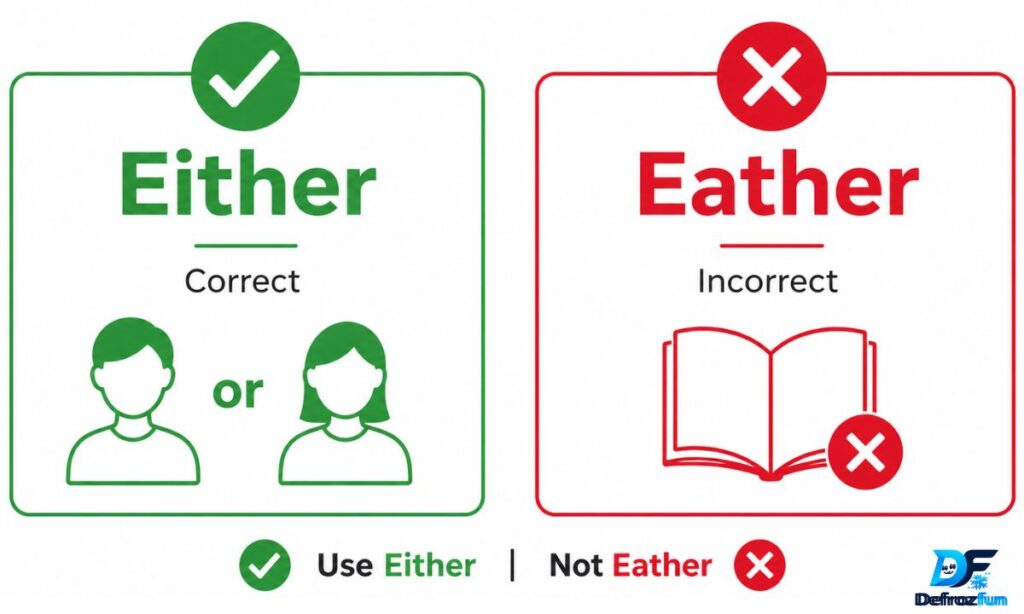
“Either” is the correct spelling. “Eather” is a misspelling and does not exist in standard English. There is no regional variation, no alternate dialect, and no exception. Whether you’re writing a formal email, a school essay, or a blog post — always use either.
Either Meaning
The word either serves multiple grammatical roles in English. Here’s what it means in each context:
- As a determiner: Refers to one of two options. “You can use either hand.”
- As a pronoun: Stands in place of one of two things. “Either will work.”
- As a conjunction (with “or”): Presents two choices. “Either you call me or I’ll call you.”
- As an adverb: Used after a negative statement to mean “also.” “I don’t like it either.”
In all uses, either refers to a choice or relationship between exactly two things — not three or more.
Either or Eather Grammar
People often ask: is it eather or either in a sentence? The answer is always either.
“Eather” has no grammatical function in English. It doesn’t appear in any recognized dictionary — not Merriam-Webster, Oxford, Collins, or Cambridge. It’s simply a phonetic spelling mistake, often made by:
- Non-native English speakers writing what they hear
- Autocorrect errors or fast typing
- Confusion with similar-sounding words
Correct grammar patterns with either:
| Pattern | Example |
| Either + noun | Either option is fine. |
| Either…or… | Either stay or leave. |
| Not…either | I don’t want to go either. |
| Either of + plural noun | Either of the candidates could win. |
Important grammar note: When using either…or…, the verb agrees with the noun closest to it.
- Either the manager or the employees are responsible. ✅
- Either the employees or the manager is responsible. ✅
Ether or Either Pronunciation
Many people confuse either with ether — these are two completely different words.
- Either = a conjunction/determiner meaning “one or the other”
- Ether = a chemical compound or a literary term for the upper atmosphere
Now, for pronunciation, either actually has two widely accepted forms:
| Pronunciation | Sounds Like | Common In |
| EE-ther | “ee” as in “see” | American English (most common) |
| EYE-ther | “eye” as in “my” | British English (predominant) |
Both are 100% correct. The Cambridge Dictionary lists both. The eye-ther pronunciation became dominant in British English during the 19th century, while ee-ther remained the standard in American English. Neither accent is wrong — it comes down to where you’re from.
The Origin of Either
Understanding where “either” comes from explains why it’s spelled the way it is.
The word traces back to Old English ǣgther, a contraction of ǣghwæther, meaning “each of two” or “both.” As the language evolved through Middle English, the spelling passed through forms like eyther and eyþer before settling into the modern either.
The word “eather” never existed at any stage of the English language. It’s a modern error — nothing more.
British English vs American English Spelling
One important point of clarity: either is spelled the same in both British and American English.
Unlike words such as colour/color or organise/organize, the spelling of either has never varied between the two dialects. The only difference is in how it’s said out loud (see the pronunciation table above).
| Feature | British English | American English |
| Spelling | either | either |
| Pronunciation | EYE-ther (dominant) | EE-ther (dominant) |
| Grammar rules | Same | Same |
| Accepted variant | EE-ther (also used) | EYE-ther (also used) |
Which Spelling Should You Use?
Simple: always use “either.”
It doesn’t matter if you’re writing in British, American, Australian, or Canadian English. The correct spelling is the same everywhere. If you’re ever unsure while writing, try this quick test:
Replace “either” with “one of the two.” If the sentence still makes sense, you’re using it correctly — and the spelling is either, not eather.
For example:
- “Either option works.” → “One of the two options works.” ✅ Correct word, correct spelling.
Common Mistakes with Either
Even confident writers make errors with “either.” Here are the most common ones to avoid:
1. Writing “eather” instead of “either” This is pure misspelling. There’s no valid use of “eather” in English.
2. Using either for more than two options
- ❌ You can choose either red, blue, or green.
- ✅ You can choose any of red, blue, or green. Either only works with two options.
3. Confusing either with neither
- Either = one or the other (positive context)
- Neither = not one, not the other (negative context)
- ❌ Neither of them is coming, and I am either.
- ✅ Neither of them is coming, and I’m not either.
4. Confusing either with whether
- Use either…or when presenting choices.
- Use whether…or when expressing uncertainty or indirect questions.
- ✅ I don’t know whether she’ll come or not.
5. Subject-verb agreement errors in either…or constructions Always match the verb to the noun closest to it.
Also Read This: Seperate or Separate: Which Spelling Is Correct in English?
Either in Everyday Examples
Here are natural, real-world sentences that show either in action:
- You can either call me or send a message.
- Either the doctor or the nurses will update you soon.
- I’ve visited neither Paris nor Rome, but either would be a great trip.
- She doesn’t drink coffee, and I don’t either.
- Either answer is acceptable on the exam.
- You can sit on either side of the table.
- Either we leave now or we miss the train.
- He hadn’t watched either of the recommended films.
Either or Eather – Google Trends & Usage Data
Search data reveals something very telling. The query “either or eather” is consistently searched in regions where English is a second language — particularly across South Asia, Southeast Asia, and parts of Africa. This reflects genuine confusion stemming from pronunciation-based spelling attempts.
In Google Books Ngram data:
- “either” appears millions of times across centuries of published text
- “eather” as a standalone English word has near-zero recorded usage in any era
Search intent analysis shows that most users searching this topic are looking for spelling confirmation — they already suspect eather is wrong and want to verify either is correct. The data confirms it every time.
Comparison Table
| Feature | Either | Eather |
| Is it a real word? | ✅ Yes | ❌ No |
| Found in dictionaries | ✅ Yes | ❌ No |
| Used in formal writing | ✅ Yes | ❌ No |
| Correct spelling | ✅ Yes | ❌ No |
| Grammatical functions | Determiner, pronoun, conjunction, adverb | None |
| Pronunciation | EE-ther / EYE-ther | N/A |
| British English | ✅ Same spelling | ❌ Not valid |
| American English | ✅ Same spelling | ❌ Not valid |
Conclusion
The either vs eather debate has one clear answer: either is correct, eather is not. There is no version of English — British, American, or otherwise — where eather is an accepted spelling. The word comes from Old English, has been standardized for centuries, and is spelled identically across all dialects.
The only real variation with either is how you say it. Whether you prefer EE-ther or EYE-ther, both are perfectly acceptable. Use either…or for choices between two things, neither…nor for negatives, and whether when expressing uncertainty. Master these three, and your writing instantly becomes cleaner and more professional.

Daniel Brooks is a passionate writer and digital content creator dedicated to sharing insightful, engaging, and informative articles across multiple niches. With a strong interest in technology, lifestyle, trending topics, and online media, Daniel Brooks focuses on delivering well-researched and reader-friendly content that inspires and informs audiences worldwide.