

Have you ever typed “kindergarden” and wondered if it looked wrong? You’re not alone. Millions of people search this exact question every year. The answer is simple — but the reason behind it is actually pretty interesting. Let’s settle this once and for all.
Kindergarten or Kindergarden – Quick Answer
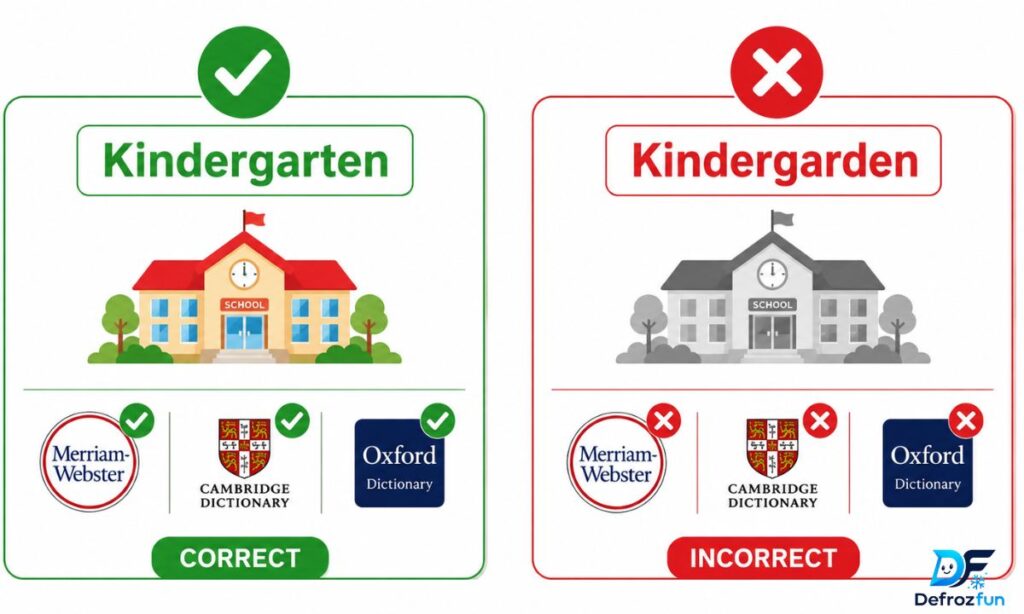
Kindergarten is the only correct spelling. “Kindergarden” is a misspelling and does not appear in any major dictionary — not Merriam-Webster, not Cambridge, not Oxford. There is no version of English, American or British, where “kindergarden” is accepted.
✅ Correct: Kindergarten
❌ Incorrect: Kindergarden
The Origin of Kindergarten
The word “kindergarten” comes directly from the German language. It is made up of two German words:
- Kinder = children
- Garten = garden
Together, they mean “children’s garden” — a place where young minds are nurtured and allowed to grow, much like plants in a garden.
The term was coined in 1840 by Friedrich Fröbel, a German educator who founded the first play-based learning institution for young children in Bad Blankenburg, Germany, in 1837. He originally called it the “Play and Activity Institute” before renaming it Kindergarten to reflect his philosophy: children, like plants, thrive when given a nurturing environment to grow freely.
Fröbel believed that early childhood education should center around free self-expression, creativity, play, and social participation — a vision that still shapes modern early childhood education today.
The concept traveled to the United States in 1856, when Margarethe Meyer Schurz, a German immigrant and student of Fröbel’s methods, opened the first American kindergarten in Watertown, Wisconsin. The first public kindergarten in the US opened in St. Louis in 1873.
British English vs American English Spelling
One reason people question the spelling is that many English words differ between British and American English — like “colour” vs “color,” or “theatre” vs “theater.” So it’s natural to wonder whether “kindergarden” might be a valid British or Australian spelling.
It is not.
| Region | Correct Spelling | Notes |
| American English | Kindergarten | Standard in all US schools and documents |
| British English | Kindergarten | Same spelling; often called “nursery school” in the UK |
| Australian English | Kindergarten | No regional variant exists |
| Canadian English | Kindergarten | Identical spelling across all varieties |
| German (origin) | Kindergarten | The original source word |
Kindergarten is one of the rare loanwords that has kept its original German spelling in every variety of English. Unlike many borrowed words that get anglicized over time, “kindergarten” has never been altered.
Which Spelling Should You Use?
Always use kindergarten — in every context, without exception:
- School enrollment forms
- Parenting blogs and articles
- Professional teaching documents
- Social media posts
- Academic writing
- Email communications
If you are writing for a school website, a government document, or any formal setting, using “kindergarden” will undermine your credibility. Spell-checkers will flag it as an error.
Simple rule to remember:
Kinder (children) + Garten (garden) = Kindergarten
Since “garten” is the German word for “garden,” the spelling stays as “garten” — not “garden.” The English word “garden” looks similar but is not the origin. That’s exactly where the confusion comes from.
Common Mistakes with Kindergarten
Here are the most frequent errors people make with this word:
1. Misspelling as “Kindergarden”
The most common mistake. People hear “garden” in the pronunciation and assume that’s how it is spelled. But because the word retains its German roots, the ending is always “-garten.”
2. Pronunciation Confusion
The word is officially pronounced: /ˈkɪn-dər-ˌgɑːr-tən/
Many people say it as “kin-der-gar-den” — with a “d” sound at the end instead of a “t.” This pronunciation confusion is the root cause of the spelling mistake.
3. Incorrect Plurals and Derivatives
| Word | Correct | Incorrect |
| Plural | Kindergartens | Kindergardens |
| Student (formal) | Kindergartener or Kindergartner | Kindergardener |
| Teacher | Kindergarten teacher | Kindergarden teacher |
| Program | Kindergarten program | Kindergarden program |
Note: Both “kindergartener” and “kindergartner” are accepted spellings for a child who attends kindergarten. The shorter form “kindergartner” follows the German noun, while “kindergartener” follows standard English word formation.
4. Capitalizing When Not Needed
“Kindergarten” is not capitalized unless it begins a sentence or is part of a proper name (e.g., “Maple Street Kindergarten”). In general usage, it is a common noun and stays lowercase.
Kindergarten in Everyday Examples
Seeing the word used correctly in sentences helps reinforce the right spelling. Here are some natural examples:
- She starts kindergarten this September and is very excited.
- The kindergarten curriculum focuses on literacy, numeracy, and social skills.
- He works as a kindergarten teacher at a local public school.
- My daughter’s kindergarten classroom has a reading corner and an art station.
- Early research shows that quality kindergarten education has long-term academic benefits.
- The school offers both full-day and half-day kindergarten programs.
Notice that “kindergarten” is used lowercase in all everyday sentences above. It only gets capitalized when it is the first word in a sentence or part of a specific school name.
Kindergarten – Google Trends & Usage Data
Search data confirms how widespread this confusion is. The term “kindergarden” receives substantial monthly searches globally, which shows that millions of writers and parents make this mistake regularly.
| Search Term | Status | Search Volume (Est.) |
| kindergarten | ✅ Correct spelling | Very High |
| kindergarden | ❌ Misspelling | High (common error query) |
| how to spell kindergarten | — | Moderate |
| kindergarten or kindergarden | — | Moderate |
| kindergarten meaning | — | Moderate |
| kindergarten age | — | High |
| kindergarten teacher | — | High |
| pre-kindergarten | — | Moderate |
The fact that “kindergarden” gets searched so frequently is itself proof of how common the confusion is — and why articles like this one consistently rank on Google.
Comparison Table – Keyword Variations
| Term | Correct? | Notes |
| Kindergarten | ✅ Yes | Always correct |
| Kindergarden | ❌ No | Common misspelling |
| Kindergartener | ✅ Yes | Refers to a child in kindergarten |
| Kindergartner | ✅ Yes | Shorter accepted variant |
| Kindergardener | ❌ No | Incorrect derivative |
| Pre-kindergarten / Pre-K | ✅ Yes | Year before kindergarten in the US |
| Kindergartens (plural) | ✅ Yes | Correct plural form |
| Kindergardens (plural) | ❌ No | Incorrect plural form |
FAQs
Is “kindergarden” ever correct?
No. “Kindergarden” is always a misspelling. There is no dictionary or regional standard where it is accepted.
Why do people spell it “kindergarden”?
Because the word sounds like it ends in “garden” when spoken aloud, people naturally assume that’s how it is spelled. The actual ending “-garten” comes from German, not English.
Is kindergarten the same in British and American English?
The spelling is identical in both. In the UK, however, the concept is often referred to as “nursery school” or “reception,” while “kindergarten” is the standard term in the US.
What age is kindergarten for?
In the United States, kindergarten is typically for children aged 5 to 6 years old, placed between preschool and first grade.
How do you pronounce kindergarten?
The standard pronunciation is /ˈkɪn-dər-ˌgɑːr-tən/. The “-ten” ending sounds like “tn,” which many speakers soften into a “dn” sound — leading to the “kindergarden” misspelling.
What does kindergarten mean in English?
It translates from German as “children’s garden” — a space where children grow and develop through guided play and learning.
Who invented kindergarten?
Friedrich Fröbel, a German educator, coined the word and founded the first kindergarten in Germany in 1837, officially naming it “Kindergarten” in 1840.
Is “pre-kindergarten” one word or hyphenated?
Both “pre-kindergarten” and “pre-K” are accepted. The hyphenated form is the most commonly used in formal and educational writing.
Conclusion
The difference between “kindergarten” and “kindergarden” comes down to a single letter — but that letter matters. Kindergarten is always correct. Kindergarden is always wrong.
The reason so many people misspell it is simple: the word sounds like it ends in “garden,” but because it was borrowed directly from German without any change, the spelling retains the original German “garten.” There is no British vs American English divide here, no regional exception, no informal alternative. One spelling, one rule.
Whenever you write about early childhood education, school enrollment, teaching, or child development, use kindergarten — confidently and consistently.
Kinder + Garten = Kindergarten. That’s all you need to remember.

Daniel Brooks is a passionate writer and digital content creator dedicated to sharing insightful, engaging, and informative articles across multiple niches. With a strong interest in technology, lifestyle, trending topics, and online media, Daniel Brooks focuses on delivering well-researched and reader-friendly content that inspires and informs audiences worldwide.