

If you have ever typed the word and paused — wondering whether it ends in -os or -oes — you are not alone. The debate over tornados or tornadoes trips up students, writers, and even journalists every day. The good news? Both spellings exist in real dictionaries, but one is clearly preferred. This article breaks down the grammar, the history, and the practical rules so you never second-guess yourself again.
Tornados or Tornadoes – Quick Answer
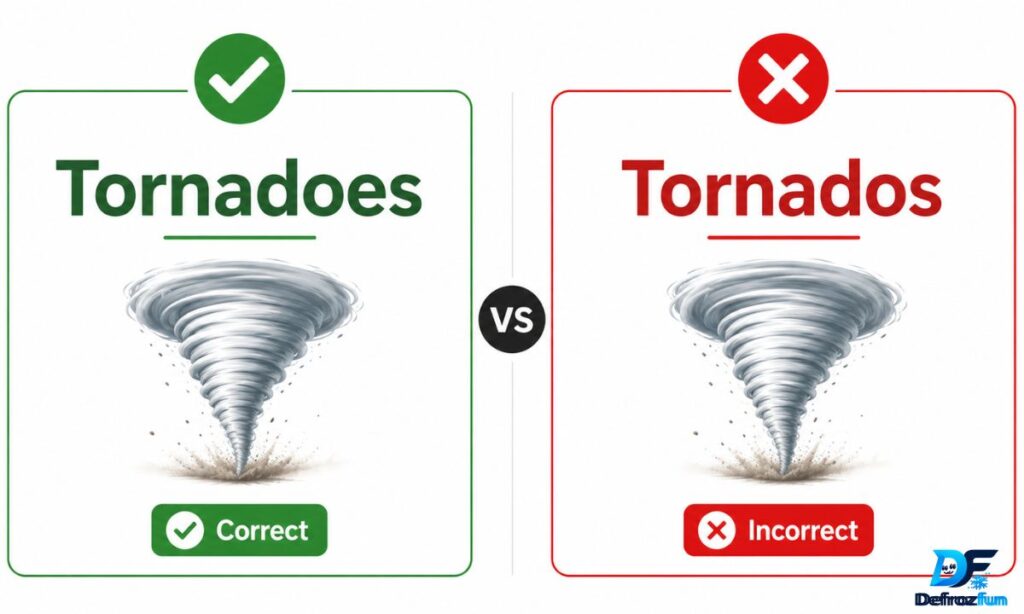
Both are correct, but they are not equally common.
| Form | Status | Preferred In |
| Tornadoes | Standard plural | American English, formal writing, AP Style, National Weather Service |
| Tornados | Accepted variant | Casual writing, British/Commonwealth English |
Bottom line: Use tornadoes in any formal, academic, or professional context. Use tornados only in casual writing or when following a style guide that accepts it.
The Origin of Tornados or Tornadoes
The word tornado did not start in English. It entered the language from Spanish, where tornar means “to turn” or “to twist” — a fitting root for a spinning windstorm.
Here is a brief timeline of how the word evolved:
- 16th–17th century – The term appeared in English texts describing violent Atlantic storms. Early writers borrowed it from Spanish sailors.
- 18th–19th century – The word became fixed in English weather vocabulary. Writers began debating the plural: should Spanish rules apply, or English ones?
- 20th century – As meteorology grew into a formal science, tornadoes became dominant in weather reports, textbooks, and government documents.
- Today – Merriam-Webster lists the plural as “tornadoes or tornados” — with tornadoes listed first, signaling it is the primary form.
The root of the confusion is straightforward: Spanish pluralizes tornado as tornados, but English grammar often adds -es to nouns ending in -o, especially those with Latin or Spanish origins.
Also Read This: Either vs Eather: Which Is Correct? Meaning, Difference & Usage Explained (2026)
British English vs American English Spelling
English spelling rules are not universal, and this word is a clear example of regional variation.
American English
American English strongly favors tornadoes. Every major U.S. institution uses it consistently:
- The National Weather Service uses tornadoes in all official alerts and reports.
- The AP Stylebook — the standard for American journalism — lists tornadoes as the correct plural.
- Major publications like The New York Times, USA Today, and The Washington Post consistently use tornadoes.
British and Commonwealth English
In British English, both forms are acceptable. Neither tornadoes nor tornados is considered an error in UK, Australian, or Canadian writing. Writers in these regions often follow the same logic used for similar words:
| Singular | American English Plural | British English Plural |
| tornado | tornadoes | tornadoes / tornados |
| volcano | volcanoes | volcanoes / volcanos |
| mango | mangoes | mangoes / mangos |
| echo | echoes | echoes |
| hero | heroes | heroes |
Notice that echo and hero take only -oes — they have no -os variant. Tornado, volcano, and mango are more flexible because they come from foreign languages and have a longer history of spelling variation.
Which Spelling Should You Use?
The answer depends on your audience and purpose. Here is a simple guide:
| Writing Context | Recommended Spelling |
| Academic papers and research | Tornadoes |
| News articles and journalism | Tornadoes (AP Style) |
| Formal business or government writing | Tornadoes |
| SEO content targeting a global audience | Tornadoes |
| Casual blog posts or social media | Either is fine |
| British or Commonwealth writing | Either is acceptable |
A Helpful Memory Trick
The Enhanced Fujita Scale — used to measure tornado intensity — contains the letter E. So does tornadoes. If you remember the EF Scale, you will remember to include the e in the plural form.
Common Mistakes with Tornados or Tornadoes
Even careful writers make these errors. Watch out for all of them:
❌ Adding an extra -s to the wrong form
- Wrong: Tornadoess caused damage across three counties.
- Right: Tornadoes caused damage across three counties.
❌ Writing “tornadoe” as a singular
The singular is always tornado — no e on the end.
- Wrong: A tornadoe hit the town last night.
- Right: A tornado hit the town last night.
❌ Mixing spellings in the same document
Pick one form and stay consistent throughout your article, report, or essay.
- Inconsistent: The tornadoes in Oklahoma were severe. Multiple tornados were also reported in Texas.
- Consistent: The tornadoes in Oklahoma were severe. Multiple tornadoes were also reported in Texas.
❌ Assuming “tornados” is wrong
Tornados is a real, dictionary-recognized plural. It is not a typo or a misspelling — it is simply the less common variant.
Tornados or Tornadoes in Everyday Examples
Seeing both forms used correctly in context helps the rule stick. Here are natural examples:
Using tornadoes:
- Tornadoes ripped through the southern United States yesterday, leaving thousands without power.
- Meteorologists tracked three separate tornadoes on radar before issuing a warning.
- The region experiences more tornadoes in spring than at any other time of year.
- Scientists studying tornadoes use Doppler radar to measure wind speed and rotation.
Using tornados:
- Several tornados were reported across the Midwest overnight.
- Animals are said to grow restless before tornados arrive.
- The documentary covered tornados in Tornado Alley and their impact on local communities.
Both sets of sentences are grammatically correct. The first set follows the standard preferred by American media and official institutions; the second uses the accepted variant.
Tornados or Tornadoes – Google Trends & Usage Data
Search data and corpus analysis both confirm that tornadoes is the dominant spelling worldwide.
Google Search Volume (Approximate Global Data)
| Keyword | Relative Search Volume | Primary Regions |
| tornadoes | Very High | USA, Canada, UK, Australia, India |
| tornados | Moderate | USA (informal), some Commonwealth regions |
| tornado plural | Low | Learners, grammar searches |
Corpus Frequency
According to data from large English-language corpora:
- Tornadoes appears roughly 4–5 times more frequently than tornados in published texts.
- In American English specifically, the gap is even larger — tornadoes dominates news, academic, and government sources by a wide margin.
- Tornados is more common in informal American writing, such as community blogs and social media posts.
Key Takeaway
If you are writing content for search visibility, always use tornadoes. It carries significantly higher search volume, aligns with what authoritative sources use, and will reach a broader audience.
Conclusion
The question of tornados or tornadoes has a clear answer for most writing situations: use tornadoes. It is the form recognized first by Merriam-Webster and Oxford, required by the AP Stylebook, used by the National Weather Service, and searched more often by readers around the world.
That said, tornados is not a mistake. It is a legitimate, dictionary-approved plural with a logical grammatical basis. If you are writing casually or in a regional context that accepts it, feel free to use it — just stay consistent within your document.
When in doubt, choose tornadoes. It is the safer, more universally understood choice in 2026 and beyond.

Daniel Brooks is a passionate writer and digital content creator dedicated to sharing insightful, engaging, and informative articles across multiple niches. With a strong interest in technology, lifestyle, trending topics, and online media, Daniel Brooks focuses on delivering well-researched and reader-friendly content that inspires and informs audiences worldwide.