

Typing fast often turns “wearing” into “waring,” and spell-check doesn’t always catch it because waring still looks like a real word. This guide settles the confusion in one place — the correct spelling, the meaning, the origin, and the exact situations where each word belongs.
✅ Quick Answer
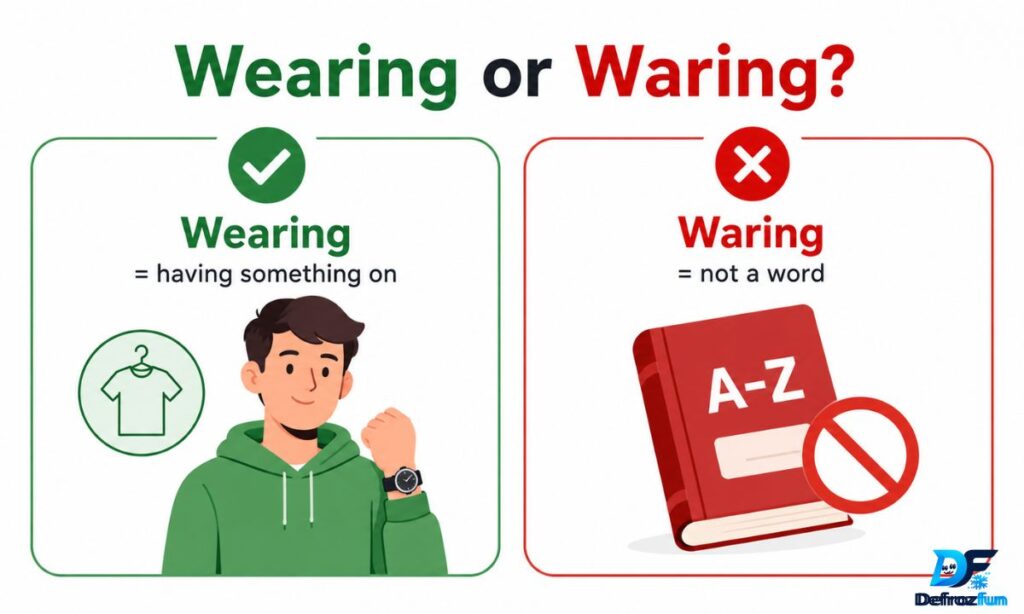
Wearing is the correct word for clothes, accessories, or anything gradually getting damaged. Waring is not a standard English word — it’s almost always a misspelling, except when it appears as a surname (like the Waring blender brand) or as a rare poetic form of “warring” (fighting).
| Word | Status | Use For |
| Wearing | ✅ Correct | Clothes, accessories, gradual damage |
| Waring | ❌ Usually wrong | Proper names only |
| Warring | ✅ Correct (different word) | Conflict, fighting, war |
Wearing Meaning
Wearing is the present participle and gerund form of the verb wear. It has three core meanings:
- Having something on your body — clothing, jewelry, shoes, or accessories. Example: She is wearing a blue dress.
- Gradual damage or erosion — something getting thinner, weaker, or worn out over time. Example: The carpet is wearing thin near the door.
- Tiring or draining someone — used figuratively for stress or fatigue. Example: The long shift was wearing on him.
Wearing also works as an adjective, as in “a wearing day” — meaning an exhausting one.
Wearing or Waring Synonym
Since waring isn’t a true word, it doesn’t carry its own synonyms. But wearing has several, depending on which meaning you intend:
For clothing:
- Donning
- Sporting
- Dressed in
- Clad in
- Draped in
For gradual damage:
- Eroding
- Deteriorating
- Fraying
- Thinning
- Breaking down
For tiring someone out:
- Exhausting
- Draining
- Fatiguing
- Taxing
Choosing the right synonym depends entirely on context, just like choosing wearing over waring in the first place.
What Is the Difference Between Wearing / Waring?
The core difference isn’t really about meaning — it’s about correctness. Wearing is a standard, dictionary-listed English word. Waring is not, in almost every case it appears.
| Feature | Wearing | Waring |
| Dictionary status | Valid word | Not a standard word |
| Root word | Wear | War (rare) |
| Common usage | Very high | Almost none |
| Typical context | Clothes, damage, fatigue | Proper nouns, brand names |
| Correct in formal writing | Yes | No (unless a name) |
Where confusion happens: people sometimes mean warring (two armies warring against each other) but drop a letter and write waring. Others simply mistype wearing as waring because the words sound almost identical when spoken quickly.
The Origin of Wearing
Wearing traces back to the Old English verb werian, meaning “to carry, to defend, or to have on the body.” This root evolved through Middle English into the modern verb wear, with “wearing” forming naturally as its -ing participle.
The secondary meaning — gradual damage — developed later, as people began using the same word to describe surfaces, fabrics, or materials slowly breaking down through friction or time, such as “wear and tear.”
Waring, on the other hand, has no independent linguistic root tied to clothing. When it does appear correctly, it usually comes from the surname Waring or from a poetic shortening of “warring.”
Also Read This: Prefer vs Perfer: Which Spelling Is Correct? Meaning, Usage & Examples (2026)
British English vs American English Spelling
There is no spelling difference between British and American English here. Both varieties of English spell the word the same way: wearing.
| Region | Correct Spelling | Notes |
| British English | Wearing | No regional variant |
| American English | Wearing | No regional variant |
| Australian/Canadian English | Wearing | No regional variant |
This is purely a spelling-accuracy issue, not a regional preference like “colour” vs “color.” No major English-speaking country accepts “waring” as a standard alternative spelling of “wearing.”
Which Spelling Should You Use?
In virtually every sentence about clothing, accessories, or gradual damage, use wearing. There is no situation in standard writing — blogs, emails, essays, product descriptions — where “waring” replaces it correctly.
Quick checklist:
- ✅ Talking about clothes, shoes, or accessories → wearing
- ✅ Describing something getting old, thin, or damaged → wearing
- ✅ Describing fatigue or stress → wearing
- ❌ Never use “waring” unless referencing a surname or brand name
- ❌ Don’t confuse it with “warring” (conflict) either
If you’re ever unsure, read the sentence aloud. If it involves something being worn, the answer is wearing — every time.
Pronunciation of Wearing or Waring
Here’s where the real confusion starts — wearing and waring often sound almost identical in casual speech, even though only one is a real word.
| Word | Pronunciation | IPA (approx.) |
| Wearing | wair-ing | /ˈwɛərɪŋ/ |
| Waring | wair-ing (same sound, wrong spelling) | /ˈwɛərɪŋ/ |
| Warring | wor-ing | /ˈwɔːrɪŋ/ |
Because wearing and waring sound nearly the same when spoken, the mistake usually shows up in writing, not speech. Warring, meaning “fighting,” is pronounced differently and shouldn’t be mixed up with either.
Common Mistakes with Wearing or Waring
These are the recurring errors people make with this word pair:
- Dropping the “e” — typing “waring” instead of “wearing” out of speed or autocorrect failure.
- Confusing wearing with bearing — “I’m wearing a heavy load” should be “I’m bearing a heavy load.”
- Mixing wearing with warring — using “wearing factions” instead of “warring factions” when discussing conflict.
- Assuming waring is a casual or texting variant — it isn’t recognized in any standard dictionary.
- Skipping proofreading — relying entirely on spell-check, which sometimes accepts “waring” as a name rather than flagging it.
A simple proofreading habit — reading sentences slowly or using a grammar checker — catches almost all of these.
Wearing or Waring – Google Trends & Usage Data
Search and usage data consistently show the same pattern: “wearing” dominates everyday English, while “waring” appears mostly in searches from people checking if it’s a real word or looking up the Waring brand (kitchen blenders).
| Term | Search Volume Pattern | Primary Searcher Intent |
| Wearing | High, steady | Grammar, clothing context, idioms |
| Waring | Low, sporadic | Spelling confusion, brand lookup |
| Wearing thin | Moderate | Idiom meaning |
| Wearing vs warring | Low-moderate | Grammar clarification |
This usage gap confirms what dictionaries already show: wearing is the standard, high-frequency word, while waring survives mainly as a name or an honest typo.
Wearing or Waring Grammar Rules
Understanding the grammar behind “wearing” makes the correct usage automatic.
- Wearing is the present participle of “wear,” used in continuous tenses: I am wearing, she was wearing, they have been wearing.
- It also functions as a gerund: Wearing sunscreen is important.
- It can act as an adjective: a wearing schedule.
- Waring has no grammatical role in standard English since it isn’t a recognized verb form.
- Warring is the present participle of “war” and follows the same -ing rule, but it’s a completely separate verb with a different meaning.
| Grammar Role | Wearing | Warring |
| Present participle | ✅ (of “wear”) | ✅ (of “war”) |
| Gerund | ✅ | Rare |
| Adjective | ✅ | ✅ |
| Standard verb base | Wear | War |
Wearing or Waring in Everyday Examples
Here’s how “wearing” naturally fits into daily sentences across different contexts:
- She is wearing a yellow raincoat to the office today.
- He’s been wearing the same running shoes for three years.
- My patience is wearing thin after that long meeting.
- The constant noise was wearing on everyone’s nerves.
- Are you wearing sunscreen before you head outside?
- The fabric started wearing out after just one wash.
None of these sentences would be correct with “waring” in place of “wearing” — the substitution would simply read as a typo to any native speaker.
Wearing Thin – Special Idiom
“Wearing thin” is a common idiom with two related meanings:
- Literal: A material, like fabric or carpet, becoming thin from repeated use. The elbows of his jacket are wearing thin.
- Figurative: Patience, tolerance, or an excuse losing its effect over time. Her excuses are wearing thin with the team.
This idiom always uses “wearing,” never “waring.” It’s one of the most searched phrases related to this word pair, since people often want to confirm the correct spelling before using it in writing.
Comparison Table
| Aspect | Wearing | Waring | Warring |
| Correct word? | Yes | No (usually) | Yes |
| Meaning | Having on body / gradual damage / fatigue | Not standard; surname/brand | Fighting, conflict |
| Pronunciation | wair-ing | wair-ing | wor-ing |
| Common in writing | Very common | Rare | Moderate (formal/news) |
| Example | She is wearing a coat. | Waring blender | Warring nations |
Conclusion
The confusion between wearing and waring comes down to one missing letter, but the impact on clarity is real — waring isn’t a recognized English word outside of names and brands. Whenever you’re describing clothes, accessories, fatigue, or gradual damage, wearing is the spelling to use, in both British and American English. Keep this guide handy, and that one-letter typo won’t slip into your writing again.

Daniel Brooks is a passionate writer and digital content creator dedicated to sharing insightful, engaging, and informative articles across multiple niches. With a strong interest in technology, lifestyle, trending topics, and online media, Daniel Brooks focuses on delivering well-researched and reader-friendly content that inspires and informs audiences worldwide.