

Confused about whether to write “trys” or “tries”? You are not alone. This is one of the most common spelling mix-ups in English, and it trips up students, professionals, and even native speakers.
The short answer is that “tries” is always correct, and “trys” is never a standard English word. This guide breaks down the meaning, the grammar rule, real examples, rugby usage, and the small details that make this word easy to get wrong.
Trys vs Tries – Quick Answer
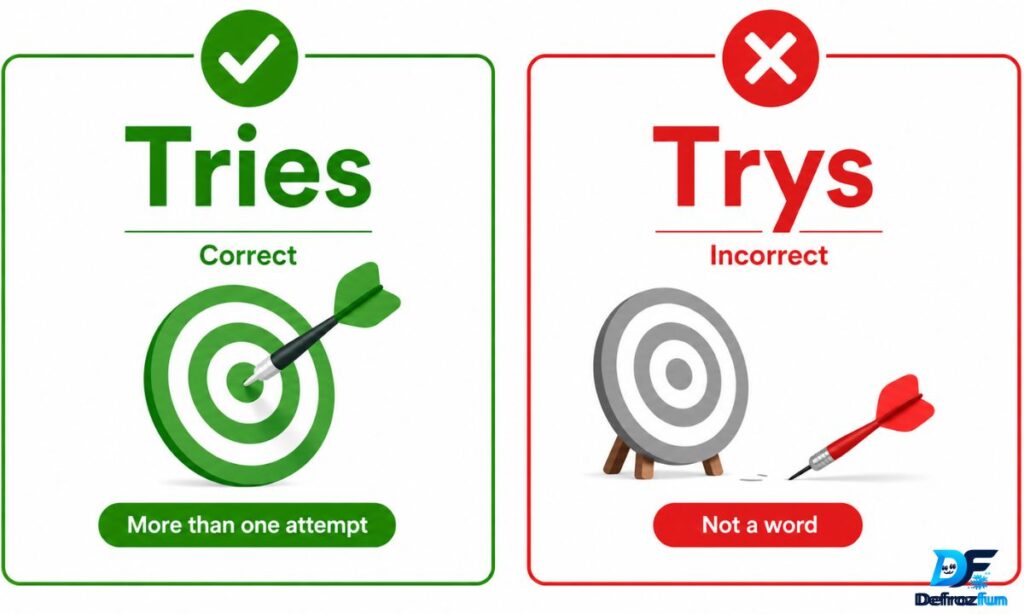
| Question | Answer |
| Correct spelling | Tries |
| Is “trys” correct? | No, it is a common misspelling |
| Part of speech | Verb (third person singular) and noun (plural) |
| Base word | Try |
| Pronunciation | /traɪz/ |
| UK vs US difference | None, both use “tries” |
If you remember nothing else from this article, remember this: tries is right, trys is wrong, in every form of English.
What Does “Tries” Mean?
“Tries” means to make an attempt or effort to do something. It comes from the verb “try” and is used when the subject is he, she, it, or a singular noun in the present tense.
As a noun, “tries” refers to multiple attempts, such as in a quiz, a game, or a sport like rugby, where it also describes a method of scoring points.
How to Spell “Tries” Correctly
The spelling follows a simple pattern. When a verb ends in a consonant followed by “y,” the “y” changes to “i” and “es” is added. Since “try” ends in r plus y, it becomes tries, not trys.
This rule applies consistently across English, so there is no exception that allows “trys” to be correct.
How to Use “Tries” in a Sentence
“Tries” works as both a verb and a noun depending on the sentence.
As a verb:
- She tries to wake up early every morning.
- He tries his best in every match.
- The dog tries to catch the ball.
As a noun (plural of attempt):
- After three tries, she finally passed the exam.
- The team scored two tries in the second half.
Is “Trys” a Real Word?
No. “Trys” is not a recognized word in any standard dictionary, British or American. It is a common misspelling that happens because people forget the consonant plus y spelling rule. Spell checkers and search engines almost always correct “trys” to “tries.”
Try vs Tries: What’s the Difference?
“Try” and “tries” are forms of the same verb, used with different subjects.
| Subject | Correct Form | Example |
| I / you / we / they | Try | They try to finish on time. |
| He / she / it | Tries | He tries to finish on time. |
| Plural noun (attempts) | Tries | Three tries were not enough. |
The simple rule is this: use “try” with I, you, we, and they, and use “tries” with he, she, it, or any singular noun.
When to Use “Tries”
Use “tries” in these situations:
- When the subject is third person singular (he, she, it, or a singular name)
- When describing repeated or multiple attempts as a plural noun
- When talking about rugby or similar sports scoring
Examples:
- Maria tries new recipes every weekend.
- The machine tries to restart automatically.
- He has had four tries at the driving test.
How to Pronounce “Tries”
“Tries” is pronounced /traɪz/, rhyming with “size” and “prize.” The “s” at the end sounds like a “z,” not a soft “s.” This is the same pronunciation used in both UK and US English.
Also Read This: Prefer vs Perfer: Which Spelling Is Correct? Meaning, Usage & Examples (2026)
Trys or Tries in Rugby
In rugby, the correct spelling is still tries. A try is scored when a player grounds the ball in the opposing team’s in-goal area, and the plural of this scoring method is tries, never trys.
Examples:
- He scored two tries in the first half.
- Their three tries secured the win.
This applies across all rugby governing bodies, including World Rugby and national unions. Rugby commentary and official records always use “tries,” so “trys” is incorrect even in this sports context.
He Trys or Tries: Which Is Right?
“He tries” is correct. “He trys” is a spelling mistake. Since “he” is a third person singular subject, the verb must follow the consonant plus y rule and become “tries.”
Correct: He tries to study every night. Incorrect: He trys to study every night.
3 Tries or Trys: Counting Attempts
When counting attempts, always use tries. “3 trys” is incorrect in every context, whether you are talking about an exam, a video game, or a sports match.
Correct: She had 3 tries to get the answer right. Incorrect: She had 3 trys to get the answer right.
Trys or Tries Grammar Rule (Explained Simply)
The rule behind this spelling comes from a standard English pattern for verbs ending in a consonant plus “y.”
- Identify if the verb ends in a consonant followed by y. Try ends in r plus y.
- Drop the y and add ies. Try becomes tries.
- This same pattern applies to other verbs, such as cry to cries, fly to flies, and carry to carries.
If a verb ends in a vowel plus y, like play, the rule does not apply, and you simply add s, as in plays. This distinction is why some learners get confused, but try always follows the consonant plus y pattern.
Common Mistakes with Trys or Tries
Here are the most frequent errors writers make with this word:
- Writing “he trys” instead of “he tries”
- Writing “3 trys” instead of “3 tries”
- Assuming “trys” is acceptable in rugby because it sounds like a sports term
- Confusing the rule for verbs ending in vowel plus y, like play or stay
- Mixing up tries with tried, which is the past tense form
Remembering one sentence helps avoid all of these mistakes: tries is always correct, trys is always wrong.
Trys or Tries Practice Exercises
Choose the correct word for each sentence.
- She _______ to be on time every day.
- The player scored three _______ in the match.
- He _______ different methods to solve the problem.
- After five _______, they finally cracked the code.
- My teacher _______ to make every lesson interesting.
Answers: 1. tries, 2. tries, 3. tries, 4. tries, 5. tries
Trys or Tries – Google Trends & Usage Data
Search data consistently shows that people type “trys” when they are unsure of the spelling, but the actual correct usage in published writing is “tries” by a wide margin. Major style guides, dictionaries, and grammar checkers list only “tries” as valid. Search engines also auto-correct “trys” to “tries,” confirming that the misspelling has no accepted standing in formal or informal writing.
Conclusion
The rule for trys vs tries is simple once you see the pattern. “Tries” is the only correct spelling, whether you are describing a third person singular action, counting attempts, or talking about rugby scores. “Trys” is a common typo, not an accepted word, in any English-speaking country. Keep the consonant plus y rule in mind, and you will never second-guess this spelling again.

Daniel Brooks is a passionate writer and digital content creator dedicated to sharing insightful, engaging, and informative articles across multiple niches. With a strong interest in technology, lifestyle, trending topics, and online media, Daniel Brooks focuses on delivering well-researched and reader-friendly content that inspires and informs audiences worldwide.