
If you’ve ever paused mid-sentence wondering whether to write “nosy” or “nosey,” you’re not alone. This is one of the most searched spelling questions in English, and the honest answer is that both spellings exist — but only one is considered standard in most modern writing.
This guide breaks down the grammar rules, regional differences, and real usage patterns so you never have to second-guess yourself again.
Quick Answer
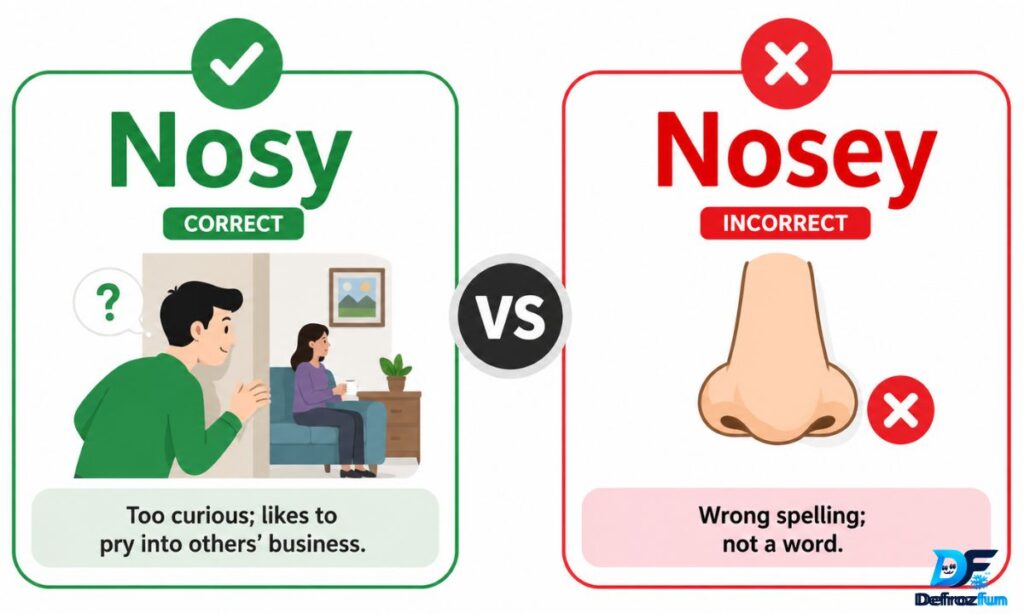
“Nosy” is the correct and preferred spelling in modern English, especially in American English, academic writing, and professional communication. “Nosey” is a recognized variant spelling, more common in British and informal writing, but it is not the standard form taught in style guides.
| Spelling | Status | Common Region | Best Used For |
| Nosy | Standard, preferred | American English (also widely used globally) | Formal writing, business, academic content |
| Nosey | Accepted variant | British English (informal) | Casual writing, conversation, older texts |
Both words mean exactly the same thing: someone who is excessively curious about other people’s private business.
Grammar Rules Explained
English adjectives formed from nouns ending in a silent “e” often drop that “e” before adding a suffix like “-y.” The word comes from “nose,” combined with the “-y” suffix that turns a noun into a descriptive adjective (similar to how “luck” becomes “lucky”).
Following standard spelling conventions:
- Nose + y → the silent “e” is typically dropped → nosy
- Keeping the “e” produces nosey, which isn’t wrong, but it goes against the usual pattern English follows when adding “-y” to a noun.
This is why most dictionaries, editors, and style guides list “nosy” as the primary entry, with “nosey” noted as a secondary or variant spelling.
Key Grammar Point
Both words function identically as adjectives in a sentence — they describe a person’s tendency to pry into others’ affairs. Neither spelling changes the meaning, pronunciation, tense, or grammatical role. The only difference is orthographic (spelling) preference.
Why People Make Mistakes With Nosy or Nosey
This confusion isn’t a sign of poor grammar — it happens for very logical reasons:
- The word sounds identical either way. Since both spellings are pronounced the same, there’s no audio cue to guide the correct written form.
- The root word “nose” keeps its “e.” Writers naturally assume the “e” should carry over into the adjective form.
- Regional exposure varies. Readers who grew up with British books, shows, or websites are more likely to see “nosey” and assume it’s standard.
- Autocorrect and spellcheckers are inconsistent. Some tools flag “nosey,” others don’t, adding to the uncertainty.
- Both spellings appear in dictionaries. Because neither is technically “wrong,” writers often can’t tell which one is expected in formal contexts.
Nosy or Nosey in Real Life Usage
In everyday conversation, both spellings show up, but “nosy” dominates in print, journalism, and digital content. Here’s how it typically plays out:
- Social media captions and comments: mixed usage, slightly leaning “nosy”
- News articles and blogs: overwhelmingly “nosy”
- British novels and older texts: “nosey” appears more frequently
- Business and workplace communication: “nosy” is the expected form
Example Sentences
- My nosy coworker keeps asking about my salary.
- The nosy neighbor watched every car that pulled into the driveway.
- She gave her nosy cousin a vague answer to avoid more questions.
- He felt embarrassed after his nosey aunt asked about his relationship status. (British informal usage)
British and American English Usage
One of the biggest drivers of this spelling debate is regional English variation. Just like “colour” vs. “color” or “favourite” vs. “favorite,” nosy vs. nosey follows a loose regional pattern — though it’s less strict than those examples.
| Feature | American English | British English |
| Preferred spelling | Nosy | Nosy (formal) / Nosey (informal) |
| Style guide preference | AP Style, Chicago Manual of Style favor “nosy” | Oxford and Cambridge list both, favoring “nosy” as primary |
| Everyday casual use | Nosy | Nosey appears more often in speech and informal writing |
| Formal documents | Nosy only | Nosy recommended |
Even in British English, “nosy” is typically the dictionary headword, while “nosey” is listed as an acceptable alternative rather than a fully separate standard.
Which One Should You Use
For nearly every writing situation, use “nosy.” It’s recognized worldwide, appears in every major dictionary, and won’t raise questions from editors, teachers, or professional readers.
Use this simple decision guide:
- Writing for a global or American audience? Use “nosy.”
- Writing academic papers, resumes, or business content? Use “nosy.”
- Writing casual dialogue for a British character or informal blog post? “Nosey” is acceptable but not required.
- Unsure of your audience? Default to “nosy” — it’s never wrong.
Common Mistakes and Corrections
| Incorrect or Inconsistent Usage | Corrected Version |
| “She’s such a nosey person, always nosy about everyone.” | Pick one spelling and stay consistent: “She’s such a nosy person, always curious about everyone.” |
| Using “nosey” in a formal report | Replace with “nosy” for professional tone |
| Switching spellings mid-document | Choose one spelling and use it throughout for consistency |
| Assuming “nosey” is a typo | It’s a valid variant, just less standard — not incorrect, simply less preferred |
The most common real mistake isn’t choosing the “wrong” spelling — it’s inconsistency. Mixing both spellings in the same piece of writing looks careless and unpolished.
Nosy or Nosey in More Sentences
- The nosy reporter kept digging for details no one wanted to share.
- Their nosy landlord always seemed to know their schedule.
- I don’t mean to sound nosy, but is everything okay?
- The kids were nosy about what was inside the wrapped box.
- She rolled her eyes at her nosey neighbor’s endless questions. (informal, British-leaning)
Related Words and Similar Confusions
English has several other word pairs that follow the same “which spelling is right” pattern. Understanding these helps reinforce the rule behind nosy/nosey:
- Grey vs. Gray – regional spelling difference (British vs. American)
- Judgment vs. Judgement – American drops the “e,” British often keeps it
- Likable vs. Likeable – similar silent “e” dropping pattern
- Sizable vs. Sizeable – same suffix rule as nosy/nosey
Recognizing this pattern makes it easier to predict which spelling is likely “standard” in similar tricky words.
Also Read This: Batton vs Baton: Meaning, Difference, Correct Spelling & Examples (2026)
Why Nosy Became More Popular

Language evolves based on usage frequency, and over the last century, “nosy” pulled ahead for a few clear reasons:
- Simplicity wins. Shorter, simpler spellings tend to become dominant over time in English.
- American publishing influence. U.S. media, journalism, and digital content have a massive global reach, and American style guides consistently favor “nosy.”
- Dictionary standardization. Major dictionaries list “nosy” as the primary headword, reinforcing it as the “default” spelling for new writers and non-native speakers.
- Search and SEO reinforcement. As more content online uses “nosy,” search engines and spellcheckers reinforce it as the expected form, accelerating its dominance.
Tone and Context Differences
While the meaning is identical, spelling can subtly influence how a sentence feels:
- “Nosy” reads as slightly more neutral, modern, and universally understood.
- “Nosey” can feel more old-fashioned, regional, or conversational, especially in dialogue meant to sound distinctly British.
Neither carries a different literal meaning, but writers crafting character voice or regional tone sometimes choose “nosey” intentionally for stylistic flavor.
Practice Exercises
Test your understanding with these quick exercises:
- Fill in the blank: My ___ neighbor always watches who comes and goes. (Answer: nosy)
- True or False: “Nosey” is grammatically incorrect. (Answer: False — it’s a valid but less standard variant)
- Which spelling would you use in a business email? (Answer: nosy)
- Rewrite this sentence correctly for consistency: “She’s nosy, but her sister is even more nosey.” (Answer: “She’s nosy, but her sister is even more nosy.”)
Writing Tips to Remember the Correct Spelling
- Think of the pattern: luck → lucky, taste → tasty, nose → nosy (the silent “e” drops).
- If you’re ever unsure, default to “nosy” — it’s accepted everywhere.
- Keep a personal style sheet if you write regularly, noting which spelling you’ve chosen for consistency.
- Run your writing through a grammar checker set to your target region (US or UK English) to catch inconsistencies.
Extra Real Life Examples
- Workplace: “Please don’t be nosy about other people’s salaries during the meeting.”
- Social setting: “He’s nosy, but he means well — he just wants to help.”
- Parenting: “My toddler is so nosy; she wants to know what’s in every bag.”
- Fiction writing: “The nosey old woman next door watched every visitor from behind her curtains.”
Conclusion
Both “nosy” and “nosey” describe the same trait: excessive curiosity about other people’s business. But when it comes to choosing the correct spelling for clear, professional, and widely accepted writing, “nosy” is the safer and more standard choice. Save “nosey” for informal, regional, or stylistic writing where a British flavor fits naturally.
When in doubt, stick with “nosy” — it’s recognized everywhere, follows standard English spelling rules, and keeps your writing polished and consistent.

Daniel Brooks is a passionate writer and digital content creator dedicated to sharing insightful, engaging, and informative articles across multiple niches. With a strong interest in technology, lifestyle, trending topics, and online media, Daniel Brooks focuses on delivering well-researched and reader-friendly content that inspires and informs audiences worldwide.