

Have you ever typed a word and suddenly stopped to wonder — is it steer or stear? You are not alone. Thousands of writers, students, and professionals search this every month. The two spellings look almost identical, but only one is correct in standard English. A single wrong letter can affect your credibility in emails, reports, and online content.
This guide clears up the confusion once and for all. You will learn the correct spelling, the meaning, the word’s origin, how it differs across British and American English, and how to use it confidently in everyday writing.
Steer or Stear – Quick Answer
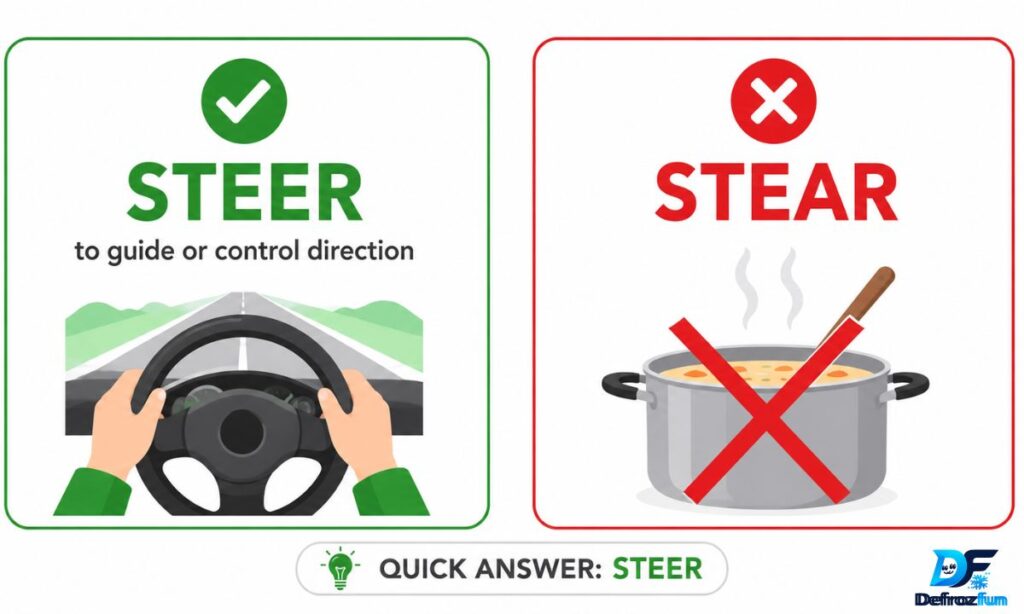
Steer is the correct spelling. Stear is not a standard English word.
If you are writing an email, article, blog post, or essay, always use steer. The word “stear” is a common misspelling caused by pronunciation habits and fast typing. It is not recognized in any major English dictionary as a verb or general noun.
✅ Correct: She tried to steer the conversation in a better direction. ❌ Incorrect: She tried to stear the conversation in a better direction.
Steer
Steer functions as both a verb and a noun in standard English.
- As a verb: To guide, control, or direct the movement of something — a vehicle, a conversation, a project, or a decision.
- As a noun: A young castrated male cow, typically raised for beef in agriculture.
Examples:
- “He had to steer the car carefully around the sharp bend.”
- “The manager tried to steer the team away from unnecessary risks.”
- “The farmer sold three steers at the cattle auction.”
All standard verb forms follow regular conjugation patterns:
| Base Form | Past Tense | Present Participle |
| Steer | Steered | Steering |
Stear
Stear is not a correct general English word. It occasionally appears in scientific and chemical contexts — specifically as a root in terms like stearic acid, a type of saturated fatty acid found in animal fats and used in soaps and candles. Outside of chemistry, “stear” has no accepted definition, no dictionary entry as a standalone word, and should never appear in everyday writing.
If your spell checker does not flag “stear,” that does not mean it is correct. Many autocorrect systems simply mark unknown words without suggesting alternatives.
The Origin of Steer or Stear
Understanding where a word comes from makes its spelling easier to remember.
The word steer traces back to Old English stēoran, which meant “to guide” or “to control.” The root stayed relatively stable through Middle English and into modern usage. Unlike many English words that transformed dramatically over centuries, “steer” maintained its double-E structure.
There was never a historical period in English where “stear” was an accepted spelling of this word. It does not appear in Old English, Middle English, or Early Modern English texts as an alternative form. So if you ever thought, “maybe stear was correct at some point,” the historical record confirms it was not.
The noun meaning — a castrated young bull — also comes from Old English stēor, again preserving the double-E pattern.
British English vs American English Spelling
Many spelling debates exist because British and American English genuinely differ — think colour vs color or organise vs organize. With steer or stear, however, there is no such debate.
Both British English and American English use steer exclusively.
There is no regional variation. Whether you are writing for a UK audience, a US audience, or a global readership, the correct spelling is always steer.
Comparison Table
| Feature | Steer | Stear |
| Correct in British English | ✅ Yes | ❌ No |
| Correct in American English | ✅ Yes | ❌ No |
| Found in standard dictionaries | ✅ Yes | ❌ No |
| Used in formal writing | ✅ Yes | ❌ No |
| Appears in scientific contexts | Rarely | In chemical terms only |
| Recognized by spell checkers | ✅ Yes | ❌ Usually flagged |
Which Spelling Should You Use?
The rule is simple: always use steer when you mean to guide, control, or direct something — or when referring to a male bovine animal.
Use steer when:
- Describing how someone guides a vehicle, boat, or aircraft
- Talking about influencing a conversation or decision
- Referring to a castrated male cow in agriculture
- Writing in any formal, informal, journalistic, or academic context
Avoid stear in all general writing. If you encounter the word “stear” in a document or online post, treat it as a spelling error, not an alternative form.
Memory tip: Think of steer and wheel — both have a double-E. You steer with a steering wheel. That visual connection helps the correct spelling stick instantly.
Also Read This: Ambience or Ambiance: Which Spelling Is Correct?
Common Mistakes with Steer or Stear
Writers make this mistake for predictable reasons:
- Pronunciation overlap: “Steer” and “stear” sound nearly identical when spoken, so the brain sometimes produces the wrong sequence of letters when typing fast.
- Pattern confusion: English has many “ea” words that sound like “ee” — steak, great, break — so “stear” can feel natural by association.
- Autocorrect gaps: Some devices do not flag “stear” as incorrect, allowing the mistake to pass through unnoticed.
- Copying errors online: Misspellings spread when writers copy from poorly proofread sources without verifying.
None of these reasons make “stear” acceptable. Recognizing why the mistake happens helps you catch it before it reaches a published piece.
Steer in Everyday Examples
Here is how “steer” appears across different writing contexts.
1. Emails
“I wanted to steer this project update toward the Q3 priorities we discussed.” “Please help steer the client meeting away from scope creep.”
In professional emails, “steer” conveys direction and control without sounding aggressive. It is a polished, confident verb choice.
2. News Writing
“The prime minister moved to steer the policy debate back to economic growth.” “Investigators tried to steer the inquiry away from political pressure.”
Journalists use “steer” frequently in both literal and figurative contexts. It signals intentional guidance, which is often at the heart of news events.
3. Social Media
“Sometimes you have to steer your own narrative. 🙌” “Trying to steer clear of negativity this week. Anyone else?”
On platforms like X (Twitter), LinkedIn, and Instagram, “steer” appears in motivational posts, personal reflections, and advice content. Its figurative use is especially common here.
4. Formal Writing
“The committee sought to steer the organization toward long-term financial sustainability.” “Board members must steer governance decisions with transparency and accountability.”
In academic papers, business reports, and policy documents, “steer” is a respected, formal verb that signals deliberate direction. It fits naturally in professional language without feeling stiff.
Steer – Google Trends & Usage Data

Search data and historical usage both confirm that steer dominates overwhelmingly, while “stear” as a standalone word barely registers.
Key usage insights:
- Google Ngram data shows “steer” has been in consistent use since the 1800s, with notable growth from the 1980s onward.
- “Stear” as a general word shows near-zero usage across centuries of published English text.
- Monthly search volume for “steer or stear” reflects genuine spelling confusion — not two competing correct forms.
- Searches for “steer” spike in agriculture-related seasons and during political or business news cycles where the word is used metaphorically.
The data makes one thing clear: the writing world has always chosen steer.
Comparison Table: Steer vs Stear Variations
| Word / Form | Correct? | Example |
| Steer (verb) | ✅ Yes | “Can you steer the car?” |
| Steer (noun) | ✅ Yes | “The steer was auctioned.” |
| Steered | ✅ Yes | “She steered carefully.” |
| Steering | ✅ Yes | “He is steering the boat.” |
| Stear (verb) | ❌ No | ~~”Stear the vehicle.”~~ |
| Stearing | ❌ No | ~~”She is stearing left.”~~ |
| Steared | ❌ No | ~~”He steared right.”~~ |
| Stears | ❌ No | ~~”She stears it well.”~~ |
Every variation of “stear” is incorrect in standard English. The correct forms are steer, steered, steering, and steers.
Conclusion
The steer or stear debate has a clear and simple answer: steer is correct, stear is not. There are no regional exceptions, no historical alternatives, and no contexts in everyday writing where “stear” is the right choice.
Whether you are writing a quick email, a news article, a social media caption, or a formal business report, the word you need is steer. It means to guide, control, or direct — and it has meant exactly that since Old English.
Bookmark this guide, share it with fellow writers, and the next time your fingers start to type “stear,” let the double-E in steer and wheel bring you back on course.

Daniel Brooks is a passionate writer and digital content creator dedicated to sharing insightful, engaging, and informative articles across multiple niches. With a strong interest in technology, lifestyle, trending topics, and online media, Daniel Brooks focuses on delivering well-researched and reader-friendly content that inspires and informs audiences worldwide.