
If you’ve ever stopped mid-sentence wondering whether to write grate or great, you’re not alone. These two words sound identical in speech but carry completely different meanings on paper. Mixing them up is one of the most common homophone errors in English writing — and it can make your content look careless, even if your ideas are solid.
This guide breaks down everything you need to know: what each word means, where it came from, how to use it correctly, and how to avoid the most common mistakes.
Grate or Great – Quick Answer
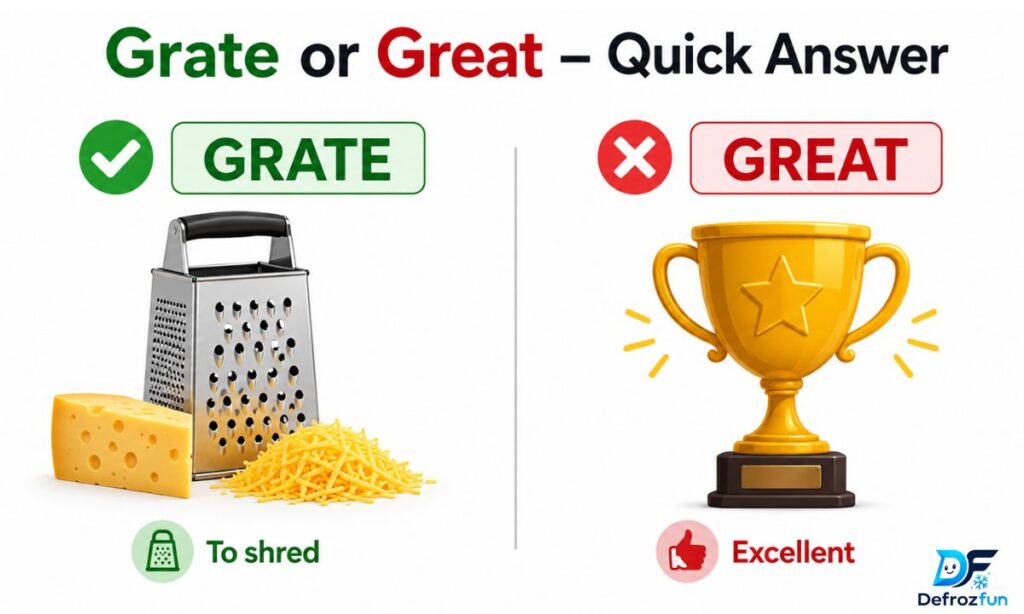
Both words exist and both are correct — but in completely different situations.
- Use great when you mean excellent, large, or important (adjective).
- Use grate when you mean to shred food, to irritate, or a metal framework (verb or noun).
They are homophones — words that sound the same (/ɡreɪt/) but are spelled differently and have unrelated meanings. Swapping one for the other is always a spelling error, never a style choice.
The Origin of Grate and Great
Understanding where these words come from helps you remember which is which.
The Origin of “Great”
The word great traces back to Old English grēat, meaning “big, tall, thick, or stout.” Over centuries, its meaning expanded from purely physical size to include excellence, importance, and distinction. That’s why we say both “a great wall” (size) and “a great performance” (quality).
Historical note: The title “the Great” was used to honor powerful rulers — think Alexander the Great or Catherine the Great — reinforcing the word’s sense of superiority and distinction.
The Origin of “Grate”
Grate as a verb comes from the Latin grattare, meaning “to scratch.” This makes sense — grating cheese or carrots involves scraping the food across a rough surface. The noun form (a metal grate) came into English from Old French grate or grille, also linked to the idea of bars or a framework. Its figurative meaning — to grate on someone’s nerves — evolved naturally from the idea of friction and irritation.
British English vs American English Spelling
Here’s some good news: there is no spelling difference between British and American English for these two words. Both varieties spell them the same way:
| Word | British English | American English |
| great | great | great |
| grate | grate | grate |
The confusion isn’t regional — it’s purely a matter of which word fits the meaning you intend.
Which Spelling Should You Use?
Ask yourself one question: What role does the word play in my sentence?
| If you need… | Use | Example |
| An adjective meaning excellent/large | great | She gave a great speech. |
| A verb meaning to shred or irritate | grate | Please grate the Parmesan. |
| A noun meaning a metal framework/grid | grate | The drain grate was rusted. |
| A word meaning “very good” in speech | great | “That’s great news!” |
A Quick Memory Trick
Look inside the word great — it contains the letters E-A-T. Associate it with something positive and pleasing, like a great meal. If your word involves something physical or irritating, reach for grate instead.
Another trick: if your word describes metal bars, a drain cover, or a kitchen tool, it’s grate — picture the grid-like image. If it’s praise or size, it’s great.
Also Read This: Feet or Foot: What’s the Correct Word? Easy Guide 👣
Common Mistakes with Grate or Great
Even careful writers slip up. Here are the most frequent errors and how to fix them:
Mistake 1: Using “grate” instead of “great” as a compliment
❌ You did a grate job on the presentation.
✅ You did a great job on the presentation.
Mistake 2: Using “great” instead of “grate” in cooking
❌ Can you great the carrots for the salad?
✅ Can you grate the carrots for the salad?
Mistake 3: Using “great” for a physical object
❌ The fireplace great needs cleaning.
✅ The fireplace grate needs cleaning.
Mistake 4: Using “grate” to mean impressive
❌ It was a grate movie — I cried at the end.
✅ It was a great movie — I cried at the end.
Why Spellcheck Won’t Save You
Both words are spelled correctly in isolation, so most spell checkers will let either pass without a flag. The only reliable check is reading for meaning and context, not just spelling.
Grate or Great in Everyday Examples
Seeing both words used correctly in natural sentences builds the habit faster than any rule.
Sentences Using “Great”
- The team showed great resilience throughout the season.
- There was a great crowd gathered outside the venue.
- She has made a great impact on her community.
- The Great Wall of China stretches thousands of miles.
- “That sounds great — let’s do it.”
Sentences Using “Grate” (Verb)
- He began to grate the nutmeg over the warm milk.
- Her habit of interrupting started to grate on everyone.
- You’ll need to grate the ginger finely for the marinade.
Sentences Using “Grate” (Noun)
- The metal grate over the basement window was bent.
- Leaves had piled up over the storm drain grate.
- They lit the fire and placed a kettle on the grate.
Sentences Using “Grate” (Adjective Form – Grating)
- The grating noise from the construction kept her awake.
- His constant complaints were becoming grating.
Grate or Great – Google Trends & Usage Data
Search data and language corpora consistently confirm that “great” is far more common in everyday English than “grate.” This is expected — great functions as a general-purpose adjective used across virtually every context, while grate has a narrower, more specific usage in cooking, construction, and expressions of irritation.
| Factor | great | grate |
| Part of speech | Adjective (primarily) | Verb, Noun, Adjective |
| Core meaning | Excellent, large, important | Shred, irritate, metal framework |
| Common contexts | Praise, size, historical titles | Cooking, plumbing, fireplaces |
| Search frequency | Very high | Moderate |
| Confusion direction | Rarely misused | Often written as “great” by error |
The most common direction of error is people writing great when they mean grate — particularly in cooking-related content and when describing physical objects.
Comparison Table
| Feature | great | grate |
| Pronunciation | /ɡreɪt/ | /ɡreɪt/ |
| Spelling | g-r-e-a-t | g-r-a-t-e |
| Origin | Old English grēat | Latin grattare / Old French |
| Parts of speech | Adjective, Noun (rare) | Verb, Noun, Adjective |
| Primary meaning | Excellent / very large | To shred / metal grid / to irritate |
| Historical usage | Titles: Alexander the Great | Fireplace grate, cheese grater |
| Can be a synonym for | Excellent, grand, significant | Shred, scrape, irritate, annoy |
| Memory cue | Contains E-A-T = pleasing | Think: metal grid or friction |
Conclusion
Grate and great are both real, correct English words — but they are never interchangeable. Great is the adjective you reach for when describing quality, size, or importance. Grate is the word for shredding food, expressing irritation, or referring to a metal grid.
The spelling difference is small — just the position of two vowels — but the meaning gap is enormous. Since spellcheck won’t catch these errors, the best habit is to pause and ask: Am I describing something excellent, or am I talking about friction or a metal framework? That one question will keep you on the right side of this common confusion every time.
When in doubt, remember: GREAT contains EAT — link it to something positive. If your word involves scraping, metal, or annoyance, it’s GRATE.

Daniel Brooks is a passionate writer and digital content creator dedicated to sharing insightful, engaging, and informative articles across multiple niches. With a strong interest in technology, lifestyle, trending topics, and online media, Daniel Brooks focuses on delivering well-researched and reader-friendly content that inspires and informs audiences worldwide.