

Thousands of people search “need or needs — which is correct?” every single day. Native speakers get it wrong. English learners get confused. Even professional writers second-guess themselves mid-sentence.
The good news? There is one clear rule that covers almost every situation. Once you know it, you will never get it wrong again. This article breaks it all down — no complicated grammar jargon, just simple explanations, real examples, and practical tips.
Need or Needs — Quick Answer
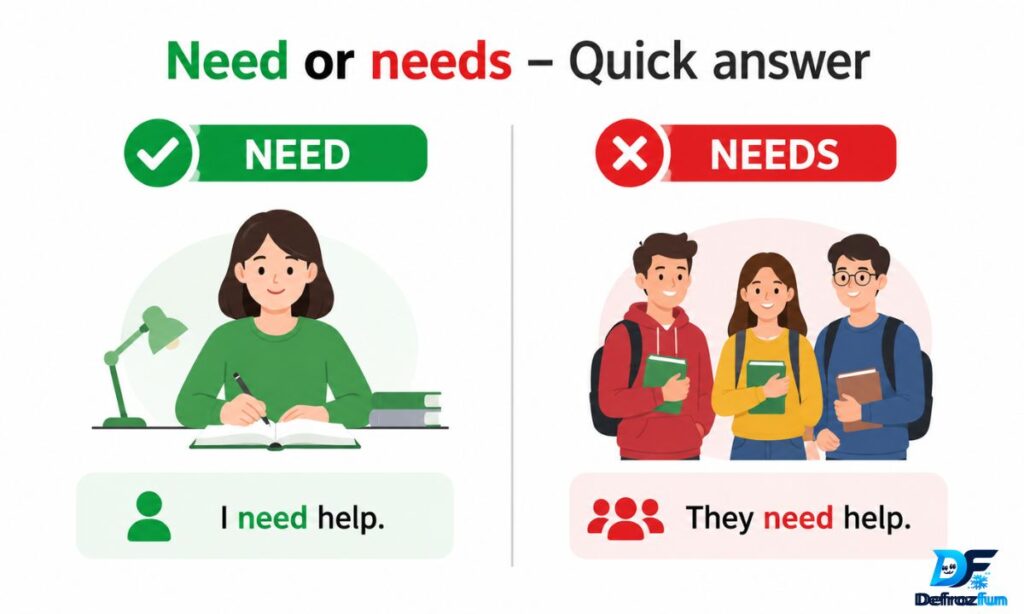
Use need with: I, you, we, they, and all plural nouns. Use needs with: he, she, it, and all singular third-person nouns.
That is the whole rule. Everything else in this article builds on this single point.
| Subject | Correct Form | Example |
| I | need | I need more time. |
| You | need | You need to rest. |
| We | need | We need a plan. |
| They | need | They need help. |
| He | needs | He needs a break. |
| She | needs | She needs support. |
| It | needs | It needs fixing. |
| The team | needs | The team needs practice. |
| The students | need | The students need guidance. |
The Origin of Need or Needs
The word need is one of the oldest words in the English language. It comes from the Old English word nied or neod, meaning “necessity” or “compulsion.” It has been part of the language since before 900 AD.
In Old English, verbs had many different endings depending on the subject and tense. Over centuries, English simplified these endings dramatically. Most verbs today only add an -s or -es for the third-person singular in the present tense — and need follows that same pattern.
So when you say “he needs,” you are following a grammatical tradition that is over a thousand years old. The rule has stayed consistent even as the rest of the language evolved.
Also Read This: Prefer vs Perfer: Explained with Easy Examples (2026)
British English vs American English Spelling
Here is a relief: there is no spelling difference between British and American English for need and needs. Both dialects use the exact same forms.
However, there is one small difference worth knowing — collective nouns.
In American English, collective nouns like team, committee, or government are treated as singular:
- The team needs more practice. ✅
In British English, the same nouns are often treated as plural:
- The team need more practice. ✅ (British)
Both are grammatically acceptable in their respective dialects. Neither is wrong — it depends on which side of the Atlantic you are writing for.
Which Form Should You Use?
The subject of the sentence determines everything. Always find the subject first, then choose the correct verb form.
Quick Cheat Sheet:
- I / You / We / They / Plural nouns → always use need
- He / She / It / Singular nouns → always use needs
- Tricky pronouns → see the table below
| Tricky Subject | Correct Form | Why |
| Everyone | needs | Singular in grammar |
| Everybody | needs | Singular in grammar |
| Anyone | needs | Singular in grammar |
| Nobody | needs | Singular in grammar |
| The government | needs / need | Singular (US) / can be plural (UK) |
| A group | needs | Treated as one unit |
| The data | needs | Treated as singular in modern English |
Special Cases:
“Need” as a modal verb In formal or question structures, need can act as a modal verb and does not change form:
- Need I say more? ✅
- Need she attend the meeting? ✅
This usage is more common in British English and formal writing. It sounds old-fashioned in casual American English but is completely correct.
“Needs to be” vs “needs doing” Both are standard English:
- The report needs to be reviewed. ✅
- The report needs reviewing. ✅
Avoid: “The report needs reviewed.” ❌ — This is a regional dialect form found in parts of Scotland, Northern Ireland, and some US states, but it is not standard written English.
Common Mistakes with Need or Needs
Even fluent speakers slip up. Here are the most frequent errors — and how to fix them.
Mistake 1: Using “needs” with a plural subject
- ❌ The students needs more support.
- ✅ The students need more support.
Mistake 2: Using “need” with a singular third-person subject
- ❌ She need a new laptop.
- ✅ She needs a new laptop.
Mistake 3: “In needs of” — incorrect plural form
- ❌ He is in needs of urgent care.
- ✅ He is in need of urgent care.
The phrase in need of is fixed. The noun here does not take a plural, regardless of context.
Mistake 4: Forgetting that “everyone” is singular
- ❌ Everyone need to sign the form.
- ✅ Everyone needs to sign the form.
Everyone, everybody, anyone, nobody, and someone are grammatically singular, even though they refer to groups of people.
Mistake 5: “You needs” — never correct
- ❌ You needs to try harder.
- ✅ You need to try harder.
You always takes need, even when referring to a single person.
Need or Needs in Everyday Examples
Seeing these words in real-world contexts makes the rule stick much faster. Here are examples across different writing styles.
Email Example
Hi Sarah,
The client needs a revised proposal by Friday. Our team needs to meet before Thursday to align on the numbers. Please confirm your availability.
Social Media Example
“She needs a vacation and she needs it now. 😩 We all need a break sometimes. #MondayMood”
News/Formal Writing Example
“The infrastructure needs significant investment over the next decade, according to the report. Experts say the public needs to be informed about the proposed changes before any decision is made.”
Formal/Academic Writing Example
“Each participant needs to complete the consent form before the study begins. The research committee needs to review all submissions by the end of the quarter.”
Need or Needs — Google Trends and Usage Data
Grammar queries are among the most consistent performers in Google Search. People search for grammar help all year round, with steady global interest regardless of season.
The query “need or needs” has maintained strong, year-round search interest across the US, UK, India, Philippines, and Nigeria — all major English-language markets. Grammar correction content tends to perform especially well in these regions because of the large base of English learners and second-language speakers.
According to general search behavior data, informational queries — exactly like “need vs needs” — account for roughly 50% of all Google searches. These queries have high click-through rates because users want a clear answer, not a product or a service.
Content targeting this type of query benefits from:
- Featured snippet optimization (direct answer at the top)
- Short, scannable paragraphs
- Tables and comparison lists
- FAQ sections that match voice search patterns
The interest in grammar topics like subject-verb agreement has grown steadily as more non-native English speakers consume and create content online — making articles like this one more relevant than ever in 2026.
Conclusion
The rule for need vs needs is straightforward: match the verb to the subject. Third-person singular subjects — he, she, it, singular nouns — take needs. Everything else takes need.
The most common mistakes happen with tricky pronouns like everyone and anybody (always singular), and with the fixed phrase in need of (never in needs of).
Get the subject right first, and the correct verb form follows naturally. Once this clicks, it becomes automatic — in emails, essays, social posts, or any kind of writing.

Daniel Brooks is a passionate writer and digital content creator dedicated to sharing insightful, engaging, and informative articles across multiple niches. With a strong interest in technology, lifestyle, trending topics, and online media, Daniel Brooks focuses on delivering well-researched and reader-friendly content that inspires and informs audiences worldwide.