

If you’ve ever typed “eather” and second-guessed yourself, you’re in good company. Thousands of people search for “either or eather” every month — students, professionals, and even native English speakers. The mix-up happens because pronunciation varies by accent, making the correct spelling feel uncertain. This guide settles the debate once and for all with clear definitions, grammar rules, real examples, and a comparison table.
✅ Quick Answer
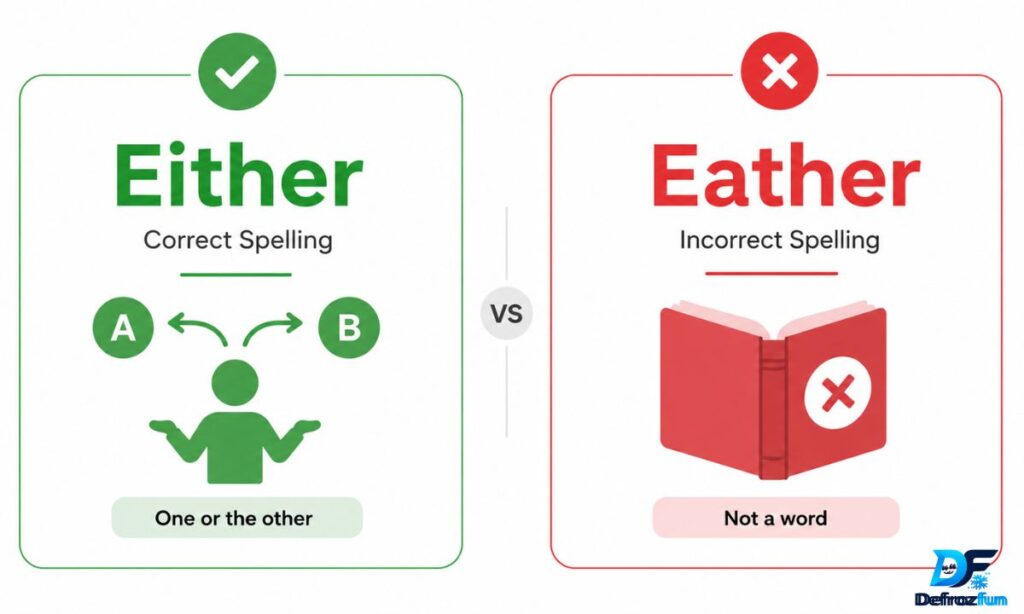
“Either” is correct. “Eather” is not a real English word — it is a misspelling.
Whenever you mean “one of two,” the only accepted spelling is either. There is no regional version, no alternate form, and no exception to this rule. Whether you’re writing an email, an essay, or a social media post, always use either.
Either Meaning
Either is a versatile word in English. It functions as an adjective, pronoun, conjunction, and adverb depending on how it is used in a sentence.
At its core, either means “one or the other of two things.” It signals a choice or alternative between two options.
As a conjunction:
You can call me or text me — either works.
As an adjective:
There are trees on either side of the road.
As a pronoun:
I don’t like both options. Either will do.
As an adverb (negative sentences):
I haven’t been there, and she hasn’t either.
Key grammar rule: either is always paired with or. For negative choices, use neither…nor.
Either or Eather Grammar
The grammar question people ask most often: Is it “either or eather”?
Here’s the clear answer:
- Either — correct spelling, real word, used in standard English worldwide
- Eather — incorrect spelling, not found in any major English dictionary, including Merriam-Webster, Oxford, or Cambridge
Why do people write “eather”? A few reasons:
- Pronunciation confusion — When spoken quickly, “either” can sound like “ee-ther” or “eye-ther,” and some people hear it as “eather”
- Typing errors — Fast typing and autocorrect mistakes cause the wrong letters to appear
- Phonetic spelling — Non-native speakers sometimes spell words the way they hear them
The fix is simple: whenever you are expressing a choice between two things, write either — no exceptions.
Ether or Either Pronunciation
This is where many people get confused. Three words sound similar but mean completely different things:
| Word | Pronunciation | Meaning |
| Either | EE-ther or EYE-ther | One of two options |
| Ether | EE-ther | A colorless, flammable chemical liquid; also used poetically to mean “the sky” |
| Eather | — | Not a real word |
Both “EE-ther” and “EYE-ther” are correct pronunciations of “either.”
According to Merriam-Webster, the word can be pronounced /ˈē-t͟hər/ or /ˈī-t͟hər/ — both are fully accepted. The difference comes down to regional accent and personal habit, not correctness.
A helpful tip: ether (the chemical) is always pronounced EE-ther with a long E sound. If you mean “one of two,” say either — with either pronunciation you prefer.
The Origin of Either
Either comes from Old English ǣġhwæþer, which meant “each of two” or “both.” Over centuries, this evolved through Middle English into the modern spelling and meaning we use today: one or the other of two.
The word has roots in Proto-West Germanic and is related to similar words in Old Saxon, Old Dutch, and Old High German — all pointing to the idea of “each” or “every one of two.”
How to Spell Eather
You don’t — because “eather” is not a word. It has no entry in any standard English dictionary. It does not appear as a valid alternate spelling, a dialectal form, or an archaic version of any English word in modern use.
The only historical note: some very old texts used “eather” as an obsolete variant of “either,” but this usage has been out of circulation for centuries. In 2026, writing “eather” is simply a spelling mistake.
Always write: either
British English vs American English Spelling
One common question: does the spelling change between British and American English?
No. The spelling of “either” is identical in both.
Unlike words such as colour/color or organised/organized, “either” has no regional spelling variation. Both British and American writers spell it the same way: e-i-t-h-e-r.
What does differ is pronunciation:
- American English — predominantly EE-ther
- British English — more commonly EYE-ther, though EE-ther is also used, particularly in Northern England
Historically, EE-ther was the dominant pronunciation in Britain as recently as the late 1700s. By the early 20th century, British educated speech had shifted toward EYE-ther. American English largely retained the older EE-ther form.
Both are correct. The spelling stays the same regardless of which pronunciation you use.
Which Spelling Should You Use?
Use either — always, everywhere, in every context.
There is no situation in standard English writing where “eather” is appropriate. Here’s a quick reference:
Use “either” when:
- Offering a choice between two things: Either option works.
- Using the either…or structure: Either come early or call ahead.
- Replacing “too” in a negative sentence: I don’t agree either.
Never use “eather” — in emails, essays, texts, social media, formal writing, or casual writing.
Do not confuse “either” with:
- Neither — used for negative choices (Neither option works)
- Whether — used to introduce alternatives or uncertainty (I don’t know whether to go)
- Ether — the chemical compound or poetic term for sky/space
Common Mistakes with Either
Even careful writers slip up with “either.” Here are the most frequent errors:
1. Spelling it “eather” This is the most common mistake. Always use the -ei- spelling.
2. Using “either” with more than two options Either is technically for choosing between two things. For three or more, use “any.”
❌ Either of the three plans will work. ✅ Any of the three plans will work.
3. Mixing up “either…or” and “neither…nor”
❌ Neither she will come or he will call. ✅ Neither she will come nor he will call.
4. Confusing “either” with “ether”
❌ I’ll take ether choice. ✅ I’ll take either choice.
Ether or Either Pronunciation — Quick Reminder
- Ether (chemical/poetic): always EE-ther
- Either (choice): EE-ther or EYE-ther — both correct
Either in Everyday Examples
Seeing a word in real sentences helps lock in the correct spelling and usage. Here are natural, everyday examples:
- You can sit on either side of the table.
- Either the red dress or the blue one will look great.
- I haven’t seen that movie, and my friend hasn’t either.
- There’s a coffee shop on either end of the street.
- Either tell the truth or stay silent — there is no middle ground.
- She didn’t enjoy the trip, and I didn’t either.
- We can take either route — both lead to the same place.
Notice how each use connects to a choice or a pair. That’s the defining feature of “either.”
Either or Eather – Google Trends & Usage Data
Search data confirms how widespread this confusion is:
- “Either or eather” gets thousands of searches every month globally
- “How to spell either” is a consistently trending query in the US, UK, India, and Pakistan
- “Eather” appears frequently in comment sections, text messages, and informal writing — but never in published, edited English
Google Trends data shows spikes in searches for this topic around school exam seasons, suggesting students encounter the word frequently in academic writing and want to confirm the correct form before submitting work.
The data also confirms that “ether or either” is a secondary query — people sometimes wonder whether the chemical word “ether” is being confused with the conjunction “either.”
Comparison Table
| Feature | Either | Eather | Ether |
| Real English word | ✅ Yes | ❌ No | ✅ Yes |
| Correct spelling | ✅ Yes | ❌ No | ✅ Yes (different word) |
| Meaning | One of two options | N/A (misspelling) | Chemical compound / poetic sky |
| Used in grammar | ✅ Yes | ❌ Never | Only in scientific/literary contexts |
| British spelling | Either | — | Ether |
| American spelling | Either | — | Ether |
| Pronunciation | EE-ther / EYE-ther | — | EE-ther |
Conclusion
The answer to “either vs eather” is clear: either is always correct, and eather is always wrong.
“Eather” has no place in standard English — it’s a spelling error caused by pronunciation confusion, fast typing, or phonetic guessing. The word “either” has been part of English since Old English times, and its spelling has remained stable across both British and American English.
Remember these three points:
- Either = one of two choices (correct spelling)
- Eather = misspelling (never use it)
- Ether = a completely different word (chemistry or poetry)
Next time you’re unsure, think of the structure: either…or. That pairing is a built-in memory trick. If you’re choosing between two things, it’s always either — spelled E-I-T-H-E-R.

Daniel Brooks is a passionate writer and digital content creator dedicated to sharing insightful, engaging, and informative articles across multiple niches. With a strong interest in technology, lifestyle, trending topics, and online media, Daniel Brooks focuses on delivering well-researched and reader-friendly content that inspires and informs audiences worldwide.