
If you have ever typed this word and second-guessed yourself, you are not alone. Analysing and analyzing are both correct — the difference comes down to where you are writing and who you are writing for. One belongs to British English, the other to American English. This guide breaks it all down clearly so you never mix them up again.
Analysing or Analyzing – Quick Answer
Both spellings are correct. Use analyzing in American English and analysing in British English. They share the same meaning, the same pronunciation, and the same grammatical role. The only difference is the letter z versus s.
| Spelling | English Variety | Example |
| Analyzing | American English | She is analyzing the data. |
| Analysing | British English | She is analysing the data. |
Analysing or Analyzing Meaning
Both words are the present participle of the verb analyze/analyse, meaning to examine something carefully in order to understand its structure, meaning, or content. Whether you write analyzing or analysing, you are describing the active process of careful examination or study.
Core meaning: to break something down into parts, study each part, and draw conclusions from the whole.
Analysing or Analyzing in English
In everyday English, the word appears across a wide range of fields:
- Science – analyzing experimental results
- Business – analyzing market trends
- Education – analysing a poem or text
- Technology – analyzing large data sets
- Medicine – analysing patient test samples
The spelling you use should always match the variety of English required by your audience, publisher, or institution.
Analyse or Analyze UK
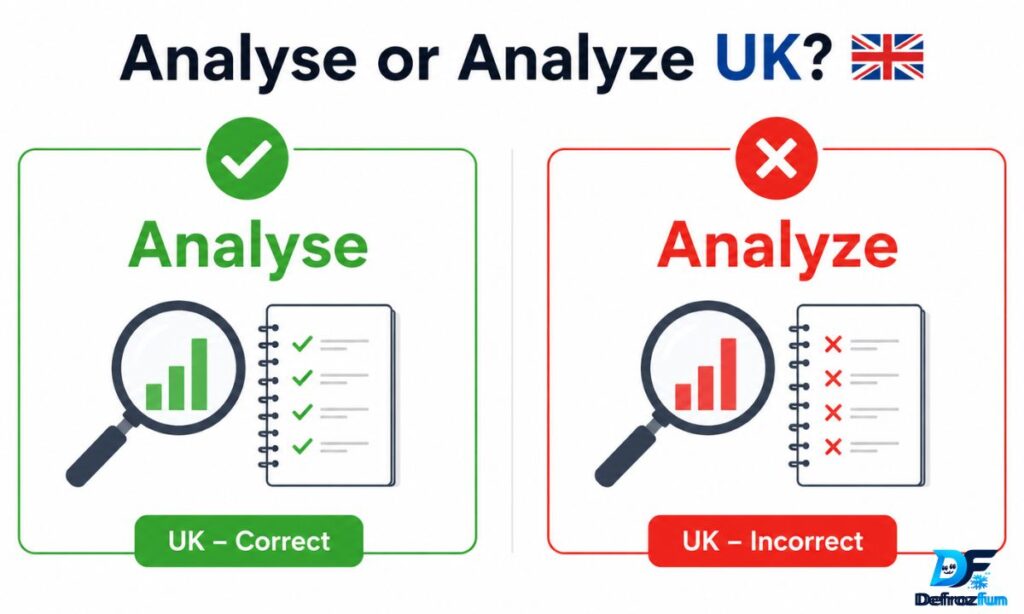
In the United Kingdom, the standard spelling is analyse (verb) and analysing (present participle). This applies to academic writing, journalism, professional reports, and everyday communication across British Commonwealth countries including Australia, New Zealand, Ireland, and Canada (though Canada also accepts the z form).
Memory tip: Both British and analyse contain the letter S. Use that connection to remember which form belongs to UK English.
Analyse or Analyze Oxford English
The Oxford English Dictionary (OED) lists analyse as the standard British English spelling. However, the OUP (Oxford University Press) is known for accepting -ize endings in some words based on etymology. For analyse, Oxford retains the -yse form because of its French and Greek roots. Most British style guides follow the OED and recommend analyse and analysing for UK audiences.
British English vs American English Spelling
The s vs z divide appears across many common English words. Here is a quick reference:
| American English | British English |
| Analyzing | Analysing |
| Organizing | Organising |
| Realizing | Realising |
| Recognizing | Recognising |
| Criticizing | Criticising |
This pattern developed in the late 18th and 19th centuries. American lexicographer Noah Webster promoted the -ize spelling in his 1828 dictionary to simplify and standardize American English. British English kept the -ise/-yse forms, which were closer to French and Latin roots.
The Origin of Analysing or Analyzing
The word traces back to Ancient Greek — analusis, meaning “to loosen up” or “break apart.” It passed through Latin and Old French before entering English. The noun analysis (which remains spelled the same in both British and American English) kept its Greek roots intact.
Over time, as English developed separately in Britain and America, the spelling conventions for the verb form diverged:
- British English retained analyse → analysing
- American English adopted analyze → analyzing
Both paths are historically justified and equally correct in their respective contexts.
Analyse or Analyze Pronunciation
Good news: both spellings are pronounced exactly the same way. The spelling difference has no impact on how the word sounds.
Pronunciation: /ˈæn.ə.laɪz/ (AN-uh-lyze)
- Stress falls on the first syllable: AN
- The suffix sounds like -lyze in both versions
- Present participle: /ˈæn.ə.laɪ.zɪŋ/ (AN-uh-ly-zing)
Analyze English
In American English, analyze is the only accepted spelling. American schools, universities, journals, and companies use this form exclusively. Using analyse in an American context is considered a spelling error by most style guides and spell-checkers set to US English.
Common American English forms:
- analyze (base verb)
- analyzing (present participle)
- analyzed (past tense)
- analyzes (third-person singular)
Analyze Noun
The noun form is analysis, and this does not change between British and American English. Both regions use the same spelling:
- Singular: analysis
- Plural: analyses (pronounced uh-NAL-ih-seez)
Do not confuse analyses (plural noun) with analyzes (third-person singular verb). They sound similar but serve different grammatical roles.
Analysis or Analyzis
The correct noun is always analysis — never analyzis. This is a common misspelling. The noun form retains its Greek-derived spelling regardless of whether you follow American or British conventions for the verb.
❌ The analyzis showed clear results. — Incorrect
✅ The analysis showed clear results. — Correct
Analysing or Analyzing Synonyms
If you want to vary your writing, here are natural synonyms that carry a similar meaning:
- Examining – examining the evidence
- Evaluating – evaluating the data
- Assessing – assessing the situation
- Investigating – investigating the cause
- Studying – studying the results
- Interpreting – interpreting the findings
- Breaking down – breaking down the problem
- Scrutinizing – scrutinizing the report
These synonyms work well in academic, business, and everyday writing contexts.
Analyzing Examples
Here are natural sentence examples using the American English form:
- The scientist is analyzing the blood samples taken during the trial.
- She spent three hours analyzing the company’s quarterly performance.
- The software is capable of analyzing millions of data points per second.
- After analyzing the results, the team made their final recommendation.
- He is analyzing customer feedback to improve the product design.
Analysing or Analyzing Examples
Here are examples showing both spellings in context:
American English (analyzing):
- The researchers are analyzing the survey responses.
- He is analyzing whether the policy change was effective.
British English (analysing):
- The researchers are analysing the survey responses.
- He is analysing whether the policy change was effective.
Both sentences are grammatically correct. The spelling simply reflects the intended audience.
Analysing or Analyzing Grammar
Grammatically, both analysing and analyzing function identically:
- Present participle / gerund: “Analyzing data takes time.”
- Progressive tense: “She is analyzing the report.”
- After prepositions: “He is skilled at analyzing risks.”
- Adjective use: “The analyzing team reviewed all files.”
The word follows standard regular verb conjugation with no irregular forms.
Which Spelling Should You Use?

Use the spelling that matches your audience and context:
- Writing for a US audience? → Use analyzing
- Writing for a UK, Australian, or Commonwealth audience? → Use analysing
- Academic submission? → Follow the required style guide (APA uses analyzing; most UK institutions prefer analysing)
- Unsure? → Pick one form and use it consistently throughout your document
The key rule is consistency. Mixing both spellings in the same document looks unprofessional and may be flagged by editors or spell-checkers.
Common Mistakes with Analysing or Analyzing
Avoid these common errors:
1. Mixing spellings in the same document
❌ The team is analyzing the data. After analysing the results…
✅ Choose one and stick with it.
2. Using “analyzis” as the noun form
❌ The analyzis was complete.
✅ The analysis was complete.
3. Changing spelling in direct quotations
Never alter the spelling of a direct quote to match your document’s style. Reproduce it as written.
4. Assuming one spelling is wrong
Both forms are correct. Neither is a mistake in its proper context.
Analysing or Analyzing in Everyday Examples
Real-world contexts where you will encounter both spellings:
- Google Scholar – Academic papers from US journals use analyzing; UK journals use analysing. Both forms appear in global search results because English users come from many regions.
- Word to PDF conversion – Converting a document from Word to PDF preserves the original spelling. Set your Word spell-check language to either “English (US)” or “English (UK)” before writing to avoid inconsistency flags.
- AI Detector tools – AI detectors and grammar checkers do not treat either spelling as an error. Both are recognized as valid standard English.
- Behaviour or Behavior – The same British/American divide applies here: behaviour (UK) vs behavior (US), following the same spelling logic as analysing/analyzing.
Analysing or Analyzing – Google Trends & Usage Data
Global search data shows that analyzing (American spelling) is searched more frequently worldwide. This reflects the dominance of American English in global media, technology, and academic publishing. However, analysing remains highly active in searches from the UK, Australia, India, and other Commonwealth regions.
Key takeaway: neither form is declining. Both remain in active, widespread use across their respective English-speaking communities.
Comparison Table
| Feature | Analyzing (US) | Analysing (UK) |
| Spelling | With z | With s |
| Region | United States, Canada | UK, Australia, NZ |
| Base verb | Analyze | Analyse |
| Noun form | Analysis | Analysis |
| Pronunciation | Identical | Identical |
| Meaning | Identical | Identical |
| Academic use | APA, Chicago | Oxford, Harvard (UK) |
| Correct? | ✅ Yes | ✅ Yes |
Conclusion
The debate between analysing and analyzing has a clear answer: both are correct. The difference is purely regional. American English uses analyzing with a z, while British English uses analysing with an s. The meaning, grammar, and pronunciation are exactly the same in both cases.
When writing, always match your spelling to your audience. Set your word processor’s language accordingly, stay consistent throughout your document, and you will never make an error with this word again.

Daniel Brooks is a passionate writer and digital content creator dedicated to sharing insightful, engaging, and informative articles across multiple niches. With a strong interest in technology, lifestyle, trending topics, and online media, Daniel Brooks focuses on delivering well-researched and reader-friendly content that inspires and informs audiences worldwide.