

If you have ever typed “posible” and had your spell checker underline it in red, you are not alone. This is one of the most common spelling mix-ups in English, especially among learners whose first language uses a single “s” in this word. The good news is that the fix is simple once you understand where the confusion comes from.
This guide breaks down the posible vs possible meaning, the correct spelling rule, real examples, common mistakes, and easy memory tricks so you never second-guess this word again.
Quick Answer
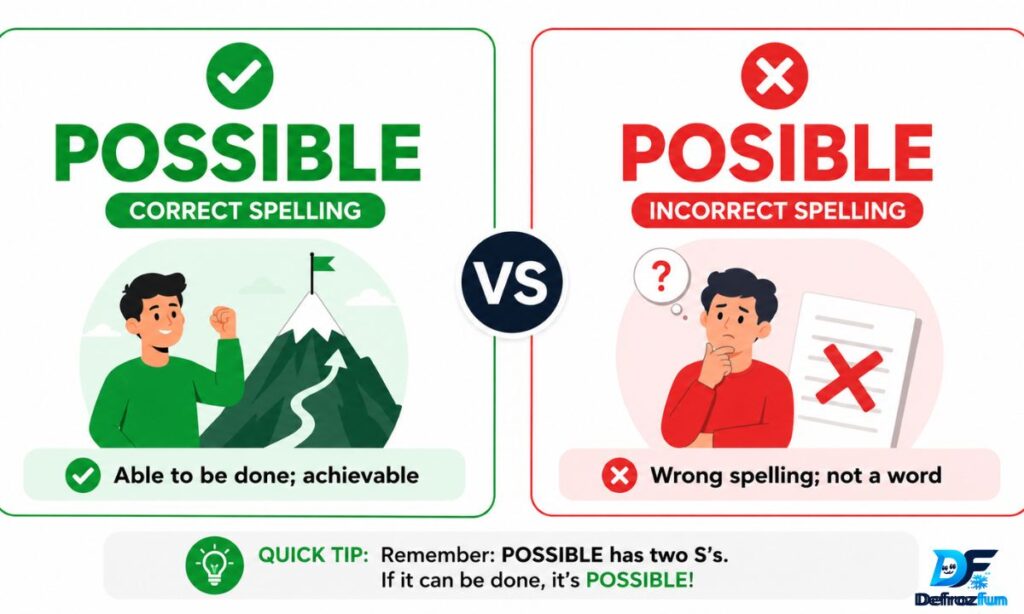
Possible is the only correct spelling in English. Posible is not a real English word — it is either a misspelling or the correct Spanish spelling of the same concept. If you are writing in English, always use “possible” with a double “s.”
| Word | Language | Correct? | Meaning |
| Possible | English | Yes | Capable of happening, existing, or being done |
| Posible | Spanish | Yes (in Spanish) | Same meaning as “possible,” but only valid in Spanish text |
| Posible | English | No | Common misspelling of “possible” |
Posible vs Possible Meaning
“Possible” is an adjective used to describe something that can happen, can be achieved, or can exist under the right conditions. It signals potential rather than certainty — something is possible if there is a realistic chance of it occurring, even if it hasn’t happened yet.
“Posible” carries the exact same meaning, but only in Spanish. Words like “posible” (Spanish), “possibile” (Italian), and “possível” (Portuguese) all trace back to the same Latin root, which is why English learners from Romance-language backgrounds often drop the second “s” out of habit.
Also Read This: Seeing or Seing? Meaning, Spelling, Grammar Rules & Examples (2026)
Posible vs Possible Difference
The two words are not different in meaning — they differ in language and correctness. Here’s the core distinction:
- Possible: correct English adjective, always spelled with two “s” letters
- Posible: correct Spanish adjective, spelled with one “s”; incorrect if used in English writing
Because both words sound almost identical when spoken with an accent, the error usually shows up in writing rather than speech. Spell-check tools, grammar checkers, and most style guides flag “posible” instantly when it appears in English content.
Spelling Rule Depth
The simplest way to remember the correct spelling is to focus on the double “s.”
- Possible = P-O-S-S-I-B-L-E
- Count two “s” letters, not one
- The “o” before “ss” never changes to an “a” or “e”
A quick memory anchor many teachers use: think of the word “success,” which also has a double “s.” If you associate success with possibility, the spelling becomes easier to recall.
The Origin of Possible
“Possible” entered English through Old French from the Latin word possibilis, meaning “that can be done.” The Latin root comes from posse, meaning “to be able.” This etymology explains why “possible” is functionally tied to ability and capability — it literally means something has the capacity to occur.
Understanding this Latin root also explains related English words such as “possibility,” “possibly,” and “impossible,” all of which share the same double-“s” spelling pattern because they come from the same source word.
Why People Write Posible Instead of Possible
This mistake happens for a few predictable reasons:
- Native language influence — Spanish, and several other Romance languages, spell the equivalent word with only one “s.”
- Pronunciation — the double “s” sound is not strongly emphasized when the word is spoken quickly.
- Fast typing — dropping a repeated letter is a common typo, similar to writing “adress” instead of “address.”
- Autocorrect gaps — on some keyboards or in casual chat apps, autocorrect doesn’t always catch the error.
- Visual similarity — the words look almost the same at a glance, so the missing letter is easy to overlook while proofreading.
Grammar Rule Depth
“Possible” functions primarily as an adjective, describing a noun’s capacity to happen or exist.
- As an adjective: It is possible to finish this project early.
- As a noun (rare, formal use): She is a possible for the manager role, meaning a candidate who might be chosen.
It is also commonly used in fixed expressions:
- “As soon as possible”
- “If possible”
- “Make it possible”
- “Whenever possible”
Note that “possible” itself is not a verb and does not conjugate. It also does not typically take a comparative or superlative form (avoid “more possible” or “most possible” in formal writing — use “more likely” or “more feasible” instead).
Real World Usage of Possible
“Possible” appears constantly in professional, academic, and everyday English:
- Business emails: Please confirm as soon as possible.
- Academic writing: It is possible that climate variables influenced the results.
- Casual conversation: Is it possible to reschedule our call?
- News and journalism: Officials say a resolution is still possible.
Because the word is so frequent, even a small spelling slip like “posible” can undermine credibility in professional documents, resumes, and client communication.
Possible in Everyday Examples
- It’s possible to learn a new skill at any age.
- Winning the match is still possible if we play carefully.
- She made it possible for the whole team to attend the conference.
- Is it possible to get a refund after 30 days?
- Anything is possible with enough preparation.
Common Mistakes with Posible vs Possible
| Mistake | Why It’s Wrong | Correct Version |
| It’s posible to finish today. | Missing second “s” | It’s possible to finish today. |
| That is not posible under the rules. | Incorrect English spelling | That is not possible under the rules. |
| We found a posible solution. | Spanish spelling used in English text | We found a possible solution. |
| This is more possible than before. | Incorrect comparative usage | This is more likely / more feasible than before. |
Posible vs Possible in Different Contexts
- Academic writing: Always use “possible.” Spelling errors are penalized in essays, reports, and research papers.
- Business writing: “Possible” is standard in emails, proposals, and official documents.
- Casual texting: While informal texts are more forgiving, “possible” is still the expected spelling in professional or semi-formal chats.
- Bilingual or translated content: “Posible” is correct only when the surrounding text is written in Spanish. Mixing it into English sentences is considered an error regardless of context.
Related Words and Similar Forms
- Possibility — the noun form, referring to a chance or potential for something to happen
- Possibly — the adverb form, used to soften certainty (She will possibly attend.)
- Impossible — the negative form, meaning something cannot happen
- Feasible — a close synonym, often used in planning and business contexts
- Achievable — a synonym emphasizing realistic effort and capability
- Probable — often confused with “possible,” but “probable” implies a higher likelihood, not just potential
Memory Tips to Avoid Mistakes
- Remember: “PoSSible = two S’s for Success.”
- Break the word into syllables while writing: pos-si-ble.
- If typing quickly, pause after the first “s” and consciously add the second one.
- Use a browser spell-check extension for extra confidence in professional writing.
- Read your sentence aloud slowly — this often catches skipped letters that the eye misses.
Usage Trends
Search and usage data consistently show that “possible” is one of the most frequently used adjectives in English writing, appearing across formal documents, digital communication, and search queries. Meanwhile, “posible” continues to trend as a common misspelling search term, driven largely by non-native English speakers and fast typists checking their own writing. Modern spell-checkers and AI writing tools now catch this error almost instantly, but manual proofreading remains valuable for anyone writing without automated tools.
Exercise 1: Choose the Correct Word
- It is (posible / possible) to reach the summit before noon.
- She asked if a refund was still (posible / possible).
- Anything is (posible / possible) with enough effort.
- We need a (posible / possible) backup plan.
- Is it (posible / possible) to attend both events?
(Answer: possible is correct in every sentence above.)
Exercise 2: Correct the Sentence
- It’s posible to finish the report today. → It’s possible to finish the report today.
- This solution seems posible under current rules. → This solution seems possible under current rules.
- We found a posible way to reduce costs. → We found a possible way to reduce costs.
- Is it posible to change my flight? → Is it possible to change my flight?
Conclusion
The difference between posible and possible comes down to one simple rule: possible is the correct English spelling, always written with a double “s,” while posible belongs to Spanish and should never appear in English writing.
Once you anchor the spelling to its Latin root and practice the “two S’s for success” trick, this mistake becomes easy to avoid permanently. Whether you’re writing an email, an essay, or a casual message, choosing “possible” correctly helps your writing look polished, professional, and error-free.

Daniel Brooks is a passionate writer and digital content creator dedicated to sharing insightful, engaging, and informative articles across multiple niches. With a strong interest in technology, lifestyle, trending topics, and online media, Daniel Brooks focuses on delivering well-researched and reader-friendly content that inspires and informs audiences worldwide.