

Have you ever typed “rosey” and then stopped to wonder — wait, is that even right? You are not alone. Thousands of people search for the correct spelling every single day. Whether you are writing a blog post, a caption, or a simple text message, getting this word right matters. This guide clears up the confusion between rosy or rosey once and for all.
Rosy or Rosey – Quick Answer
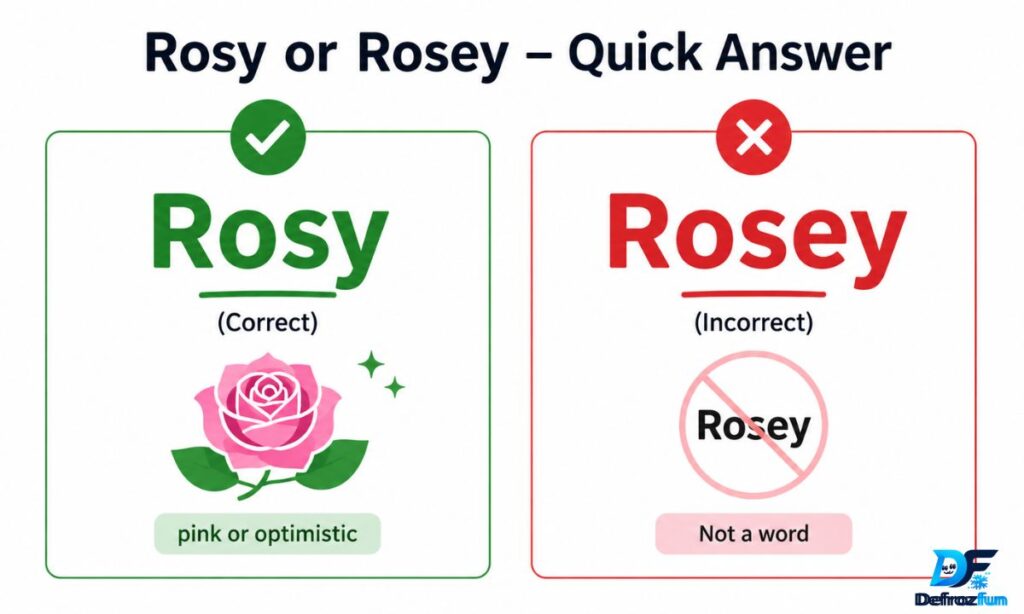
Rosy is the correct spelling. It is the standard adjective used in both American and British English to describe a pink color or an optimistic situation. Rosey is not a standard dictionary word — it is considered a misspelling in most formal and professional writing contexts. If you see “Rosey” with a capital R, it is likely a proper name or nickname, not the adjective.
Rosey vs Rosy: Which Spelling Is Correct?
The answer is clear: rosy is correct, and rosey is not. Here is a quick side-by-side comparison:
| Feature | Rosy | Rosey |
| Standard spelling | ✅ Yes | ❌ No |
| Found in dictionaries | ✅ Yes | ❌ No |
| Used as adjective | ✅ Yes | ❌ No |
| Used as a proper name | Sometimes | Sometimes |
| Acceptable in formal writing | ✅ Yes | ❌ No |
The word rosy appears in every major English dictionary — Merriam-Webster, Oxford, Cambridge, and Britannica — all list rosy as the correct adjective form. None of them recognize rosey as a valid word.
The confusion happens because both spellings are pronounced exactly the same way: /ˈroʊzi/. Since they sound identical when spoken, many writers accidentally add an extra “e” — possibly influenced by the base word “rose,” which already ends in “e.”
The Origin of Rosey or Rosy
Understanding where rosy comes from helps explain why the spelling is what it is. The word rosy traces back through several languages:
- Ancient Greek → rhodon (rose flower)
- Latin → rosa (rose)
- Old French → rose
- Old English → rōse
- Middle English → rosi (adjective form)
By the 14th century, English speakers were already using “rosy” to describe the color of a rose — particularly the natural blush on someone’s cheeks. Over time, the word gained a second meaning: optimistic or promising. The adjective suffix -y (meaning “full of” or “characterized by”) was simply added to the noun rose. There was never an extra “e” in the equation, which is why rosey never became the standard form.
British English vs American English Spelling
One common reason people question a spelling is because British and American English sometimes differ (think colour vs color or realise vs realize). With rosy, however, there is no regional split.
| English Variety | Correct Spelling |
| American English | rosy |
| British English | rosy |
| Australian English | rosy |
| Canadian English | rosy |
Both British and American English agree: rosy is the correct form. So whether you are writing for a UK audience or a US audience, always use rosy.
Which Spelling Should You Use?
Use rosy — always, in every situation where you mean the adjective. Here are a few simple guidelines:
- In formal writing (essays, reports, emails): always use rosy
- In casual writing (texts, social media): still use rosy
- As a proper name or nickname: Rosey is acceptable (e.g., Rosey Smith)
- In creative fiction: use rosy unless a character’s name is Rosey
The only time “Rosey” with a capital R is acceptable is when it refers to a person’s name or nickname.
Rosey vs Rosie: What’s the Difference?
People sometimes confuse three similar-looking words: rosy, rosey, and Rosie. Here is how they differ:
| Word | Type | Meaning / Use |
| Rosy | Adjective | Pink-colored; optimistic; hopeful |
| Rosey | Non-standard | Misspelling of rosy; sometimes a proper name |
| Rosie | Proper name | A girl’s name; also a nickname for Rose or Rosemary |
Rosie is a completely separate word. It is one of the most popular girls’ names in the English-speaking world and has nothing to do with the adjective “rosy.” If you are describing pink cheeks or a hopeful outlook, use rosy — lowercase, no extra “e.”
Also Read This: Which or Wich: Spelling and Meaning Explained Simply (2026)
Common Mistakes with Rosey or Rosy
Here are the spelling errors people make most often — and how to fix them:
Mistake 1: Adding an Extra “E”
❌ Her rosey cheeks glowed in the cold air.
✅ Her rosy cheeks glowed in the cold air.
Mistake 2: Confusing the Name with the Adjective
❌ The future looks Rosie for the company.
✅ The future looks rosy for the company.
Mistake 3: Using Rosey in Professional Writing
❌ The report painted a rosey picture of the economy.
✅ The report painted a rosy picture of the economy.
Mistake 4: Treating Rosey as a British Spelling
❌ I think British people spell it “rosey.”
✅ Both British and American English use “rosy.”
The easiest trick to remember: rose + y = rosy. Just drop the “e” from rose and add a “y.” Simple.
Rosey or Rosy Cheeks: Which One Is Correct?
Rosy cheeks is correct. Rosey cheeks is a misspelling.
“Rosy cheeks” describes a natural, healthy flush on someone’s face — the kind you get from cold weather, excitement, or good health. It is a very common phrase used in everyday writing, literature, and even medical descriptions.
Examples of correct usage:
- The baby had rosy cheeks after playing outside.
- She walked in from the snow, her rosy cheeks bright red.
- Cold winters always give children rosy cheeks.
You will never see “rosey cheeks” in a dictionary, a grammar guide, or a style manual. Always write rosy cheeks.
Rosey or Rosy in Everyday Examples

Seeing the word in real sentences is one of the best ways to remember the correct spelling. Here are natural examples across different contexts:
Describing appearance:
- Her rosy lips stood out against her pale skin.
- The baby’s rosy complexion made everyone smile.
Describing optimism or hope:
- The company painted a rosy picture of next year’s growth.
- Despite the challenges, she had a rosy outlook on life.
Describing color:
- The sky turned a beautiful rosy shade at sunset.
- He picked a rosy pink for the bedroom walls.
Describing health:
- His rosy glow suggested he had been exercising regularly.
- The doctor said the patient’s rosy color was a good sign.
Rosey or Rosy – Google Trends & Usage Data
Search data tells an interesting story about these two spellings. When you compare “rosy” vs “rosey” in Google Trends and major corpus tools like Google Ngram Viewer, the results are decisive:
- Rosy consistently dominates in published books, academic writing, and news articles across all decades.
- Rosey shows very limited usage — mostly as a proper name rather than the adjective.
- In informal online spaces (forums, social media), “rosey” does appear occasionally, but it is almost always treated as a typo.
The Google Ngram Viewer, which tracks word frequency in millions of books published since 1800, shows rosy appearing thousands of times more frequently than rosey. This data confirms what every dictionary already tells us: rosy is the dominant, preferred, and correct spelling.
Is Rosey a Word?
Technically speaking, rosey is not an officially recognized English word in any major dictionary.
| Dictionary | Lists Rosy? | Lists Rosey? |
| Merriam-Webster | ✅ Yes | ❌ No |
| Oxford English Dictionary | ✅ Yes | ❌ No |
| Cambridge Dictionary | ✅ Yes | ❌ No |
| Britannica Dictionary | ✅ Yes | ❌ No |
However, “Rosey” does exist as a proper name — a nickname or given name used for people. For example, Rosey Grier was a famous American football player. In that context, “Rosey” is perfectly fine because it is a name, not an adjective.
So: Is Rosey a word? As an adjective — no. As a name — yes.
Conclusion
The spelling debate between rosy or rosey has a clear winner: rosy is the correct English adjective, accepted across all dialects and recognized by every major dictionary. The word comes from Middle English rosi, built on the Latin rosa, and has been the standard form for centuries.
Use rosy when you mean:
- A pink or rose-like color
- Healthy, flushed cheeks
- An optimistic or hopeful outlook
Reserve Rosey (with a capital R) only for proper names and nicknames.
Quick trick: rose – e + y = rosy. Drop the “e,” add a “y,” and you will never second-guess yourself again.
Frequently Asked Questions
Is it rosy or rosey?
Rosy is correct. Rosey is a misspelling in standard English.
Is rosey a real word?
No. Rosey is not in any major dictionary as an adjective. It may appear as a proper name.
How do you spell rosy cheeks?
The correct spelling is rosy cheeks, not rosey cheeks.
Is Rosie the same as rosy?
No. Rosie is a proper name for a person, while rosy is an adjective meaning pink or optimistic.
Do British people spell it rosey?
No. Both British and American English use rosy as the standard spelling.
What does rosy mean?
Rosy means pink-colored (like a rose) or optimistic and hopeful about the future.
Can rosey ever be correct?
Only as a capitalized proper name (e.g., Rosey is someone’s nickname). Never as an adjective.

Daniel Brooks is a passionate writer and digital content creator dedicated to sharing insightful, engaging, and informative articles across multiple niches. With a strong interest in technology, lifestyle, trending topics, and online media, Daniel Brooks focuses on delivering well-researched and reader-friendly content that inspires and informs audiences worldwide.