

If you’ve ever paused mid-sentence wondering whether to write “seperate” or “separate,” you’re not alone. This is one of the most commonly misspelled words in the English language — right up there with definitely and occasion. The good news? Once you know the rule, you’ll never second-guess it again.
This guide covers the correct spelling, its origin, usage examples, common errors, and a simple trick to remember it for good.
Seperate / Separate – Quick Answer
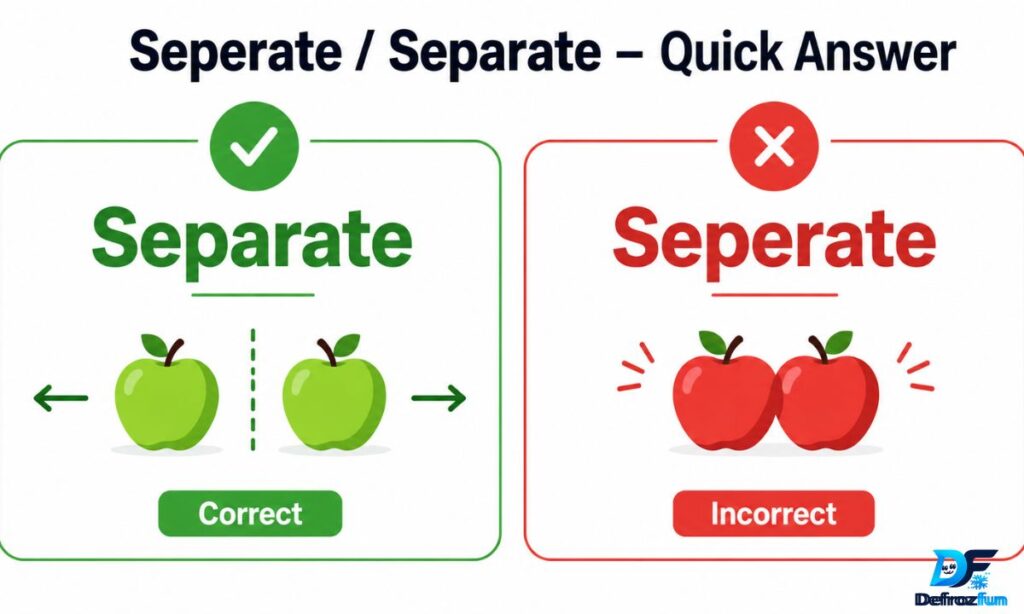
The correct spelling is always “separate.”
“Seperate” (with three e’s) is a misspelling. It does not appear in any reputable English dictionary — not Merriam-Webster, Oxford, Cambridge, or Collins. No grammar style guide (AP, Chicago, MLA, APA) accepts it. Spell-check tools flag it as an error every time.
Quick Rule: If you see an “e” in the middle where an “a” should be, it’s wrong. The correct form is sep-a-rate — with an “a” in the middle.
The Origin of Separate
Understanding where a word comes from often helps you spell it correctly.
“Separate” entered English in the early 15th century, directly from the Latin word sēparātus, the past participle of sēparāre — meaning “to pull apart” or “to divide.” The Latin root is made up of two parts:
- se- — meaning “apart” or “away”
- parare — meaning “to prepare” or “to make ready”
When the word moved through Middle English, it kept its Latin spelling structure intact. That’s why the vowel pattern is a–e–a (sep-a-r-a-te), not a–e–e (sep-a-r-e-te).
Knowing the Latin root parare can act as a memory anchor — think of “prepare,” which also uses the parare base and has an “a” in the same position.
British English vs American English Spelling
One reason people assume “seperate” might be a valid variant is that British and American English do sometimes spell the same word differently — for example, colour vs color, or organise vs organize.
However, “separate” is not one of those words.
Both British English and American English spell it exactly the same way: s-e-p-a-r-a-t-e. There is no regional variation here. Whether you’re writing for a UK audience or a US one, the spelling is identical.
Pronunciation Differences (But Same Spelling)
What does differ slightly between dialects is pronunciation:
| Usage | American English | British English |
| As a verb | /ˈsep-uh-rayt/ | /ˈsep-uh-rayt/ |
| As an adjective/noun | /ˈsep-uh-ruht/ | /ˈsep-ruht/ |
Notice that the adjective form sounds more compressed in British speech, which may be one reason the middle “a” gets dropped when people write it quickly.
Which Spelling Should You Use?
Always use separate. Every time. In every context.
“Seperate” is never correct — not as an alternative spelling, not in informal writing, not in any dialect of English. It’s simply a typo or error caused by the way the word sounds when spoken quickly.
When to Use “Separate”
“Separate” is a versatile word that functions as:
- A verb: to divide, to part, to set apart
- Please separate the recycling from the general waste.
- An adjective: distinct, individual, not connected
- They stayed in separate hotel rooms.
- A noun (rare): individual clothing items worn in different combinations
- She packed a set of separates for the trip.
Common Mistakes with Seperate / Separat
Misspellings of “separate” show up in several forms. Here are the most frequent ones you should watch for:
| Incorrect Spelling | Correct Spelling |
| seperate | separate |
| seperated | separated |
| seperately | separately |
| seperation | separation |
| seperating | separating |
Why Does This Mistake Happen?
There are a few reasons this error is so widespread:
- Pronunciation misleads writers. When spoken at normal speed, the middle syllable sounds like “er,” not “ar.” So people write what they hear: sep-er-ate.
- The stress falls on the first syllable. Because “SEP” is stressed, the middle vowel is reduced and unclear.
- Repeated exposure to the misspelling online. Social media, comment sections, and informal emails are full of “seperate” — and seeing it often makes the wrong version look right.
- “Separate” plays multiple grammatical roles. Switching between verb and adjective uses can confuse learners who are still building spelling habits.
The Trick That Actually Works
Many spelling guides recommend this mnemonic:
“There’s a RAT in sepaRAte.”
Just look for the word “rat” hiding inside: sepa-RAT-e. If you can find the rat, you’ve got the right spelling.
Another helpful trick: think of the word in syllables — sep · a · rate — and consciously place the “a” before you type the “r.”
Separate in Everyday Examples
Here’s how “separate” looks in real sentences across different contexts:
As a verb:
- The teacher asked the students to separate into two groups.
- Oil and water naturally separate when left to settle.
- The couple decided to separate after years of conflict.
As an adjective:
- The twins were raised in separate households.
- Please submit your expenses on a separate form.
- The two departments operate as completely separate units.
As a noun:
- She chose a set of mix-and-match separates for her weekend trip.
Related forms used correctly:
- The documents were filed separately.
- The lab recorded a clear separation between the two compounds.
- He is currently separated from his business partner.
Also Read This: Feet or Foot: What’s the Correct Word? Easy Guide
Seperate / Separate – Google Trends & Usage Data

Google Trends data consistently shows that “separate” dominates global searches, as expected. The misspelled form “seperate” appears in search queries primarily because users are searching for the correct spelling or checking whether their version is right.
Google’s autocorrect also immediately flags “seperate” and suggests “separate” — a strong signal that the misspelling is widely recognized and consistently corrected at scale.
Grammarly’s internal data has identified “separate” as one of the top 10 most commonly misspelled words in English, based on millions of documents analyzed across professional and academic writing.
Comparison Table: Seperate vs Separate
| Feature | Seperate | Separate |
| Correct spelling? | ❌ No | ✅ Yes |
| Found in dictionaries? | ❌ No | ✅ Yes |
| Accepted by style guides? | ❌ No | ✅ Yes |
| Flagged by spell-check? | ✅ Always | ❌ Never |
| Used in formal writing? | ❌ Never | ✅ Always |
| British English variant? | ❌ No | ✅ Same spelling |
| American English variant? | ❌ No | ✅ Same spelling |
Conclusion
There’s only one correct spelling: separate. The version with three e’s — “seperate” — doesn’t exist in any dictionary, style guide, or dialect of English. It’s a phonetic error caused by the way the word sounds when spoken quickly.
To lock it in your memory: find the RAT — sepa-RAT-e. Say it slowly: sep · a · rate. And remember that this spelling is the same whether you’re writing for a British or American audience.
Getting this word right takes seconds, but it makes your writing look noticeably more polished and credible — especially in professional emails, academic work, and formal documents.

Daniel Brooks is a passionate writer and digital content creator dedicated to sharing insightful, engaging, and informative articles across multiple niches. With a strong interest in technology, lifestyle, trending topics, and online media, Daniel Brooks focuses on delivering well-researched and reader-friendly content that inspires and informs audiences worldwide.